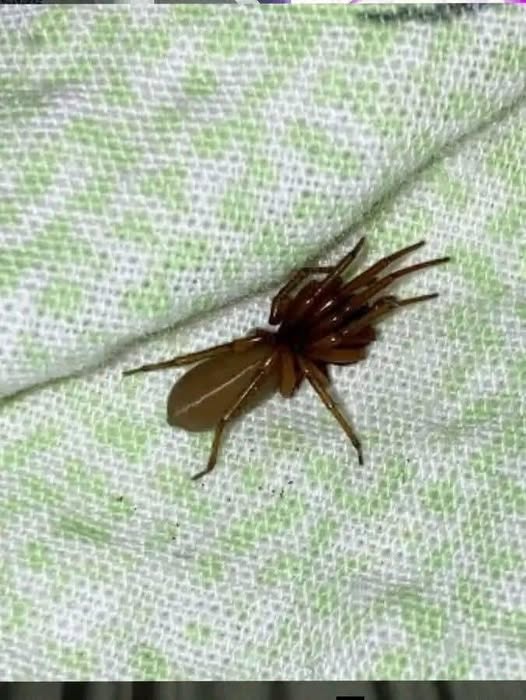
Most people picture spiders sitting motionless in carefully constructed webs, waiting for prey to make a fatal mistake. But some spiders have abandoned that strategy completely, becoming active hunters that rely on speed, stealth, and highly sensitive senses instead of sticky traps.
Often described as red-fanged wandering hunters, these spiders typically spend daylight hours concealed beneath rocks, logs, bark, or leaf litter. When darkness arrives, they emerge and begin searching for insects and other small prey.
Tiny sensory hairs covering their legs allow them to detect subtle vibrations around them. Once prey is located, the spider can approach quickly and strike rather than waiting for an insect to become trapped in a web.
Its reddish mouthparts or fangs can give it an intimidating appearance. During an attack, venom helps immobilize prey so the spider can feed safely. However, appearance alone doesn’t indicate how dangerous a spider is to humans, and identifying the exact species is important before making claims about medical risk.
These active hunters also play a useful ecological role. By feeding on insects and other small animals, they contribute to the natural balance of their environments.
Scientists study wandering and ground-hunting spiders because their behavior demonstrates just how diverse spider evolution can be. Some species became masters of web construction, while others developed entirely different strategies.
For these nighttime hunters, survival doesn’t depend on waiting patiently.
It depends on sensing movement, approaching unnoticed, and striking at exactly the right moment.
And that makes them a fascinating reminder that **not every spider needs a web to be an extraordinarily effective predator.**