The box arrived on my porch with cruel timing, just twenty-four hours after we had buried my seventeen-year-old granddaughter, Gwen. I stood there staring at it, the cardboard edges blurring as my chest ached with a heavy, bruised grief. Gwen had been my whole world since she was eight—since the accident that took her parents and left the two of us to piece life back together. For nine years, we carried each other through loss, laughter, and growing pains. And then, on an ordinary Tuesday afternoon, her heart simply stopped.
The doctors called it an undetected rhythm disorder, worsened by stress and exhaustion. But to me, it felt like the universe had decided I had been happy long enough.
When I finally brought the box inside and opened it, I found the dress she had talked about for months. It shimmered like moonlight rippling across water. Gwen had been obsessed with her senior prom, calling it the one night everyone remembers, no matter how hard high school had been. As I held the cool silk against my chest, an unexpected, almost irrational idea took hold of me.
If Gwen couldn’t go to prom… then I would go for her.
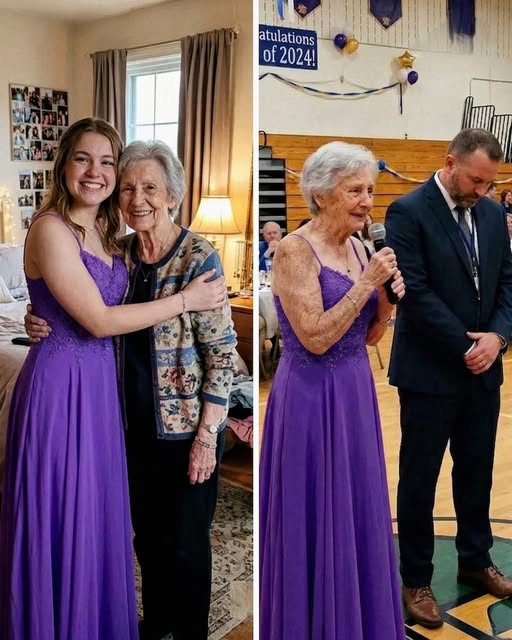
That night, I pinned up my silver hair, fastened my pearls, and stepped into the dress. I knew I would stand out. I knew people would whisper. But when I looked in the mirror, something shifted. The fabric wrapped around me felt like a connection—as if Gwen were just behind me, smiling, urging me forward.
I walked into the high school gym with my head high, stepping into a room alive with music, perfume, and the restless energy of teenagers standing on the edge of adulthood.
The whispers came quickly. I heard laughter, confused comments, boys joking about someone bringing their grandmother to prom. I ignored it all, standing near the back and watching the life Gwen should have been living.
Then I felt it—a sharp, persistent prick along my side. At first, I thought it was a pin or a rough seam, but it was too deliberate, too precise.
I stepped out into the hallway and carefully examined the dress. Hidden inside the lining, near the ribs, was a small, stitched pocket. Inside it, a folded piece of paper.
My hands trembled as I unfolded it. I recognized the handwriting instantly—Gwen’s soft, looping script.
Dear Grandma, if you’re reading this, I’m already gone.
The words hit me like a physical blow. I slid down against the cold hallway wall, tears spilling as I read.
Gwen had known. Weeks earlier, she had fainted at school and gone to the doctor. They told her the truth—her heart was a ticking clock. And she chose to keep it from me. She wrote that she couldn’t bear to see me live in fear again after everything we had already lost. She wanted our last months together to be filled with normalcy—prom plans, shared meals, quiet laughter—not hospital rooms and sterile silence.
It was her final act of love. Of protection.
At the end of the letter, she made one last request:
She wanted me to wear the dress.
If she couldn’t be there, then the woman who gave her everything should take her place.
I didn’t stay in that hallway long. I wiped my tears, straightened the fabric, and walked back into the gym—this time with purpose.
The principal was giving a speech, but I didn’t wait. I walked straight up the aisle, climbed onto the stage, and gently took the microphone from his hand. The music faded. The room fell silent.
And I told them about Gwen.
I told them about the dress, about the hidden pocket, about the letter I had just found. I read her words aloud—her gratitude, her courage, her quiet decision to protect me.
The laughter disappeared. Heads lowered. Some students began to cry.
I told them I had come thinking I was honoring her—but the truth was, she had spent her final weeks honoring me. She had spared me guilt, spared me fear, and left me only with love.
When I stepped off the stage, the room changed. Students moved aside in silence, some reaching out to touch my hand, others brushing the fabric of the dress as I passed.
The next morning, the final piece of the story found me.
The dressmaker called. Gwen had come in days before she died, asking for that hidden pocket to be sewn near the heart. She had said her grandmother would be the only one brave enough to wear the dress after she was gone—and she wanted to make sure the message would be found in the middle of the dance floor.
She was right.
I had the courage. And I understood.
The dress now hangs in my home—not as a reminder of a life cut short, but as a symbol of a love so deep it reached beyond death. I stopped blaming myself for what I didn’t see, and started honoring the extraordinary young woman I was lucky enough to raise.
Gwen never made it to prom.
But she gave her grandmother the most unforgettable night of her life—proving that the strongest hearts are not the ones that beat the longest, but the ones that love the deepest.