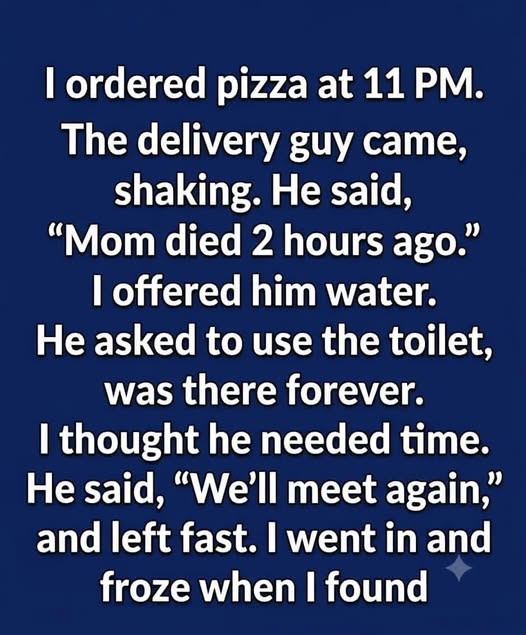
He was shaking when I opened the door. His voice barely made it out, and for a moment I couldn’t understand why the young man standing on my porch looked so completely broken. Two hours earlier, his mother had died. I thought I was simply accepting a pizza, paying for dinner, and closing the door like I had done countless times before. Instead, I was standing in front of a boy who suddenly seemed to have no one left. Something in his face made it impossible to send him away. I let him inside, gave him a glass of water, and watched him disappear into my bathroom for far too long. When he finally emerged, his eyes were different, exhausted and distant. Before leaving, he gave me seven words I couldn’t shake: “We’ll meet again.” I didn’t understand then that those words were a promise.
For days afterward, I kept thinking about him. I wondered where he had gone after leaving my house, whether someone had eventually come to sit beside him, and whether he had anybody who knew just how badly he was hurting. But life has a way of pulling us back into routines. The dishes still needed washing, the children still needed attention, and ordinary responsibilities slowly filled the space where that strange encounter had been. Yet every so often, I remembered his trembling hands and those final words.
I didn’t learn the true weight of his promise until the hospital called and asked for the “Kind Stranger.” At first, I thought they had the wrong number. Then they said Tom’s name, and everything from that night came rushing back. Hearing that label—“Kind Stranger”—broke something open in me because I had never considered what I did extraordinary. I had opened a door. I had offered water. I had given a grieving person a few minutes of safety when he didn’t know where else to go.
But Tom had remembered it differently. He had saved my number because, during one of the worst nights of his life, a stranger had looked at him and treated him like he mattered. I hadn’t known that such an ordinary gesture could become important enough to save in a phone. To him, however, that small moment had become proof that somewhere in the world there was at least one person he could contact when everything else collapsed.
That realization followed me all the way to the hospital. Walking through those sterile hallways, I kept wondering how someone could become so isolated that the emergency contact they trusted most was practically a stranger. When I finally saw Tom lying in the hospital bed, the frightened delivery boy from my doorway suddenly looked even younger. Whatever distance had existed between us disappeared the moment I sat beside him.
I held his hand while he grieved, and for a long time there was nothing useful to say. There are losses that words cannot repair, and his mother’s death was one of them. So I stopped trying to find the perfect sentence. I simply stayed. Sometimes he talked. Sometimes he cried. Sometimes we sat quietly while machines hummed around us. And slowly, I began to understand just how fragile and invisible some people’s lives can become.
No crowd would ever applaud what happened between us. Nobody hands out medals for offering a glass of water, allowing someone a quiet bathroom, answering a phone call, or sending a weekly message asking, “How are you doing?” Those things seem too small to count as rescue. Yet for someone who feels completely alone, small acts can become the threads connecting them back to the world.
The weekly texts continued. Then came occasional visits, conversations, meals, and ordinary moments that gradually stopped feeling unusual. My children got to know Tom, and eventually he stopped being the shaken stranger who had once appeared at our door carrying a pizza. He became someone whose presence belonged in our lives. What began as a few minutes of compassion slowly stitched him into a new kind of family.
And somewhere along the way, Tom changed me too. I had always imagined mercy as something dramatic—the kind of act people tell stories about because it requires extraordinary courage or sacrifice. But I learned that mercy rarely looks heroic while it is happening. Sometimes it looks almost disappointingly ordinary. It looks like answering the door instead of closing it. It looks like listening when you would rather return to your evening. It looks like remembering someone after everyone else has moved on.
Those seven words eventually made sense: “We’ll meet again.” Tom wasn’t simply saying goodbye that night. In his own way, he was holding onto the possibility that one moment of human kindness didn’t have to end at the doorstep. And neither of us could have known that a pizza delivery, a glass of water, and an open door would become the beginning of something much larger—a reminder that sometimes another person’s pain enters your life quietly, and compassion begins when you decide not to look away.