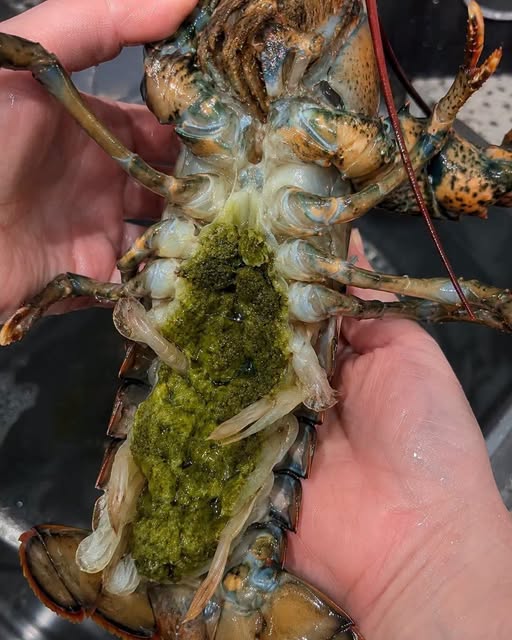
Your fork stops midair. For a moment, everything else on the plate disappears as your eyes lock onto that unexpected smear of green hidden inside what looked like a perfect lobster. The color can be startling—thick, soft, almost creamy, but unlike anything many first-time diners expect to find inside their dinner. In a single heartbeat, curiosity can turn into hesitation and a healthy appetite can suddenly vanish. Some people call it “ocean butter,” treating it as one of the richest delicacies the sea has to offer. Others look at the same green substance and immediately wonder whether something has gone terribly wrong. Chefs praise its intense flavor, longtime lobster lovers eagerly search for it, while health officials sometimes speak about it with far more caution. And diners are left staring at their plates, wondering whether to taste it, scrape it away, or simply leave it untouched.
That mysterious green substance is known as tomalley. Despite its unusual appearance, it is not automatically a sign that the lobster is spoiled or unsafe. Tomalley is part of the lobster’s digestive system, functioning much like the liver and pancreas in other animals. It helps process nutrients and plays an important role in digestion. Its natural color can range from yellowish-green to a darker green, and its soft texture is completely different from the firm white meat found in the claws and tail.
But that biological role is also exactly why tomalley attracts attention from health experts. The organ does more than help digest food. Because it processes substances entering the lobster’s body, it may also accumulate contaminants from the surrounding environment. Lobsters live and feed along the ocean floor, constantly interacting with an ecosystem that can change dramatically depending on water quality, pollution, and naturally occurring marine events.
Tomalley concentrates flavor, which is one reason enthusiasts love it, but it can also concentrate substances the lobster has encountered in its environment. Depending on where the animal was harvested, concerns may include certain pollutants, heavy metals, or toxins associated with harmful algal blooms. This does not mean every spoonful of tomalley is dangerous, but it explains why advice about eating it can be more cautious than recommendations concerning the lobster’s muscle meat.
Harmful algal blooms, sometimes associated with what people commonly call “red tide,” are particularly important. Certain algae can produce toxins that accumulate in marine organisms. During contamination events, authorities may issue specific seafood advisories or harvesting restrictions. The lobster’s edible meat may sometimes be treated differently from its internal organs because contaminants can accumulate at different levels in different tissues.
That is why health officials may recommend limiting or avoiding tomalley in certain circumstances, particularly when local advisories are in effect. Where the lobster was harvested can matter just as much as how beautifully it was prepared. A lobster served steaming with melted butter may look completely normal, even when environmental conditions in its harvesting area deserve attention. Knowing the source and checking local seafood guidance can therefore be more meaningful than judging safety by appearance alone.
Yet none of this has stopped generations of lobster lovers from considering tomalley one of the greatest pleasures hidden inside the shell. For them, throwing it away would be almost unthinkable. Its texture is creamy and its flavor is intensely marine—far stronger and richer than ordinary lobster meat. To someone who grew up eating it, that green paste is not an unpleasant surprise. It is the part they have been waiting for.
Some spread warm tomalley over crusty bread, allowing the bread to absorb its salty richness. Others blend small amounts into melted butter before dipping pieces of lobster meat into the mixture. In restaurant kitchens, chefs may incorporate it into bisques, sauces, seafood stocks, or compound butters, using its concentrated flavor to give a dish a depth that ordinary lobster meat alone cannot provide.
Its appearance and flavor also explain why reactions can be so dramatically divided. One diner sees something strange and potentially alarming. Another sees a delicacy. Neither reaction is particularly surprising. Food is deeply connected to familiarity, culture, memory, and personal comfort. Something treasured in one household may be immediately rejected in another simply because people have different experiences with it.
For anyone encountering tomalley for the first time, there is no obligation to treat it as a culinary test of courage. Inspect the lobster, consider where it came from, pay attention to current local seafood advisories, and make your own decision. If there are warnings concerning harmful algal blooms or contamination in the harvesting region, official health guidance should take priority over culinary curiosity.
And if everything checks out but that green spoonful still makes you hesitate, there is nothing wrong with leaving it behind. Lobster claws and tail meat provide plenty of enjoyment without requiring anyone to eat every part of the animal. On the other hand, those who enjoy tomalley may see a small taste as part of the complete lobster experience, particularly when it comes from a trusted source and no relevant health warnings are in place.
In the end, the strange green substance inside a lobster is neither automatically a forbidden poison nor a magical delicacy everyone needs to experience. It is an organ with a distinctive culinary tradition and legitimate reasons for caution depending on environmental conditions. The smartest approach combines curiosity with awareness rather than fear or blind enthusiasm.
Luxury, after all, is not proving that you are adventurous enough to swallow a spoonful of green tomalley. It is having a beautiful meal in front of you, understanding what you are eating, knowing where it came from, and having the freedom to make the choice that feels right. Taste it, leave it, or simply enjoy the lobster meat around it. The final decision belongs to the person holding the fork—and there is no reason to apologize for saying either yes or no.