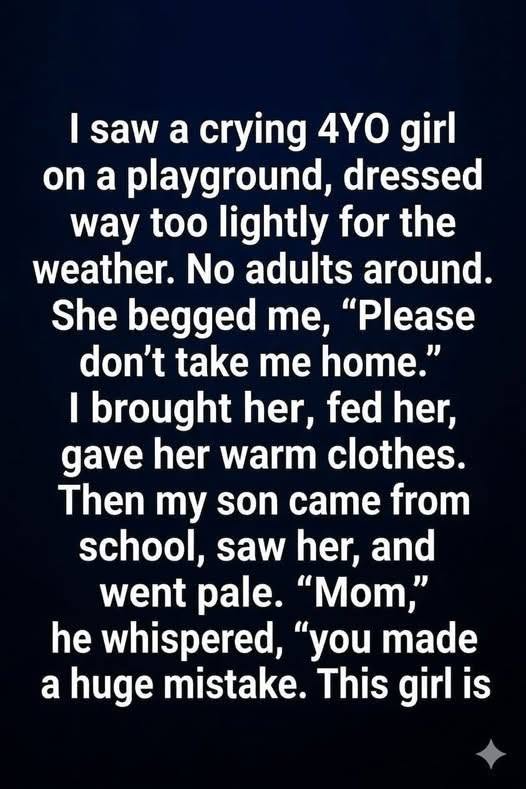
On a bitterly cold day, I noticed a little girl sitting by herself on a playground swing. She wore clothing that was far too light for the weather, and tears moved quietly down her face as the empty swings beside her shifted in the wind. No parent or other adult seemed to be nearby. I approached carefully and asked whether she was hurt or needed help. Instead of answering, she clutched my sleeve and begged me not to take her home.
Her words frightened me because they suggested that wherever she had come from did not feel safe to her. I could not leave a shivering child alone in the cold, so I brought her to my house while I tried to understand what had happened. I found warm clothes for her, wrapped her in a blanket, and put food on the table. She said almost nothing, yet she ate with the urgency of someone who had missed more than one proper meal.
I kept my voice calm and avoided overwhelming her with questions. She watched every movement in the room and startled at small sounds. I wanted her to know that she was safe for the moment, even though I still had no idea who she was or why she had been alone. The answer began to emerge when my son returned from school.
As soon as he saw the girl, his expression changed. He recognized her as Emma, the granddaughter of Mrs. Rose, a teacher known and loved by many people in the community. Emma’s parents had died in a terrible accident, and Mrs. Rose had stepped in to raise her. For Emma, her grandmother had not simply been a relative. She had been her parent, her home, and the person who made the world feel secure.
After Mrs. Rose died, Emma was placed in an orphanage. She had struggled with the loss and with the unfamiliar surroundings. According to my son, she sometimes ran away because she was still searching for the grandmother she could not accept was gone. His explanation made sense of the fear in her eyes and the desperate way she had asked not to be taken back.
My heart wanted to keep Emma beside us immediately, but I knew I could not simply hide a missing child in my home. The responsible choice was to contact the proper people and return her to the orphanage. Before we separated, I promised her that I would come back. I did not offer those words lightly. By then, I understood that another broken promise was the last thing she needed.
Keeping that promise required far more than opening our front door. I began the formal adoption process, which meant months of applications, interviews, home inspections, legal reviews, and waiting. Every stage existed to protect Emma, yet the slow pace was difficult because I could not stop thinking about the lonely child on the swing. I visited and stayed involved so that she would know I had not forgotten her.
The adoption was finalized two months ago, and Emma officially became part of our household. A legal decision, however, could not erase her grief or instantly teach her to trust again. She does not call me Mom, and I never ask her to. That word belongs to her and should come only if it ever feels right. What matters is that she now sleeps through the night, smiles more often, and no longer reacts to every sound as though something bad is about to happen.
My son once believed that bringing Emma home had been a mistake because he understood the seriousness of her situation before I did. Now he is her strongest protector. He checks on her, includes her, and gives her the steady companionship of a brother. Their bond has helped our home become something Emma can experience rather than merely be told about.
I found Emma by chance, but becoming her family was a deliberate promise renewed through every appointment, form, visit, and patient day. Blood did not bring us together. Choosing to return, to listen, and to remain when she needed someone did. The frightened girl who once sat alone in the cold now has a room, a brother, and people who will keep showing up for her.