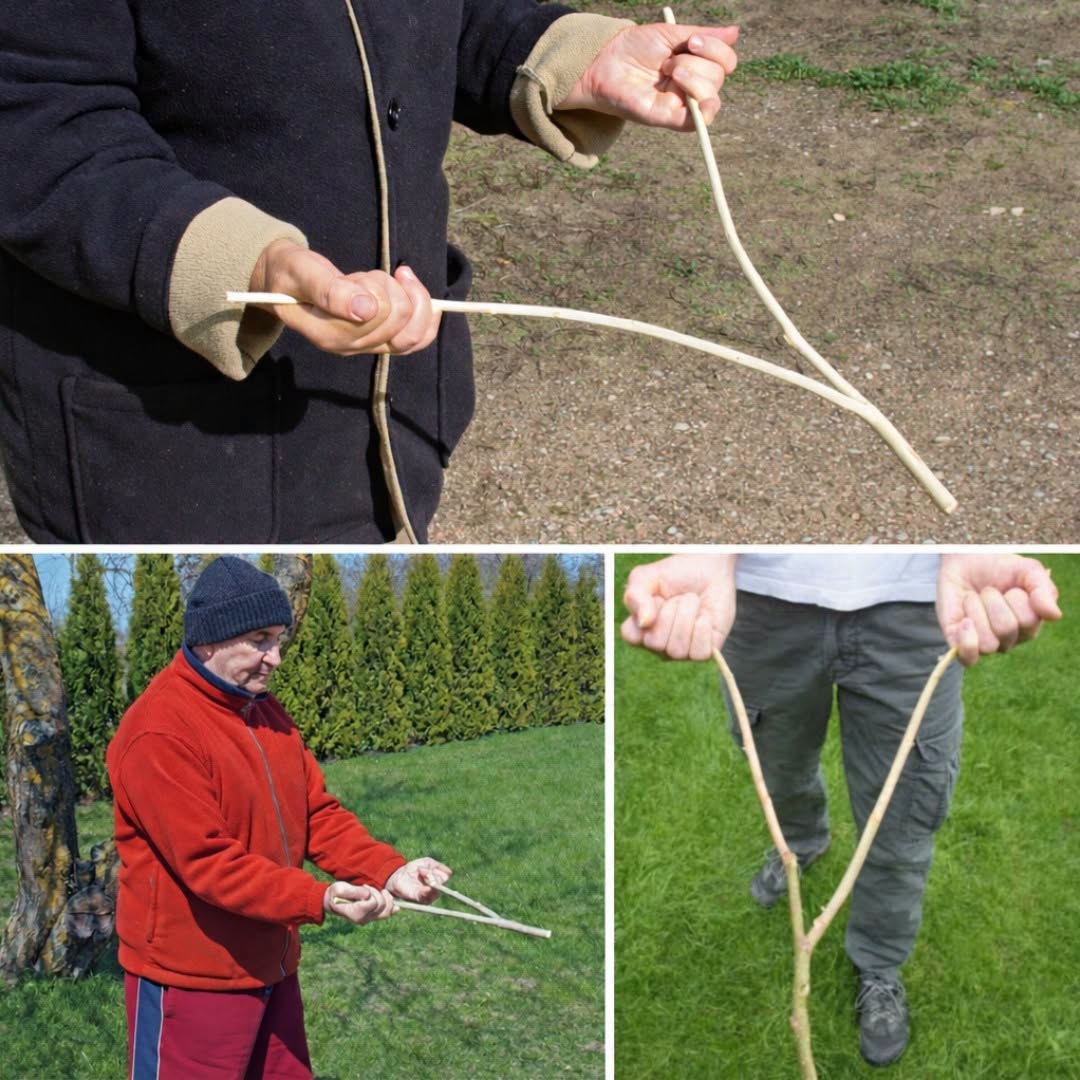
A simple forked branch. At first glance, it looked like nothing more than an ordinary piece of wood cut from a nearby tree. Yet for generations of farmers, villagers, and landowners facing drought and uncertainty, that humble V-shaped stick represented something far greater. It was carried with hope across dry fields and barren landscapes, believed by many to possess the mysterious ability to reveal hidden underground water. Skeptics dismissed it as little more than superstition or an illusion created by unconscious movements of the hands. But for people whose livelihoods depended on finding a reliable source of water, disbelief often became a luxury they simply couldn’t afford.
Long before advanced geological surveys, satellite imaging, and powerful drilling equipment transformed the search for groundwater, communities relied on far simpler methods. People would walk slowly across their land holding a freshly cut forked branch with both hands, carefully watching for the slightest movement. If the stick dipped downward, twisted unexpectedly, or seemed to pull against their grip, many believed it was responding to water buried beneath the surface. Whether the movement came from natural forces or subtle muscle reactions that the person wasn’t even aware of, the experience often felt convincing enough to inspire hope where certainty was impossible.
For families living in isolated rural communities, choosing where to dig a well could determine their future. Drilling in the wrong location meant wasting valuable time, exhausting limited resources, and facing the possibility of another failed attempt. Every dry well represented disappointment, financial hardship, and sometimes even the threat of losing crops or livestock. In those moments, the forked branch became more than a tool—it became a symbol of possibility. Even if it offered no scientific guarantee, it gave people the confidence to make a decision when no better information was available.
Stories about successful water dowsers spread from one generation to the next. Some individuals gained local reputations for their apparent ability to locate underground water with remarkable accuracy. Neighbors would travel long distances seeking their help, hoping they could identify the best place to begin digging. Whether those successes resulted from experience, familiarity with the landscape, fortunate coincidence, or factors not fully understood at the time, the tradition continued because enough people believed it worked often enough to be worth trying.
Modern science has largely attributed the movement of dowsing rods to what is known as the ideomotor effect—a phenomenon in which small, unconscious muscle movements create the sensation that an object is moving on its own. Numerous scientific studies have found no reliable evidence that dowsing can consistently detect underground water better than chance. Today, professional geologists rely on sophisticated surveying techniques, geological mapping, and advanced equipment to identify groundwater sources with far greater accuracy. Even so, the practice of dowsing continues to fascinate many people and remains a part of local folklore and cultural tradition in various parts of the world.
Today, the old forked branch is more likely to be found hanging in a shed, tucked away in an attic, or appearing in nostalgic photographs than carried across open farmland. It has become a reminder of an era when people depended as much on instinct, experience, and hope as they did on measurable evidence. Although technology has replaced many of the methods our ancestors relied upon, the story of the dowsing rod continues to capture the imagination because it speaks to something deeply human—the desire to find answers hidden beneath the surface when certainty is impossible.
In many ways, the forked stick has become a symbol of resilience rather than proof of mysterious powers. It reminds us that throughout history, people have often faced overwhelming uncertainty armed with little more than determination and faith. Standing in an empty field with a simple branch in their hands, they searched not only for water but also for survival, stability, and the promise of a better tomorrow. Whether the branch truly pointed toward hidden springs or simply gave people the courage to begin digging, its greatest power may have been the hope it inspired.
That is why the story of the dowsing rod still resonates today. It reminds us that every generation has searched for answers beyond what it could immediately see. Sometimes those searches are guided by science, and other times by tradition, intuition, or belief. Even if the mystery surrounding the forked stick has largely been explained, its legacy endures as a powerful reminder that hope has always been one of humanity’s most valuable tools—especially when standing on uncertain ground, looking for something essential hidden just beneath the surface.