The steady mechanical hum of the clinic was the last sound I expected would change my life.
It was an ordinary Tuesday afternoon. The kind that blends into every other workday without leaving much of a memory behind. At thirty-two, my life was stable, predictable, and comfortably quiet. I lived alone, followed routines I enjoyed, and had carefully built a future that belonged entirely to me.
There were no children waiting at home.
No husband.
No complicated family obligations.
Just a life I understood.
Or at least I thought I did.
That illusion shattered the moment my phone rang.
The number was unfamiliar.
I almost ignored it.
Instead, I answered.
The voice on the other end was professional and detached.
“Hello. Is this Emma?”
“Yes.”
“I’m calling from St. Andrew’s Hospital.”
Immediately, my attention sharpened.
Hospitals rarely call people without a reason.
The nurse continued.
“A young boy has listed you as his emergency contact.”
I laughed nervously.
Not because it was funny.
Because it made absolutely no sense.
“There must be a mistake.”
A brief silence followed.
“I’m thirty-two,” I explained. “I’m not married. I don’t have children.”
The nurse listened patiently.
Then she said something that instantly erased every assumption I had made.
“The child is conscious.”
Another pause.
“And he keeps asking for you by name.”
The room around me suddenly felt smaller.
“What?”
“He specifically requested you.”
I stared at my desk.
My computer screen.
The stack of paperwork waiting for my attention.
Everything suddenly felt distant.
Unreal.
How could a child I had never met know my name?
The logical explanation was some sort of administrative error.
Wrong contact information.
Mistaken identity.
A simple misunderstanding.
Yet something about the nurse’s voice made that explanation feel increasingly unlikely.
She sounded certain.
More importantly, so did the boy.
When I finally hung up, I sat frozen for nearly a minute.
Then I grabbed my coat and left.
The drive to the hospital felt endless.
Every possible explanation raced through my mind.
Perhaps I had volunteered somewhere and forgotten.
Maybe a distant relative I didn’t know about.
Maybe a coincidence.
Maybe someone with the same name.
Each theory fell apart as quickly as it formed.
By the time I parked outside the pediatric wing, my heart was pounding.
The sterile smell of disinfectant greeted me as I entered.
Bright fluorescent lights reflected off polished floors.
Nurses moved quickly between rooms.
Families sat quietly in waiting areas.
Everything looked normal.
Yet nothing felt normal anymore.
A nurse met me at the reception desk.
Without asking many questions, she guided me down a long hallway.
Room 412.
The numbers on the door seemed strangely significant.
As if crossing that threshold would divide my life into before and after.
The nurse opened the door.
And there he was.
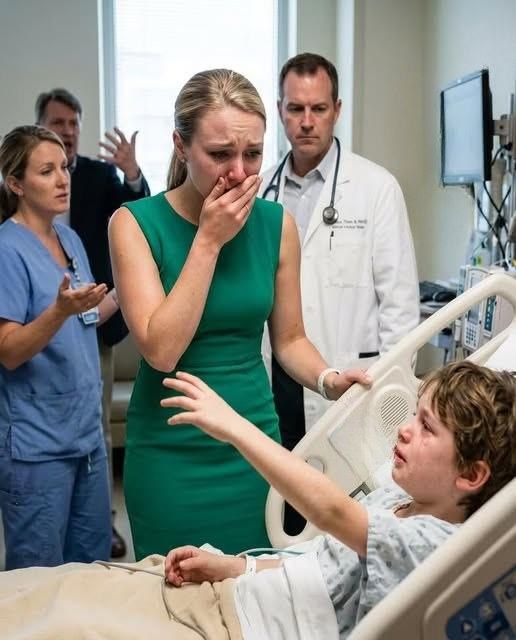
A small boy lying in a hospital bed.
Too small.
Too fragile.
Bruises marked parts of his face.
Dark circles rested beneath tired eyes.
Yet despite his condition, the moment he saw me, recognition flashed across his face.
Not confusion.
Not uncertainty.
Recognition.
As though he had been waiting.
The nurse quietly stepped out.
Leaving us alone.
For several seconds neither of us spoke.
Then the boy smiled faintly.
“The woman who sees twice.”
The words stopped me cold.
Because I knew exactly where they came from.
Years earlier, only one person had ever called me that.
Rachel.
My former colleague.
My former friend.
Someone I had not seen in years.
Someone I thought had disappeared from my life permanently.
The phrase wasn’t literal.
It was something Rachel once said during a difficult period of her life.
She claimed I had a habit of seeing both the person people pretended to be and the person hiding underneath.
“The woman who sees twice.”
Nobody else knew those words.
Nobody.
Suddenly, this wasn’t a mistake anymore.
This was Rachel.
Or at least something connected to her.
I sat carefully beside the bed.
The boy studied me closely.
As though comparing me to memories he had heard about.
“What’s your name?” I asked gently.
“Oliver.”
His voice was quiet but steady.
“And how do you know Rachel?”
The question made him smile sadly.
“She’s my mom.”
The answer hit me harder than I expected.
For years I had wondered what happened to Rachel after we lost contact.
Now part of that answer sat directly in front of me.
A frightened child in a hospital bed.
Slowly, the pieces began fitting together.
Rachel had listed me as his emergency contact.
Not family.
Not a spouse.
Not a relative.
Me.
At first that decision seemed impossible to understand.
Then I remembered who Rachel was.
Years ago, when her life began falling apart, most people backed away.
Some judged her.
Others disappeared.
I stayed.
Not because I knew how to fix anything.
Because I refused to leave.
Even when things became messy.
Even when the truth was uncomfortable.
Eventually life pulled us apart.
But apparently Rachel never forgot.
The door opened again.
And everything changed.
A man entered.
The moment Oliver saw him, his entire body tensed.
He pulled back against the bed immediately.
Fear flashed across his face.
Raw.
Instinctive.
The reaction told me more than any explanation could.
The man stopped when he noticed me.
Then he looked toward Oliver.
“Oliver.”
The boy didn’t answer.
The room filled with silence.
Heavy silence.
Dangerous silence.
Finally the man spoke again.
“My name is Mark.”
I knew that name.
Rachel had mentioned him years ago.
Never fondly.
Never comfortably.
The expression on Oliver’s face confirmed my worst suspicions.
Mark represented a chapter of Rachel’s life she had never truly escaped.
A chapter she had desperately tried to leave behind.
Without thinking, I moved slightly closer to Oliver.
Not dramatically.
Not protectively in a heroic sense.
Just enough to remind him he wasn’t alone.
The boy immediately relaxed.
Only a little.
But enough.
Mark noticed.
His expression shifted.
Not anger.
Recognition.
He understood exactly why Oliver felt safer with a stranger than with him.
And somehow that realization seemed to hurt him.
The next several hours unfolded slowly.
Painfully.
Truth emerging piece by piece.
Rachel had been injured.
Not critically.
But seriously enough that emergency contacts became necessary.
Oliver had remembered the stories she told about me.
The woman who stayed.
The woman who listened.
The woman who didn’t run when things became difficult.
So when fear took over and everything felt uncertain, he asked for the one person he believed would show up.
And somehow, despite years of separation, he had been right.
As evening approached, Rachel finally regained enough strength to speak with hospital staff.
Relief spread through the ward.
Oliver’s shoulders relaxed for the first time all day.
The immediate crisis had passed.
Yet something else remained.
A connection.
Unexpected.
Unplanned.
But real.
In the days that followed, I visited often.
Not because anyone asked me to.
Because leaving suddenly felt impossible.
Rachel recovered slowly.
Oliver recovered too.
The fear faded little by little.
Trust returned gradually.
Nothing dramatic happened.
No miraculous transformation.
No perfect ending.
Life simply continued.
But now it included people who hadn’t been there before.
That was enough.
Looking back, I realize the most important lesson wasn’t about emergency contacts or coincidence.
It was about presence.
About the people who remain when staying becomes difficult.
Blood matters.
Family matters.
History matters.
But sometimes the people who save us are not the ones we are born connected to.
They are the ones who choose to stay.
The ones who see the truth clearly and refuse to turn away from it.
Years earlier, Rachel had trusted me with one of the darkest chapters of her life.
I never imagined that trust would return to me through her son.
Yet when the past finally came knocking, it didn’t ask whether I was ready.
It simply placed a frightened child in a hospital room and asked a single question.
Will you stay?
And this time, just like before, the answer was yes.