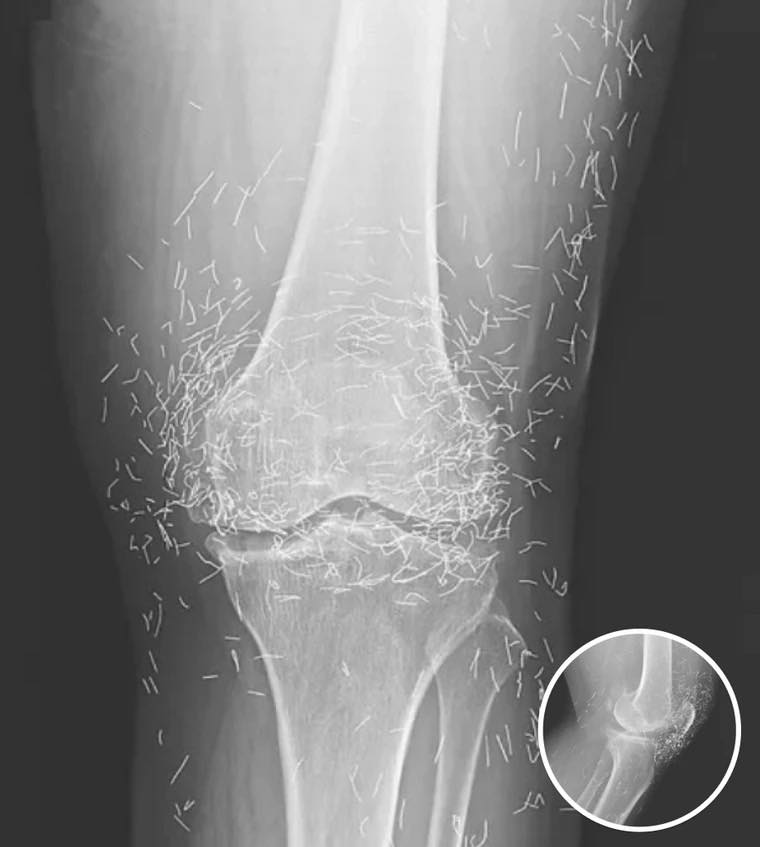
Anomalies are common in the medical world, yet even the most experienced radiologists occasionally come across a case that defies rationality. A routine diagnostic process for persistent joint discomfort became a worldwide medical phenomenon for one 65-year-old lady in South Korea. Her medical team was stunned by what they saw on the digital imaging screen—not just the normal wear and tear of a life well lived, but a glittering, metallic constellation. Hundreds of tiny gold needles, a permanent and unintentional map of her frantic search for relief, were embedded deep inside the soft tissue and surrounding the bone of her knees.
The patient was diagnosed with osteoarthritis years prior, which marked the beginning of their adventure into this medical riddle. The protective cartilage that cushions the ends of the bones gradually deteriorates, making this degenerative disorder an unrelenting foe. Bone rubs against bone as the cartilage disappears, resulting in a vicious cycle of edema, inflammation, and excruciating stiffness that may make even the most basic movements seem like a huge undertaking. The pain had been a lifelong companion for this lady, a chronic aching that finally became a crippling obstacle to her day-to-day existence.
She first resorted to the mainstays of Western medicine, as do many patients with persistent inflammation. She was administered a combination of non-steroidal anti-inflammatory medications and strong painkillers. But the relief was short-lived and came at a high price. Her digestive health started to deteriorate as a result of long-term usage of these drugs, leading to serious stomach issues that compelled her to stop using conventional pharmaceutical treatment. With limited choices and a fast declining quality of life, she resorted to her culture’s deeply ingrained customs, finding comfort in the age-old practice of acupuncture.
The foundation of traditional Asian medicine is acupuncture, which uses hair-thin needles inserted into particular meridian sites to balance the body’s energy and release chemicals that naturally relieve pain. These needles are placed and withdrawn in a single session in the majority of contemporary procedures. However, the therapy goes one step further in some intense variants of the technique that are still practiced in some regions of East Asia. The procedure, also referred to as “gold thread” or “permanent needle implantation,” is purposefully leaving tiny pieces of gold inside the tissue. This extreme approach is based on the premise that the precious metal’s presence stimulates blood vessels and neurons locally and continuously, perhaps providing a long-term remedy for chronic conditions like arthritis.
The X-ray revealed a far more nuanced picture, even if the patient might have thought she was making a proactive move toward recovery. The sight appeared to the hospital’s physicians more like a confined shrapnel field than a surgical procedure. Over time, the hundreds of gold needles had moved and woven themselves into the very structure of her joints. The huge amount of foreign material created a biological minefield that contemporary medical professionals find quite worrying, despite the fact that gold is frequently regarded as a friendly metal.
The human body is not a passive host for alien things, according to radiology specialists, including professors from prestigious Western universities. Anything that doesn’t belong is recognized and separated by the immune system. The body’s defensive systems go into overdrive when hundreds of metal fragments are inserted into the tissue. This frequently leads to persistent inflammation, the development of thick, fibrous scar tissue, and in the worst situations, the emergence of deeply ingrained infections or abscesses that can be very challenging to cure. The “treatment” could have been causing a persistent condition of low-level immunological stimulation rather than relieving the joint.
The existence of these needles poses a serious obstacle to contemporary diagnostic technologies in addition to the biological hazards. Her medical team was aware of the irony that the needles weakened the precise instruments required to keep an eye on her arthritis. On X-rays, metal pieces can produce “artifacts” or shadows that obscure the fine features of the bone and prevent medical professionals from determining the full amount of joint damage. Even more perilously, these gold slivers practically prevented her from ever getting an MRI. Metallic things may vibrate or move throughout the body due to the strong magnetic fields employed in MRI devices. A routine scan might become a life-threatening emergency if those hundreds of needles moved like tiny scalpels, puncturing blood vessels or severing nerves.
This story serves as a sobering reminder of the persistent cultural barrier in international healthcare and was finally published in the esteemed New England Journal of Medicine. These gold implants are frequently seen as an acceptable and even distinguished kind of therapy for the elderly in South Korea and a number of nearby countries. The promise of a “permanent” treatment is a strong appeal for many who feel let down by the adverse effects of contemporary medications. Nevertheless, there is very little scientific proof that leaving metal in the body is effective. The technique is seen by the majority of Western practitioners as an unnecessary risk that makes long-term patient care more difficult.
The South Korean woman’s tale is not unique. Every year, millions of adults and children in the US seek out acupuncture for a variety of conditions, including back pain and migraines. More patients are returning from overseas with these permanent implants due to the growth of “alternative” medical tourism, even though the vast majority of American acupuncturists adhere to stringent safety regulations and never leave needles behind. It is an increasing difficulty for radiologists and emergency department physicians who might not be familiar with the procedure and could unintentionally endanger a patient by ordering an unsuitable scan.
The patient’s body serves as a lasting record of her despair as she struggles to manage her osteoarthritis. There are still hundreds of gold needles, too many and too deeply lodged to be removed safely without seriously harming the surrounding tissue. For anybody at the nexus between conventional and alternative medicine, her story serves as a warning. It emphasizes how crucial informed consent is and how patients must realize that “natural” or “traditional” does not necessarily equate to “harmless.”
Ultimately, the woman’s X-ray is a terrible yet eerily beautiful picture. It symbolizes the extent to which a person will go in order to break free from the prison of persistent suffering. It also emphasizes how important it is for the international medical community to close the gap between traditional wisdom and contemporary safety regulations. The gold in her knees may have been meant to buy her a pain-free future, but instead it served to emphasize the precarious balance between the unwavering truth of human biology and the hope for a miraculous cure. The message is obvious: sometimes the most glittering answers come at the highest cost while trying to find healing.