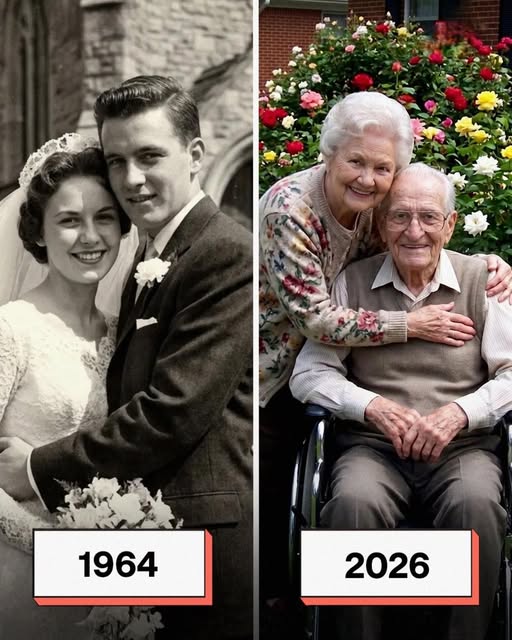
The silence that follows a sixty-two-year marriage is not merely the absence of sound; it is a heavy, suffocating presence that settles into the walls, into the furniture, into the very rhythm of breathing. For sixty-two years, Harold had been the steady pulse of my days. We had met when the world still felt wide and uncomplicated, married within a year of our first dance, and built a life I once believed was as solid and transparent as glass. My name is Rosa, and at eighty years old, I stood in a drafty church surrounded by our sons, feeling less like a grieving widow and more like someone drifting outside her own life, unable to step back inside. I thought I knew every crease of his hands, every pause in his voice, every corner of the man I had chosen. I was wrong in ways I could not yet understand.
The service passed in a blur of lilies, soft condolences, and the careful restraint of people trying not to intrude on grief. But everything shifted during the final moments, as the mourners began to spill toward the doors. A young girl appeared—no more than thirteen—moving with a kind of anxious determination that made her stand out immediately against the slow drift of black clothing. She didn’t belong to any branch of our family that I could recognize, nor to any familiar circle of neighbors. She crossed the aisle directly, her steps too deliberate for a child, until she stopped in front of me.
Her hand shook as she held out a plain white envelope.
She asked, almost in a whisper, if I was Harold’s wife. When I nodded, she pressed it into my palm as though it carried weight beyond paper. Then she told me Harold had given it to her months earlier, when his health had first begun to fail. He had made her swear that she would not deliver it until this exact day—the day of his funeral. Before I could form a single question, before I could ask who she was or how she had come to know him, she turned and slipped away through the thinning crowd, disappearing beyond the church gates like a shadow that had only briefly solidified.
That night, the house felt larger than it ever had, as if grief had expanded its dimensions. I sat at the kitchen table long after the sons had gone, the envelope resting in front of me like something that might detonate if disturbed too abruptly. When I finally opened it, a small brass key slid out and struck the wood with a sharp, final sound that seemed to echo too long in the quiet room.
Inside was a letter in Harold’s familiar handwriting, though altered by age and urgency. He called me his love. He spoke gently, almost carefully, as if even in writing he feared causing harm. Then he confessed that he had been carrying a secret for sixty-five years—one he had never found the courage to speak aloud. He directed me to a storage facility on the outskirts of the city, giving me a number: Garage 122.
The taxi ride felt less like travel and more like passage into a different version of reality. The city receded, replaced by industrial stretches of metal fencing and gravel lots where the wind had nothing to soften against. When I found the unit and turned the key, the door rolled upward with a groan that seemed to awaken everything inside.
The air was thick with the smell of cedar, dust, and time. The space was carefully arranged, not abandoned. In the center stood a large wooden trunk, its surface worn smooth by years of handling. Around it were smaller boxes, labeled in Harold’s precise handwriting. Everything felt preserved rather than hidden, as though it had been waiting, not for discovery, but for permission.
Inside the trunk, I found a life I had never known existed.
There were children’s drawings in faded crayon, their colors softened by age. School certificates carefully preserved in plastic sleeves. Bundles of letters tied with ribbon, stacked with almost reverent order. Every document carried the same recurring name: Virginia. Some were addressed to her, others from her, and others still appeared to be records of care—medical receipts, tuition slips, rent payments spanning decades.
At first, my mind refused to accept what my eyes were seeing. It assembled explanations that collapsed as quickly as they formed. Another family. A second life. A long deception built parallel to mine. The thought was not just painful—it was disorienting, as though the ground beneath memory itself had shifted.
I sank to the floor, gripping a folder of receipts that stretched backward through time like a second biography of Harold I had never been given access to. The numbers told their own story: years of payments, sacrifices, and obligations that could not be explained by ordinary generosity alone.
A sound at the entrance made me freeze.
The girl from the funeral stood there, slightly out of breath, as if she had followed at a distance the entire way. She hesitated only briefly before stepping inside.
She introduced herself as Gini.
Her voice was steady, but her eyes carried something older than her years. She told me her mother, Virginia, was in the hospital, waiting for a heart procedure the family could not afford. She spoke of Harold not as a hidden man, not as a secret, but as something almost sacred in her understanding—a constant presence who had always ensured there was food, shelter, and stability even when no one else did.
But she didn’t know why.
That question remained unanswered in the air between us, heavy and unresolved.
Compelled by something I could not name—anger, curiosity, grief, or a mixture of all three—I followed her to the hospital. The building was sterile and bright in the way hospitals are when they are trying to hold chaos at bay. On the third floor, in a quiet room filled with the soft hum of machines, I saw her.
Virginia was frail, her breathing measured but strained. There was something hauntingly familiar in her face, though I could not place it at first—an echo of features I had seen in mirrors, in photographs, in memory itself distorted by time. When her eyes met mine, they filled with tears before either of us spoke.
She whispered that Harold had saved them.
Not once. Not briefly. But for years. For decades.
And still, the central truth remained missing—the reason.
I returned home in a silence heavier than before and went straight to Harold’s study. Past the formal papers, past the organized records of our shared life, I found his leather-bound diaries. My hands trembled as I opened them, moving backward through years that no longer felt distant but immediate, as if I were stepping into a room that had always existed beside mine without my knowledge.
I stopped at 1961.
And there, the story finally split open.
Harold wrote about finding a young woman in a trailer park during a storm, alone and exhausted, holding a newborn child. She had been cast out by her family, deemed a disgrace for becoming pregnant outside of marriage. He had gone there by chance—or what he once believed was chance—and stayed because leaving felt impossible.
Her name was Iris.
My older sister.
The world in the room seemed to tilt.
Iris had vanished when I was fifteen. My parents had erased her carefully, publicly claiming she had gone to the city for work, privately refusing ever to speak her name again. She became a silence in our household, a wound that had been sealed over but never healed. I had grown up believing she had chosen to leave us.
But she had not left.
She had been nearby all along.
Harold had discovered the truth early. And in that moment, he had made a choice that would define the rest of his life. He did not bring her back to a family that would have destroyed her a second time. He did not expose her to judgment that would have been presented as concern. And he did not tell me, knowing it would force me into an impossible position between loyalty and love.
Instead, he became something else entirely.
A quiet bridge between broken pieces.
He supported Iris in silence. Then Virginia. Then, eventually, Gini. Not as a distant benefactor, but as a constant, careful presence who ensured survival where there would otherwise have been none. Every extra shift he worked, every sacrifice he made, every compromise in our own comfort—none of it had been for deception. It had been for continuity. For protection. For survival disguised as ordinary life.
He had not lived a double life in the way betrayal is usually defined.
He had lived one life stretched across shadows, held together by secrecy and endurance.
And at its center, he had placed me—not outside of it, but unknowingly supporting its weight.
When I closed the diary, I did not feel the sharp edge of betrayal I had expected. Instead, there was something far more complicated settling into place: grief intertwined with recognition. A realization that love can sometimes require silence so complete it looks, from the outside, like absence.
I used the savings Harold had left—carefully structured, precisely arranged, as if he had anticipated every outcome—to authorize Virginia’s surgery. There was no hesitation in the decision. Only inevitability.
Days later, I sat at the kitchen table with Gini and Virginia. The space that had once felt hollow now carried a different kind of fullness. Photo albums lay open between us, revealing the same man across decades—always present, always steady, always quietly ensuring that no one fell too far into the margins.
And I finally understood what Harold had done.
He had not divided his life.
He had expanded it.
Carefully. Quietly. At great personal cost.
In the end, he had not left me with a secret meant to wound me. He had left me with a truth too large to speak while he was alive—a truth that required absence to be fully seen.
And as I looked at the faces of the people he had sustained, I realized something I had never expected to learn at eighty years old:
Love is not always loud.
Sometimes it survives only because it is silent.