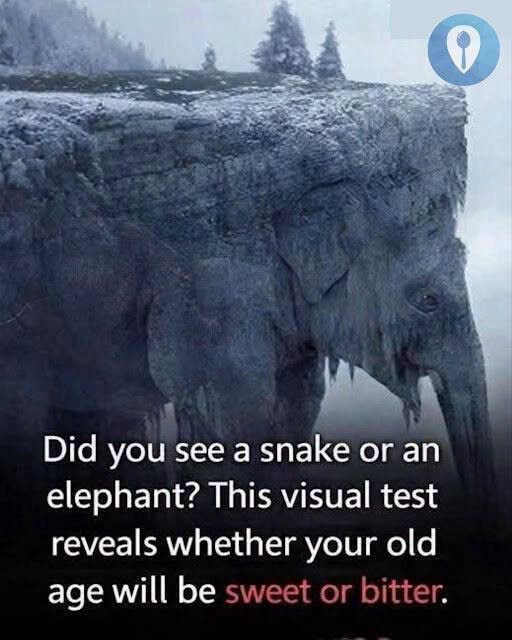
Millions of people look at the same image and swear they see a snake. Others stare at it and immediately see an elephant. The landscape doesn’t change. The picture remains exactly the same. Yet two completely different interpretations appear almost instantly.
So what do you see first?
A snake hiding across the icy landscape?
Or an elephant emerging from the shapes and shadows?
Before you decide that it is simply a clever optical illusion, take another look. Your first impression may reveal something much more interesting about the way your brain processes the world.
The important thing is that there is no magical personality test hidden inside the image.
Seeing the snake doesn’t automatically mean you are adventurous, cautious, analytical, or anything else. Seeing the elephant doesn’t place you into a particular psychological category either.
What the illusion really demonstrates is something more fundamental.
Perception is not completely neutral.
Your brain does not work like a simple camera that records every detail exactly as it appears. Instead, it constantly interprets information, decides what deserves attention, and creates a coherent picture from incomplete visual signals.
That process happens incredibly quickly.
Before you consciously think about what you are seeing, your brain has already begun searching for familiar shapes and patterns.
A curved line might become a body.
A shadow might become an ear.
A cluster of shapes might suddenly resemble an animal.
And once your brain identifies a recognizable form, it becomes much harder to see the image in another way.
That is why optical illusions can be so frustrating.
One person looks at the picture and immediately sees the snake.
Another person cannot understand what the first person is talking about.
Then someone points out the elephant.
Suddenly, the elephant becomes obvious.
You may even wonder how you failed to notice it.
Nothing in the image changed.
Only your interpretation changed.
That tiny moment reveals something surprisingly important about human perception.
We don’t simply observe reality.
We interpret it.
Every day, our brains are making similar decisions without us realizing it.
Consider walking into a crowded room.
Two people can stand in exactly the same place and remember completely different things afterward.
One person remembers the loud conversation in the corner.
Another remembers the person sitting alone.
Someone else remembers the music.
Another notices the unusual painting on the wall.
Everyone experienced the same environment, but nobody necessarily experienced the exact same version of it.
Our attention determines what becomes important.
And attention is influenced by our experiences.
Memory matters.
Mood matters.
Expectations matter.
What we are looking for matters.
If you expect to see a snake, you may notice shapes that resemble one.
If someone tells you an elephant is hidden in the image, your brain may suddenly begin searching for the features of an elephant.
The image remains unchanged.
Your brain changes the question it is asking.
That is why these illusions can teach us something beyond visual puzzles.
They show how easily different people can look at the same thing and walk away with different impressions.
This happens in everyday conversations, too.
Two people can hear the same sentence and interpret it differently.
One person hears criticism.
Another hears advice.
One person sees confidence.
Another sees arrogance.
One person remembers a conversation as supportive.
Another remembers it as dismissive.
Neither person necessarily believes they are lying.
Their brains may simply be emphasizing different parts of the experience.
Personal history influences perception.
So does emotion.
If you are already worried, a neutral expression may appear threatening.
If you are excited, the same expression may seem encouraging.
If you expect something to go wrong, you may notice evidence supporting that expectation while overlooking evidence that contradicts it.
This doesn’t mean perception is meaningless.
It means perception is complicated.
Our brains are constantly filtering enormous amounts of information so that we can function efficiently.
Without that filtering system, everyday life would be overwhelming.
Imagine consciously processing every sound, object, color, movement, facial expression, and texture around you at the same time.
You couldn’t.
Your brain has to prioritize.
That efficiency is one of its greatest strengths.
But it also creates blind spots.
Optical illusions expose those blind spots in a harmless and entertaining way.
They remind us that what feels obvious may not be universally obvious.
The snake may seem completely undeniable to you.
Someone else may look at the same image and see only the elephant.
And when you finally recognize their interpretation, you may realize that both were present in the same visual information all along.
That is the fascinating part.
The illusion doesn’t necessarily tell us which person is right.
It shows us how the same information can produce different experiences.
This idea becomes particularly important in a world where people increasingly argue about what is real.
Social media encourages people to surround themselves with information that confirms what they already believe.
Algorithms can repeatedly show users similar opinions, similar images, and similar interpretations.
Over time, something that is merely familiar can begin to feel unquestionably true.
But familiarity is not the same thing as accuracy.
The snake-and-elephant illusion offers a simple reminder.
Before assuming that your interpretation is the only possible one, consider what someone else might be seeing.
Ask what information they are focusing on.
Ask what assumptions might be shaping their interpretation.
And most importantly, remain willing to look again.
Sometimes another perspective doesn’t destroy your understanding.
It expands it.
Once you learn to see the elephant, you don’t have to stop seeing the snake.
You can see both.
That may be the deeper lesson hidden inside the puzzle.
Different perspectives do not always mean that one person must be completely wrong.
Sometimes they simply reveal different parts of the same picture.
The same thing happens in relationships.
It happens at work.
It happens in families.
It happens in politics.
It happens whenever human beings attempt to understand the same complicated situation from different positions.
We bring our memories with us.
We bring our fears.
We bring our expectations.
We bring our experiences.
And all of those things influence what appears most obvious.
That doesn’t make us incapable of knowing the truth.
It simply means we should be humble about how quickly our brains arrive at conclusions.
So take another look at the image.
Forget what you were told to see.
Look at the shapes.
Look at the negative space.
Look at the areas your eyes ignored the first time.
Can you see the snake?
Can you see the elephant?
Maybe you can see one immediately and the other only after someone points it out.
Maybe you see both at once.
Whatever you see first isn’t a verdict on your personality.
It’s a small demonstration of how wonderfully complicated perception can be.
The image never changed.
Your brain did the changing.
And perhaps that is the most valuable thing the illusion has to teach us.
Two people can stand in the same place, look at the same world, and still see something different.
The challenge isn’t always deciding who is right.
Sometimes, it’s having enough curiosity to ask:
“What are they seeing that I might be missing?”