PART 2: THE LETTER THAT CHANGED EVERYTHING
The first thing I took from my coat was not a photograph.
It was a small blue notebook.
Its corners were worn, and the elastic band holding it closed had lost most of its strength.
I had carried notebooks like it throughout my military career, recording details that seemed unimportant until someone needed to reconstruct exactly what had happened.
This one contained the most difficult investigation of my life.
An investigation into my own family.
“Your Honor,” I said, “I would like to submit a chronological record of the incidents described in my son’s petition, along with supporting documents.”
Curtis Hale stood immediately.
“Your Honor, Mrs.
Vance is appearing without legal representation.
Given the concerns regarding her capacity, I would suggest—”
“Mr.
Hale,” Judge Mercer interrupted, “Mrs.
Vance is entitled to be heard.
We will determine the admissibility and significance of her evidence through the appropriate procedures.”
He turned toward me.
“Before we proceed, Colonel, I should disclose something for the record.”
My stomach tightened.
“Mrs.
Vance and I crossed paths professionally approximately twenty years ago during an investigation involving military procurement.
We did not maintain a personal relationship, but I remember her testimony.”
He looked toward both sides.
“If anyone believes that previous professional contact creates a conflict, we can address it now.”
Curtis Hale consulted quietly with Daniel and Vanessa.
“No objection, Your Honor.”
I shook my head.
“None from me.”
“Very well.
Mrs.
Vance, your military career is a matter of public record, but it is not proof of your present capacity.
The court will consider your medical records and the relevant facts.”
“I understand, Your Honor.”
In fact, I was relieved to hear him say it.
I had not come to court expecting my former rank to save me.
I had come because I wanted the truth to be examined.
The judge glanced at my notebook.
“Please explain what you have brought.”
I opened it to the first page.
“The petition describes seven incidents in which my son and daughter-in-law claim I fell or became confused.
I have recorded the circumstances of each incident, the people present, and the documents that may help establish what happened.”
Daniel stared at the notebook.
I recognized his expression.
It was the same one he had worn as a little boy when he discovered that I had already found the broken window behind our garage.
Only this time, there was no innocent explanation waiting to be discovered.
The first record concerned an afternoon in March.
According to Daniel’s petition, I had fallen while attempting to carry groceries into my kitchen.
I remembered the afternoon clearly.
Vanessa had arrived with a folder containing forms from my bank.
She told me the paperwork would make it easier for Daniel to handle my finances.
I asked why I needed someone else to handle them.
She said Daniel was worried about me.
When I declined, our conversation became uncomfortable.
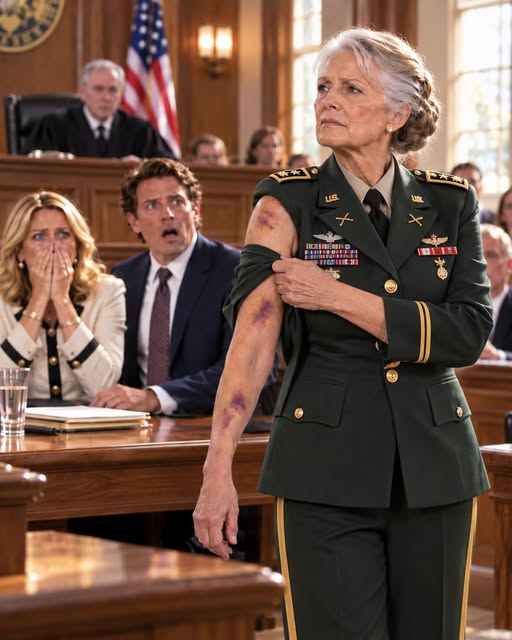
Vanessa grabbed my wrist when I tried to leave the room, and the resulting bruise was photographed later that afternoon.
The picture appeared in the guardianship petition under the caption Injury following another fall.
I turned a page.
“The photograph was taken on March eighteenth,” I explained.
“At two forty-three that afternoon, I called my primary care physician’s office.
I reported the injury and explained how it occurred.”
I handed the court clerk a copy of the medical record.
“My physician also referred me to a social worker.
Her report is included.”
Vanessa lowered her eyes.
Judge Mercer examined the documents.
“Were you medically evaluated after the other incidents?”
“Yes, Your Honor.
Not every time, but I sought medical attention when I needed it.
The dates and records are listed.”
I turned another page.
“The petition also states that I have demonstrated progressive memory loss since my husband’s death.
I underwent a cognitive evaluation with a geriatric specialist two weeks ago.
I brought the report.”
Curtis Hale rose again.
“Your Honor, we haven’t had an opportunity to review these documents.”
“Then you will have that opportunity,” the judge replied.
He looked at me.
“Mrs.
Vance, have you considered obtaining an attorney?”
“Yes, Your Honor.”
“May I ask why you haven’t retained one?”
I glanced briefly toward Daniel.
“Because I kept hoping this would never reach a courtroom.”
My voice remained steady, but my hands tightened around the notebook.
For forty-three years, I had loved my son.
I had held him through childhood fevers, listened to his disappointments, celebrated his achievements, and watched him build a life with the woman he loved.
Now I was presenting evidence to protect myself from him.
Nothing in my military career had prepared me for that particular kind of sorrow.
The hearing continued for another hour.
I submitted bank statements, household expense records, copies of my tax filings, and a letter from my financial adviser.
There was also a monthly budget.
My income.
My expenses.
My savings.
Every figure reconciled.
“Your Honor,” I explained, “I am seventy-one years old.
I sometimes forget where I put my reading glasses.
Last month, I drove halfway to the grocery store before remembering that I’d left my shopping list on the kitchen counter.”
A few people smiled.
“But I know where my money is.
I know what my house is worth.
And I understand what it means to give someone authority over my property.”
I looked toward Daniel.
“I also understand that my son is experiencing financial difficulties.”
He shifted in his chair.
Six months earlier, Daniel had asked me for seventy-five thousand dollars to expand his automotive repair business.
I had asked him to provide financial statements and a business plan.
He took my request as an insult.
He said I had never trusted him.
I told him that lending money without understanding how it would be repaid wasn’t trust.
It was wishful thinking.
That conversation marked the beginning of the distance between us.
Or so I believed.
“Mr.
Vance,” Judge Mercer said, “did your mother give you permission to change the locks on her home?”
Daniel hesitated.
“I thought it was necessary.”
“That wasn’t my question.”
“No, Your Honor.”
“Was there a court order authorizing you to exclude her from her residence?”
“No.”
Daniel looked down.
Judge Mercer reviewed the documents.
“Based on the evidence presented today, I am not prepared to grant the request for emergency guardianship.”
Vanessa closed her eyes.
The judge continued.
“The parties will have time to review the newly submitted records.
An appropriate independent assessment may be arranged if necessary.
I also expect the question of Mrs.
Vance’s access to her home to be addressed promptly.”
He looked directly at me.
“Mrs.
Vance, this matter remains open.
But family disagreement, by itself, is not evidence of incapacity.”
I nodded.
“Thank you, Your Honor.”
For the first time in weeks, I could breathe.
The hearing had not repaired my family.
But it had given me the opportunity to begin repairing my life.
Daniel approached me outside the courtroom.
Vanessa remained several steps behind him.
“Mom, can we talk?”
I closed my notebook.
“What would you like to talk about?”
He rubbed his forehead.
“You made us look like we were trying to take everything from you.”
I studied his face.
“Were you?”
His eyes widened.
“That’s not fair.”
“Then tell me what is.”
He glanced toward Vanessa.
She stepped closer.
“Eleanor, we really were worried about you.”
“I believe there may have been moments when you were worried,” I replied.
“But concern doesn’t explain changing my locks.”
Vanessa’s eyes filled with tears.
Daniel placed a hand on her shoulder.
“We thought you’d calm down and come home once you agreed to let us help.”
I looked at him for a long moment.
“You thought I would surrender my independence in exchange for permission to enter my own house?”
Something changed in his expression.
“We didn’t think of it that way.”
“No,” I said quietly.
“I don’t believe you did.”
I walked toward the courthouse entrance.
Behind me, Daniel called my name.
“Mom?”
I stopped.
“I didn’t mean for things to get this far.”
I turned toward him.
“What did you mean to happen, Daniel?”
He had no answer.
My oldest friend, Ruth Palmer, was waiting beside her green Subaru.
She stood when she saw me.
“Well?”
“The emergency petition wasn’t granted.”
She wrapped her arms around me.
I hadn’t realized how badly I needed a hug.
“Good,” she whispered.
“There’s still another hearing.”
“Then we’ll have more tea.”
“That seems to be your answer to everything.”
“It’s kept me alive for seventy-four years.”
She opened the passenger door.
A paper bag from my favorite bakery rested on the seat.
I looked at her.
“Ruth.”
“What?”
“You bought cinnamon rolls.”
“You looked like a woman who might need one.”
I started laughing.
It surprised us both.
For weeks, my life had narrowed to documents, court dates, medical appointments, and memories I would rather have forgotten.
Yet here was Ruth, offering me a cinnamon roll as though the world had not stopped turning.
Perhaps it hadn’t.
Perhaps I was allowed to enjoy breakfast even while my family was falling apart.
Two days later, I met Claire Bennett.
She was an attorney recommended by a local senior advocacy organization.
She had short brown hair, sensible shoes, and the habit of listening without interrupting.
We met in her office overlooking a small public garden.
Ruth came with me but waited in the reception area.
Claire read the documents I had brought.
Then she looked up.
“You’ve done a remarkable amount of preparation.”
“Old habits.”
“I can see that.
But I’d like to suggest something.”
“Go ahead.”
“You don’t have to approach this as an investigation that you must win alone.”
I considered that.
It had been easier to organize evidence than to admit how frightened I was.
Evidence had dates.
Statements could be verified.
Financial records could be reconciled.
But there was no procedure for discovering that the son you had raised no longer saw you as someone entitled to make her own decisions.
Claire seemed to understand my silence.
“What outcome do you want, Eleanor?”
“My house back.”
“Of course.”
“My financial independence.”
“Certainly.”
“And I want Daniel to understand that he can’t make decisions for me simply because he’s afraid I’ll make decisions he dislikes.”
Claire nodded.
“Anything else?”
I looked out the window.
A little boy was helping his grandfather feed birds beside a fountain.
The older man held the seed while the boy scattered it with wild enthusiasm.
I remembered Daniel at that age, following Thomas through the backyard with a plastic toolbox.
“I want my son back,” I admitted.
Claire’s expression softened.
“That may be more complicated than the legal case.”
“I know.”
“And it may not be entirely within your control.”
“I know that, too.”
I looked down at my wedding ring.
“But I don’t want to close the door unless I have to.”
Over the following week, Claire helped arrange my return home while the guardianship proceedings continued.
Daniel and Vanessa agreed through their attorney to return my keys and personal documents.
They also agreed not to enter the house without my permission.
I insisted that Ruth accompany me the first time I went back.
The day was bright and unusually warm.
Our maple tree had begun to grow new leaves, and the flower beds were full of weeds.
Thomas would have been horrified.
He had treated gardening like a military campaign, although he possessed none of my talent for planning.
Ruth parked in the driveway.
“Would you like me to go in first?”
“No.”
I stood beside the front steps.
For forty years, I had crossed that threshold without thinking about it.
I had carried Daniel inside when he came home from the hospital as a newborn.
I had watched him leave for his first day of school through that doorway.
I had stood there beside Thomas when Daniel moved out, both of us waving until his car disappeared around the corner.
Now I held a new key in my hand.
The lock turned easily.
Inside, everything looked almost normal.
My blue umbrella stood beside the coat rack.
Thomas’s old slippers were still beneath the hallway bench.
Someone had moved the furniture in the living room.
There were unfamiliar coffee mugs in the sink.
And the photograph of Thomas and me on our fortieth wedding anniversary was missing from the mantel.
I found it later in a kitchen drawer.
The glass was cracked.
I sat at the table, holding the frame.
Ruth quietly made tea.
For a long time, neither of us spoke.
Then she came over and placed a cup beside me.
“Do you remember that anniversary party?”
I smiled.
“Thomas insisted on giving a speech.”
“He talked for twenty minutes.”
“Twenty-seven.”
“And forgot to thank the caterer.”
“He thanked the dog.”
Ruth laughed.
I looked down at the photograph.
Thomas was smiling at me with the expression he had worn whenever he knew something I didn’t.
“I wish he were here,” I whispered.
Ruth sat beside me.
“I know.”
There was nothing else she needed to say.
That evening, I went into Thomas’s study.
I had avoided the room since his death.
It still smelled faintly of cedar and the peppermint sweets he kept in his desk drawer.
His reading glasses rested beside a small brass lamp.
On the bookshelf stood a photograph of Daniel at sixteen, holding the keys to his first car.
Thomas had spent six months rebuilding that old Ford with him.
I remembered how proud they had been.
For years, the two of them had understood each other best when they were working on something side by side.
Thomas had never been especially good at expressing affection directly.
He showed it by repairing things.
A leaking faucet.
A loose stair.
A car that refused to start.
And sometimes, unfortunately, he tried to repair people the same way.
I sat at the desk and opened the lower drawer.
Several folders had been moved.
The file containing our original house deed was missing, although Claire had already helped me obtain certified copies.
I found our insurance records, Thomas’s retirement documents, and a collection of old letters.
Then I noticed an empty space beside the filing cabinet.
Thomas kept a narrow wooden box there.
It was made of walnut, with a brass latch.
He had built it himself during the winter Daniel went away to college.
I hadn’t seen it since the week after the funeral.
I searched the drawers and shelves.
Nothing.
Then I remembered something Vanessa had said during an argument.
Thomas left a lot of unfinished paperwork.
Daniel is just trying to sort everything out.
At the time, I had assumed she meant our estate documents.
Now I wondered whether she had been referring to something else.
Daniel called me three days later.
I was pruning roses when my telephone rang.
For a moment, I considered letting it go to voicemail.
Then I answered.
“Hello, Daniel.”
“Hi, Mom.”
He sounded tired.
There was traffic in the background.
“I got the letter from your attorney.”
“I assumed you would.”
“About Dad’s papers.”
“Yes.”
He was quiet for a few seconds.
“I’m not trying to keep anything from you.”
“Then you won’t mind returning them.”
“It’s not that simple.”
I stopped cutting.
“Why not?”
“I need to look through some things first.”
“Daniel, those documents belong in this house.”
“I know.”
Something about his voice caught my attention.
He didn’t sound angry.
He sounded worried.
“Is there something in those papers that I should know about?”
“No.”
The answer came too quickly.
I had heard that tone before.
When he was nine, Daniel had used it to assure me he hadn’t eaten the birthday cake hidden in the refrigerator.
When he was seventeen, he used it to explain why his car had mysteriously acquired a dent.
But I had never heard him use it when the stakes were so high.
“Daniel, I would rather hear an uncomfortable truth from you than discover it somewhere else.”
He sighed.
“I’ll bring the box over.”
“When?”
“Tomorrow.”
“All right.”
“Mom?”
“Yes?”
“I didn’t mean for any of this to happen.”
I closed my eyes.
“What did you mean to happen?”
There was a long silence.
“I thought once you understood how serious things were, you’d agree to help.”
“Serious in what way?”
He exhaled.
“I have to go.”
The call ended.
I stood among the roses for several minutes.
For the first time, I began to suspect that the missing papers were connected to something larger than the guardianship petition.
The next afternoon, Daniel arrived alone.
I watched him walk up the driveway carrying the wooden box.
He had lost weight.
There were dark circles beneath his eyes.
I opened the front door before he knocked.
“Hello, Mom.”
“Hello.”
He looked past me into the hallway.
“It’s strange being here.”
I almost said that it was strange being locked out.
Instead, I stepped aside.
“Come in.”
We went into the kitchen.
Daniel placed the box on the table.
For several moments, we simply looked at it.
“Did you find everything?”
I asked.
“I think so.”
“Thank you.”
He rubbed the back of his neck.
“Vanessa says we should stop talking about the court case until the lawyers sort it out.”
“That might be sensible.”
He nodded.
Then he glanced toward the window.
“Dad always said that tree would outlive both of you.”
I followed his gaze.
The maple tree stood beyond the kitchen window, its leaves moving gently in the afternoon breeze.
“He planted it the year you were born.”
“I remember.”
“No, you don’t.
You were six months old.”
Daniel almost smiled.
“I remember him telling me.”
I poured us each a cup of tea.
He took his without complaining, although he had hated tea since childhood.
For ten minutes, we managed to talk about ordinary things.
The leaking roof at his workshop.
Ruth’s new dog.
The maple tree.
It was the longest conversation we had shared in months that did not involve money.
Then Daniel stood.
“I should get back.”
I wanted to ask him to stay.
Instead, I walked him to the door.
Before leaving, he turned.
“Mom, did Dad ever tell you he thought I was a disappointment?”
The question stunned me.
“Of course not.”
Daniel gave a small, humorless laugh.
“He told me I needed to learn to stand on my own two feet.”
“That isn’t the same thing.”
“Maybe not to you.”
He stepped outside.
“Goodbye, Mom.”
I watched him drive away.
Then I returned to the kitchen and opened the wooden box.
Inside were the familiar odds and ends Thomas had kept for years.
His father’s pocket watch.
A photograph of our first house.
The tiny hospital bracelet Daniel had worn when he was born.
A packet of letters tied with blue ribbon.
And several manila envelopes.
I sat down and began sorting through them.
The first envelope contained old family photographs.
The second held receipts from repairs Thomas had made around the house.
The third was labeled Daniel—Workshop.
I frowned.
Thomas had always helped Daniel with the garage, but I didn’t remember him keeping a separate file.
Inside were invoices from contractors, equipment suppliers, and a small-business lender.
The dates covered the final two years of Thomas’s life.
I remembered those years well.
Thomas had developed a serious heart condition.
He had continued working in his garden long after his doctors advised him to slow down.
Daniel had visited frequently.
Often, he and his father disappeared into the study for hours.
I assumed they were discussing the workshop.
Now, looking at the invoices, I realized they had been discussing considerably more.
There was a loan agreement.
A series of bank transfers.
And several handwritten calculations in Thomas’s unmistakable handwriting.
At the bottom of one page, he had written:
Daniel’s repayments are current.
Must speak to Eleanor about the remaining balance.
I stared at the note.
What repayments?
What remaining balance?
I had always believed Thomas and I discussed our financial decisions openly.
Yet here was evidence that he had been lending money to Daniel without telling me.
I felt a sharp, unexpected pang of betrayal.
Then I kept reading.
The original loan had been modest.
Twenty thousand dollars to purchase equipment for Daniel’s workshop.
But there were additional payments.
Seven thousand.
Twelve thousand.
Another fifteen.
And finally, a transfer for thirty-eight thousand dollars.
Some payments appeared to have been repaid.
Others had not.
There was something unusual about the largest transfer.
Thomas had written a short note beside it.
Not a business loan.
Temporary support.
Daniel must not carry this alone.
I read the sentence several times.
Then I found a receipt from a private home-care agency.
It was dated eight months before Thomas died.
Another followed.
Then another.
Suddenly, the numbers began to make sense.
During the final months of his illness, Thomas had refused to enter a residential care facility.
He wanted to remain at home, sleeping beside me and watching the maple tree through our bedroom window.
I had taken leave from my volunteer work to care for him.
Daniel visited whenever he could.
But there were evenings when I was exhausted and Thomas needed more assistance than I could provide.
Daniel had found a private care agency.
He told me a veterans’ support program was helping with the costs.
I had never questioned him.
I was too grateful for the relief.
Now I realized that Daniel had been paying a substantial portion of those expenses himself.
And when his business began struggling, Thomas had quietly tried to reimburse him.
I leaned back in my chair.
For weeks, I had been certain I understood what had happened.
Daniel needed money.
He wanted control of my accounts.
He had tried to obtain it through the courts.
Those facts had not changed.
But I had not known what had happened before he asked me for the money.
Or how much of his financial trouble had begun while helping his father.
The following morning, I called Claire.
She examined the papers that afternoon.
“These records may help explain Daniel’s financial circumstances,” she said.
“But they’re separate from the question of your capacity.”
“I understand.”
“Do you want to discuss them with him?”
“Yes.”
“Then I suggest you do so with clear boundaries.
There are unresolved legal matters, and some of these documents may become relevant to the proceedings.”
She pointed to Thomas’s handwritten note.
“There’s something else you should consider.”
“What?”
“Your husband intended to formalize an arrangement, but we don’t yet know whether he completed any additional documents.”
I looked at the wooden box.
“I think this is everything.”
“Perhaps.
But the attorney mentioned in this letter may have a more complete file.”
His name was Martin Ellis.
He had handled our wills for nearly thirty years.
I called his office before leaving Claire’s.
His assistant remembered me immediately.
“Mrs.
Vance!
It’s good to hear from you.”
I explained that I had found some of Thomas’s papers and wanted to review the estate file.
There was a pause.
Then she said, “Mr.
Ellis has actually been trying to reach you.”
I felt my heart quicken.
“About what?”
“He received an inquiry concerning your property several weeks ago.
He wanted to confirm whether you had authorized it.”
“What kind of inquiry?”
“I think he’d prefer to discuss the details with you personally.”
We arranged an appointment for the next morning.
Martin Ellis’s office occupied the second floor of an old brick building downtown.
He was eighty years old and had been threatening to retire for at least fifteen of them.
When I arrived, he came out to greet me personally.
“Eleanor.”
He took both my hands.
“I’m very sorry about Thomas.”
“Thank you, Martin.”
“He was a good man.”
“Yes,” I replied.
“He was.”
Martin led me into his office.
Claire accompanied me.
After a few minutes of conversation, he retrieved a thick file from a cabinet.
“I understand there’s a dispute involving Daniel.”
I nodded.
“I’ve been reviewing some financial papers Thomas kept.
I didn’t realize he’d been helping Daniel with the workshop and our care expenses.”
Martin’s expression became thoughtful.
“Thomas was concerned about Daniel’s business.
But he was also concerned about something else.”
“What?”
“He worried that Daniel was beginning to measure his worth entirely by whether he could provide for everyone around him.”
That sounded painfully familiar.
Martin opened the file.
“Thomas originally planned to forgive part of Daniel’s debt.
Then Daniel insisted on repaying everything.
They argued about it for weeks.”
I smiled sadly.
“They were both stubborn.”
“They certainly were.”
Martin withdrew a letter.
“Thomas asked me to prepare this after their last meeting.
He intended to discuss it with you, but his health deteriorated before we could arrange the appointment.”
I unfolded the paper.
It was a draft memorandum concerning Daniel’s loan.
Thomas had proposed forgiving a substantial portion of the remaining debt and converting the rest into a manageable repayment plan.
But the arrangement had never been signed.
Martin explained that Thomas had also asked about ways to protect me financially while offering Daniel support.
“He was very specific,” Martin said.
“He didn’t want your house involved.
He wanted Daniel to have an opportunity to recover without placing your future at risk.”
I read the memorandum again.
Then I looked up.
“Why didn’t Daniel tell me?”
Martin hesitated.
“I can’t answer that.
But I can tell you something Thomas said during our final meeting.”
He opened a smaller folder and removed a handwritten note.
“Thomas told me Daniel believed you were disappointed in his business.
He said your son was determined to prove he could build something worthwhile without relying on either of you.”
I stared at him.
“Disappointed?”
“That was Daniel’s impression.”
I thought of the workshop.
The years Daniel had spent learning to repair engines.
The day he opened his first garage, standing outside beneath a homemade sign while Thomas took photographs.
I had been proud of him.
But I had also been worried.
His business plan was ambitious.
His savings were limited.
I remembered advising him to keep his old job until the workshop became profitable.
Daniel had taken that advice badly.
He had accused me of thinking he would fail.
And instead of explaining that I was frightened for him, I had answered with figures and statistics.
Another practical solution.
Another conversation that ended before either of us understood the other.
Martin brought me back to the present.
“There’s also the property inquiry.”
He opened an email.
Three weeks earlier, a real estate consultant had contacted his office asking whether the Vance residence could be sold following a proposed guardianship appointment.
The inquiry had come through Curtis Hale’s office.
Claire read the email carefully.
“Has any agreement been signed?”
“Not to my knowledge,” Martin replied.
“I refused to release any information without Eleanor’s authorization.”
I felt a cold weight settle in my stomach.
Daniel had not merely wanted access to my accounts.
He had already been exploring the possibility of selling my home.
Yet there was something unusual about the inquiry.
The estimated sale price was considerably higher than the amount Daniel had requested from me.
And attached to the email was a preliminary statement of his business liabilities.
I looked at the total.
One hundred and eighty-six thousand dollars.
My eyes returned to the figure.
“That can’t be right.”
Martin remained silent.
Claire asked, “Did you know Daniel owed this much?”
“No.”
I had known he was struggling.
I had not known he was approaching insolvency.
The workshop was more than a business to Daniel.
It was the place where he and Thomas had spent countless weekends together.
It was the last project they had shared.
And now Daniel appeared to be trying to save it at almost any cost.
I looked down at my husband’s unfinished letter.
For the first time, I understood why Thomas had been so worried.
That evening, I called Daniel.
He answered on the fourth ring.
“Mom?”
“I met with Martin Ellis today.”
There was a long silence.
Then he said, “I figured you would.”
“I found the paperwork about the loans.”
He exhaled.
“Okay.”
“And I found out what you spent on your father’s care.”
“Mom, please.”
“Why didn’t you tell me?”
“Because you already had enough to worry about.”
I sat at the kitchen table.
“Daniel, I was his wife.”
“I know.”
“We were supposed to make those decisions together.”
“I know that now.”
His voice sounded tired.
I looked at the photograph of Thomas on the windowsill.
“Why did you think I was disappointed in you?”
He didn’t answer immediately.
Then he said, “Because every time I told you about the garage, you asked whether I had enough money.
Whether I’d checked the insurance.
Whether I’d spoken to an accountant.”
“I was trying to help.”
“I know.”
“Then why—”
“Because Dad asked me whether I was happy.”
I stopped.
Daniel continued.