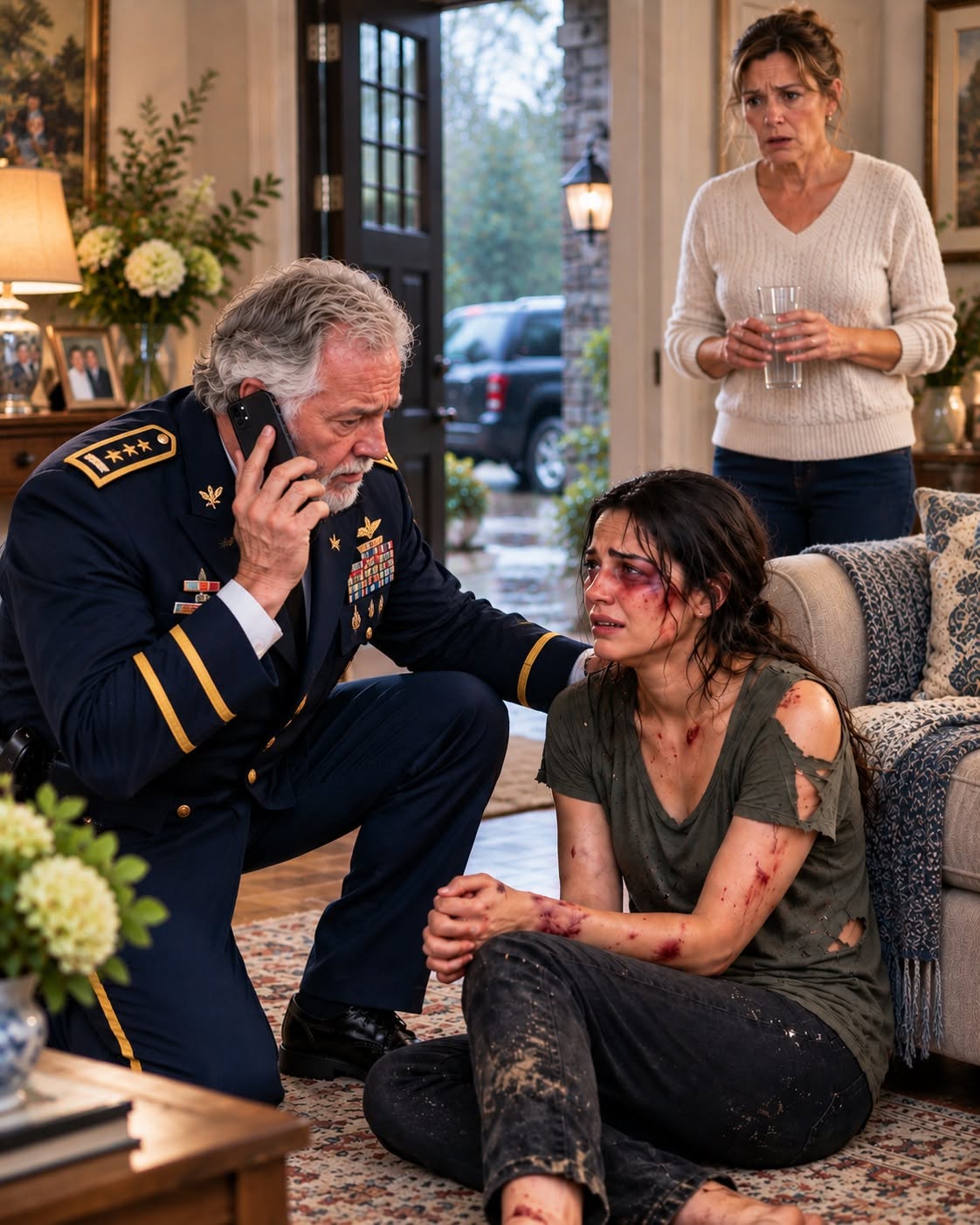
Six years had passed since I’d retired from the county police department, but Ortiz had been one of the youngest detectives in my final years as chief. He’d arrived at the department with a sharp mind, an uneasy smile, and a habit of asking one more question than everyone else.
That habit had made him good.
It had also made him unpopular with people who wanted an investigation finished quickly.
Now his attention shifted back to Emily.
“Is she conscious?”
“Yes,” I said. “She was when I arrived.”
One of the uniformed officers knelt near my daughter and introduced herself as Officer Patel. The other, Officer Greene, moved carefully through the room, making notes without touching anything.
Jessica took a step toward Ortiz.
“Detective, this is all a misunderstanding. Emily has been under a lot of stress. She slipped, and her father panicked.”
Ortiz didn’t answer her immediately.
He crouched beside Emily instead.
“Emily, my name is Daniel Ortiz. I’m with the county police. Can you tell me what hurts?”
Emily swallowed.
“My cheek. My shoulder.”
“Did anyone strike you?”
Jessica inhaled sharply.
“Detective—”
Ortiz raised one hand without looking at her.
“Let her answer.”
Emily’s fingers tightened around mine.
“Yes,” she whispered.
The room went quiet.
I felt her grip tremble, but she didn’t let go.
“Who?” Ortiz asked.
“Michael.”
Jessica’s face hardened.
“That’s not true.”
“Mrs. Hale,” Officer Patel said gently, “please wait in the kitchen while we speak with Emily.”
“I live here.”
“And you can remain here,” Patel replied. “But I need you to give us some space.”
Jessica looked at me then, as if somehow this were my fault.
I had seen that look on suspects, witnesses, grieving families, and even fellow officers. It was the look of someone who had lost control of the story.
For the first time since I arrived, Jessica’s calm began to crack.
“I was trying to help her,” she said. “She gets confused when she’s upset.”
Emily flinched.
That small movement told me more than Jessica’s words.
Ortiz noticed it too.
“Officer Greene,” he said, “can you escort Mrs. Hale to the kitchen and get her full information?”
Jessica opened her mouth to object.
Ortiz met her eyes.
“Please.”
The word was polite.
The tone was not.
She left with Officer Greene, but not before giving Emily a long, wounded look.
My daughter stared at the floor.
I wanted to ask what had happened. I wanted names, times, explanations. I wanted the truth in a form I could hold and use to protect her.
But the first lesson I had learned as a father was that wanting answers did not give me the right to demand them.
Ortiz spoke softly.
“Emily, do you feel safe staying here tonight?”
Her eyes filled.
“No.”
“Do you believe Michael may return?”
“Yes.”
“Do you have somewhere else you can stay?”
Emily looked at me.
I nodded before she could ask.
“With me,” I said.
Ortiz continued asking questions, slowly and clearly. He didn’t press when she hesitated. He didn’t finish her sentences. When she apologized for taking up everyone’s time, he told her she had nothing to apologize for.
I watched him work and remembered the first case we’d handled together.
A missing teenager. Sixteen years old, frightened, and convinced she would be punished for running away. Ortiz had sat on the floor beside her for nearly an hour while everyone else stood around waiting for a statement.
He hadn’t asked, “Why did you leave?”
He’d asked, “What would help you feel safe enough to tell us?”
He was asking Emily the same kind of question now.
That was when I realized how badly I’d needed someone like him to arrive.
Not because I was incapable of helping my daughter.
Because I loved her too much to trust myself not to turn fear into action.
The paramedics came in and checked Emily’s injuries. Nothing appeared life-threatening, but the swelling on her face needed attention, and her shoulder was badly strained. The blouse tear, they determined, was not the result of a fall.
One of the paramedics quietly told Ortiz that Emily should be examined at the hospital.
Michael still hadn’t returned.
Ortiz asked for his full name, date of birth, and vehicle description. I gave him what I knew, then stopped.
“I don’t know where he works now,” I said.
Emily looked up.
“His office is on Mill Street.”
“You’re sure?” I asked.
She nodded.
Ortiz wrote it down.
Jessica reappeared from the kitchen, now accompanied by Officer Greene.
“You can’t take her anywhere,” she said. “Michael will come back and find the house empty.”
“That is not your decision,” I replied.
Her eyes narrowed.
“You always thought you could run everyone’s life.”
I felt an old reflex rise in me—the desire to answer sharply, to put someone in their place with a few carefully chosen words.
But retirement had taught me that not every provocation deserved a response.
Especially not when my daughter was watching.
Ortiz stepped between us, not aggressively, simply occupying the space.
“Mrs. Hale, we need to speak with you separately.”
“I’ve already told you what happened.”
“You said Emily fell.”
“She did.”
“You also said she slipped near the table.”
Jessica’s lips pressed into a thin line.
“I was upset.”
“Which version is accurate?”
She glanced at Emily.
That glance was not concern.
It was calculation.
“I don’t see why you’re treating me like a criminal.”
“We’re trying to establish what happened.”
“My daughter-in-law has emotional problems. She has episodes. Michael has been patient with her.”
Emily’s face went pale.
I looked at Ortiz.
He gave the smallest shake of his head.
Not yet.
Not in front of her.
I understood.
Sometimes the most important thing in an investigation was not what you said. It was what you protected someone from hearing before they had the strength to bear it.
The paramedics helped Emily stand. She swayed, and I caught her elbow.
“I’m okay,” she said automatically.
“You don’t have to be,” I told her.
That nearly undid her.
She lowered her head, and tears slipped down her cheeks.
Jessica sighed.
“Oh, Emily.”
The disappointment in her voice was almost worse than anger.
As though tears were another inconvenience my daughter had created.
Ortiz turned toward her.
“Mrs. Hale, I need you to remain in the kitchen until we’re finished.”
“I have done nothing wrong.”
“Then answering questions should not be difficult.”
For the first time, Jessica went silent.
At the hospital, the waiting room smelled like disinfectant and coffee that had been sitting too long. I sat beside Emily while a nurse took her for imaging. Ortiz stayed behind to speak with me.
“Chief,” he said.
I gave him a look.
“Sorry,” he corrected. “Tom.”
Nobody had called me Tom at the department in years. To everyone there, I had been Chief Mercer, even at family barbecues where the title had followed me home like a second shadow.
Now hearing my first name from Ortiz made something loosen in my chest.
“What do you know?” he asked.
“That Michael has been hurting her for some time.”
“That’s what she said tonight.”
“She told me last month that he grabbed her arm during an argument.”
“Did you see an injury?”
“No.”
“Did she want to report it?”
“No.”
He nodded, not judgmental, just recording.
“Did you confront Michael?”
“I asked him if everything was all right.”
“That’s not what I asked.”
I looked through the glass doors toward the corridor where Emily had disappeared.
“I told him that if he ever put his hands on her again, I would make sure he regretted it.”
Ortiz’s expression tightened.
“I know you were trying to protect her.”
“I wasn’t threatening him.”
“I know.”
“I meant that I would help her leave. Get a lawyer. Do whatever was necessary.”
“I know that too.”
We sat in silence.
The old chief in me wanted to know why he wasn’t arresting Michael immediately. The father in me wanted someone to blame. The man I had become after retirement understood that an arrest was not the same thing as safety, and anger was not the same thing as justice.
“What happens now?” I asked.
“If Emily confirms what happened and the medical findings support it, we’ll begin an investigation. We’ll try to locate Michael and ask him for his account.”
“He’ll lie.”
“Maybe.”
“He’ll say she fell.”
“He may.”
“And Jessica will back him up.”
“Probably.”
I leaned back.
“Then why does it feel like we’re waiting for permission to believe my daughter?”
Ortiz looked at me directly.
“We’re not waiting for permission. We’re building something that can stand when people start changing their stories.”
That answer was so familiar I almost smiled.
It was the same answer I had given families for thirty-two years.
Evidence mattered because memory changed under pressure. Because fear made people doubt themselves. Because the truth deserved more than one person’s certainty, even when that person happened to be the chief of police.
Emily returned with her arm in a sling and a paper bag of medication. Her cheek was bruised, but the swelling had gone down slightly.
Ortiz stood.
“I need to ask you a few more questions, but we can do that tomorrow if you’re tired.”
Emily looked at me.
I didn’t answer for her.
“I can talk,” she said.
He led us to a private consultation room. A victim advocate named Marisol joined us. She was calm, warm, and direct, and she explained every step before it happened.
Emily began with small details.
Michael had started checking her phone almost a year ago. At first, he’d said he was worried about her. Then he began keeping track of where she went, who she spoke to, and how long errands took.
When Emily tried to object, he accused her of hiding something.
The injuries had started later.
Nothing dramatic, she said. A grip too tight. A shove away from a doorway. A hand on the back of her neck when he wanted her to listen.
Each time, he apologized.
Each time, Jessica told Emily that marriage required patience.
“He wasn’t always like this,” Emily said.
“People don’t become strangers all at once,” Marisol replied. “Sometimes they change in ways you keep explaining because the person you love is still there in other moments.”
Emily lowered her eyes.
“His good days made me question the bad ones.”
I reached across the table, but stopped before touching her.
She noticed.
After a moment, she took my hand.
“I knew something was wrong,” I said. “I’m sorry I kept waiting for you to say it.”
“You asked.”
“I should have asked better.”
“You didn’t want to make me choose between you and him.”
“That was never your choice to make.”
Her eyes shone.
“I thought if I admitted it, everything would become real.”
“It was real before you admitted it.”
“I know.”
Her voice broke.
“I just didn’t know how to leave.”
Marisol explained that they could help arrange emergency housing, legal resources, and a protective order if Emily wanted one. She emphasized that Emily controlled the pace, except where immediate safety required action.
By the time we finished, it was nearly two in the morning.
Ortiz had learned that Michael’s phone was off. His employer said he had left the office earlier than usual. His car had been seen near the river district, but patrol officers had not located him.
Jessica had gone home with a family friend after refusing to spend the night at the hospital.
Emily was coming with me.
There was no argument.
My house had been quiet for six years, ever since my wife died and Emily moved to another state. I had turned the guest room into a place for storing old police files, fishing equipment, and boxes I kept meaning to sort.
Before we arrived, I called my neighbor, Mrs. Alvarez, and asked if she could help me clear the room.
She was seventy-eight years old, widowed, and more efficient than every emergency planning committee I had ever chaired.
“Put clean sheets on the bed,” I told her.
“I already did.”
“How did you—”
“Your daughter called me last week.”
I stopped.
“Emily called you?”
“She wanted to know if I still had the spare key.”
That detail stayed with me during the drive.
When we reached the house, the porch light was on. Mrs. Alvarez stood in the doorway wearing a robe over her pajamas, holding a tray of soup and bread.
Emily gave a tired laugh.
“You told her?”
“I told her you needed a room.”
“That’s all?”
“That’s enough.”
Mrs. Alvarez pulled my daughter into a careful embrace.
“No explanations tonight,” she said. “Just food.”
Emily cried again, but these tears were different.
They carried exhaustion rather than fear.
I watched them disappear inside, then stood alone on the porch with the cold air pressing against my face.
My phone rang.
Ortiz.
“Tom,” he said, “we found Michael’s car.”
“Where?”
“Behind the old train depot. Empty.”
I looked toward the warm rectangle of light spilling across my porch.
“Is that good or bad?”
“I don’t know yet.”
“Did you find him?”
“No.”
I closed my eyes.
“Do you think he left the area?”
“Possibly. We’re checking family and work contacts.”
“What about Jessica?”
“She’s at her sister’s house. She’s agreed to come in tomorrow morning.”
“Agreed?”
“She called us first.”
That surprised me.
“What did she say?”
“She wants to correct her statement.”
I glanced through the window. Emily sat at the kitchen table while Mrs. Alvarez poured soup into a bowl. My daughter looked small beneath the oversized sweater I had given her.
“What changed?” I asked.
Ortiz was silent for a moment.
“She said there’s something you need to know about Emily’s phone.”
I felt the cold deepen.
“What about it?”
“Officer Greene recovered it from beneath the table. The screen is damaged, but our technician managed to access part of the call history.”
“I heard the call.”
“You heard the beginning.”
I waited.
“There was another call placed from Emily’s phone twelve minutes before she contacted you.”
“To whom?”
“Jessica.”
I looked back through the window.
Emily was speaking now, her hands wrapped around the soup bowl. She appeared almost peaceful, unaware that another piece of the evening had just shifted.
“What did Jessica tell her?” I asked.
“According to the records, the call lasted nine minutes.”
“Did you listen to it?”
“We’re obtaining a warrant for the audio. But there’s more.”
My fingers tightened around the phone.
“What more?”
“Your daughter didn’t call you from the phone we found beneath the table.”
I looked toward the kitchen.
“Then whose phone did she use?”
“That’s what we’re trying to determine.”
A pause followed.
Then Ortiz said, “Tom, when our technician examined the damaged phone, he found a recording saved under a hidden file. It was created earlier tonight.”
“What kind of recording?”
“We don’t know yet.”
“Why not?”
“Because it’s encrypted.”
My pulse began to climb.
“Can you open it?”
“We may be able to. But there’s one thing you should hear before we do.”
“What?”
Ortiz’s voice dropped.
The old detective in him was careful with words.
“Your daughter didn’t make that recording,” he said. “The file was created on Jessica’s phone.”
Inside the house, Emily suddenly looked toward the window.
And behind her, on the kitchen counter, the spare key Mrs. Alvarez had mentioned was no longer there.
-END OF PART 2, –PRESS NEX PART IN BOTTOM OF PAGE TO READ NEXT PART