Elvis Presley is remembered by history as an enduring symbol of American royalty, a monument of genius and magnetism. But despite the sparkling jumpsuits of his later years, the reality of his mid-career existence was far more precarious and full of existential dread. The guy who once electrified a generation and frightened parents with a single hip swivel had turned into a self-described laughingstock by the late 1960s. Elvis was a bird in a golden cage, forced to sing silly songs to dogs and kids as the cultural revolution of the 1960s raced by. He was trapped in an exhausting, soul-crushing cycle of predictable Hollywood musicals. He was a trailblazer who had been marginalized by his own achievements and forced into a condition of creative stagnation by a system that prioritized his bankability over his humanity. His 1968 Comeback Special is a visceral story of a man struggling for his artistic life, harnessing Marlon Brando’s unadulterated rebellion to mount a coup against his own created image. It is not just a tale of a successful television program.
One must first examine the darkness that preceded the dawn in order to appreciate the significance of this moment. Elvis had not performed live in front of an audience for seven arduous years. Once his home, the stage had turned into a terrifying place. Return of the King: The Fall and Rise of Elvis Presley, a recent Netflix documentary, depicts a man whose dignity was being undermined with each frame of the thirty-one films he was forced to do. He was acutely conscious of the jokes being told about him. Feeling like a relic of a bygone period, he witnessed the birth of The Beatles, The Rolling Stones, and the psychedelic movement. Later, Priscilla Presley said that it felt like a crime against his genius to see him pushed into those late-career film parts. Elvis had a strong desire to be a serious dramatic actor when he first started the business. He looked to Marlon Brando’s animalistic charm and James Dean’s brooding intensity as his North Stars. Rather, Hollywood had prepared him to be a sterile, safe product.
Tension had escalated to a breaking point by 1968. Elvis was desperate, not just unhappy. Colonel Tom Parker, his manager, first proposed a conventional, morally upright Christmas program when the chance for a television special presented itself. It was intended to be an additional layer of the “safe” Elvis brand. Director Steve Binder, however, had a different perspective. He observed a man with a dormant volcano of energy beneath the surface. An unexpected source served as the impetus for the visual revolution that would characterize the era: a picture of Elvis riding a motorcycle that bore a remarkable resemblance to Marlon Brando’s famous character in The Wild One. This was a shadow of the original rebel, not the polished Elvis of Blue Hawaii.
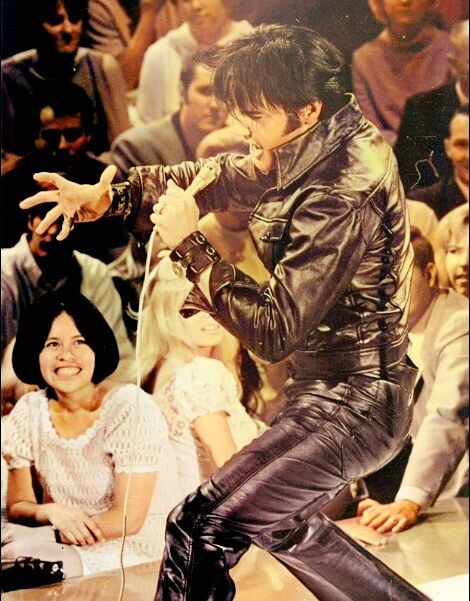
The most well-known group in rock and roll history was formed as a result of that motivation. Bill Belew, the costume designer, was entrusted with designing a suit that would evoke a return to the peril of the mid-fifties but also feeling modern and classic. The jet-black, second-skin leather suit was the end product. It had a high, dramatic collar that framed the King’s face like a dark halo, and silk accents gave the leather’s rough texture a hint of regality. It was a symbolic engineering masterpiece. Elvis was reclaiming the American outlaw ideal by wearing the leather, rather than merely copying Brando. He was letting the world know that he was no longer a puppet of the film companies. He was a man of flesh, blood, and sweat, willing to give his life in the service of his profession.
On the night of the tape, there was an oppressively tight atmosphere in the dressing room. According to director Jason Hehir, Elvis was completely immobilized by stage anxiety and nearly refused to emerge from behind the curtain. He was certain that the leather outfit was a costume he could no longer wear, that the audience would not accept him, and that the world had moved on. But something old and strong took over when he eventually entered that tiny, square stage, surrounded by admirers and illuminated by the harsh, merciless studio lights. The leather suit served as a suit of armor despite being physically taxing and extremely hot beneath the stage lights. It enabled him to embrace the “Real Elvis” and let go of the “Hollywood Elvis.”
The performance that ensued was so powerful and unfiltered that it essentially restarted his career. He was doing more than just singing songs; he was driving out the spirits of a decade’s worth of subpar soundtracks and terrible scripts. He performed with his original bandmates during the “sit-down” sessions, displaying a tenderness that had been missing from his public presence for years. He laughed, he hissed, he perspired, and he recovered his edge and sexuality. As the King demonstrated that his crown had not been lost but had instead been buried beneath the weight of expectations, the world watched in amazement. In addition to being a huge hit on television, the special restored Elvis’s soul. It was the link that took him to both the last, victorious performance of his time on the road and his fabled residence in Las Vegas.
The ultimate act of rebellion was choosing to channel Brando’s spirit. Brando stood for the “Method,” the truth, and the refusal to follow the whims of the studio system. Elvis was announcing his independence by adopting that style. He came to the realization that although Hollywood had undermined his self-assurance as an actor, it could never match the bond he had with an audience via music. The iconic picture of the artist as a survivor is still the leather-clad Elvis from 1968. It serves as a reminder that, if you have the courage to confront your anxieties and take back control of your own story, you can reinvent yourself even when everyone else believes you are done. Elvis Presley proved once and for all that there is only one King, even though many may attempt to ascend to the throne, by performing a resurrection while wearing that black leather costume.