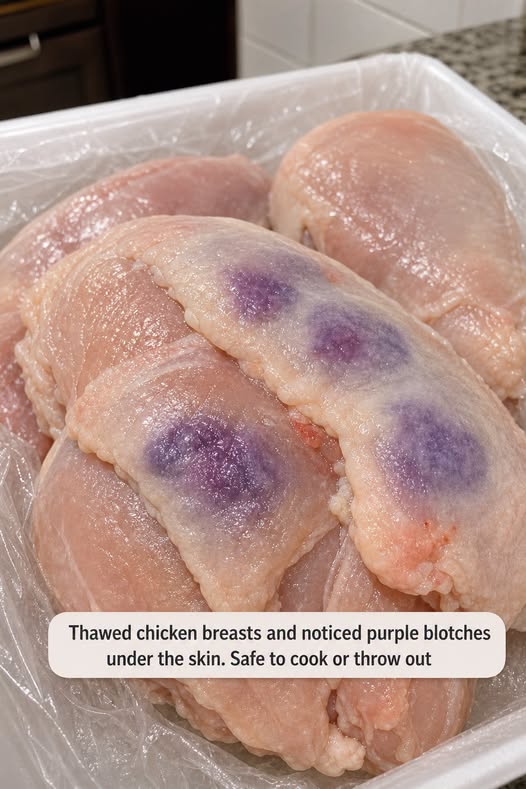
The panic hits fast. You peel open the package of chicken, expecting to see the familiar pale pink meat—and instead, dark purple patches seem to bloom beneath the skin. They look almost like bruises, strange stains, or signs that something has gone terribly wrong. Suddenly, a meal that seemed completely ordinary feels questionable. Is the chicken secretly rotten? Has it spoiled without an obvious smell? Could eating it put your entire family at risk?
The answer is usually far less frightening than the color suggests.
Those unexpected purple or reddish patches found on thawed chicken can look disturbing, but in many cases they are the result of natural pigments moving through the meat during freezing and thawing. Myoglobin, the protein responsible for much of meat’s color, can shift and become more visible under certain conditions. Bone marrow pigments can also contribute, particularly in younger chickens whose bones are relatively porous.
Freezing can make this effect more noticeable. As chicken freezes, ice crystals form inside its tissues and can damage some of the surrounding cells. When the meat eventually thaws, small amounts of myoglobin and pigments from the bone marrow may seep into nearby tissue. The result can be a purple, reddish, or darker area that looks dramatically different from the rest of the meat.
To your eyes, it can resemble a bruise.
But appearance alone does not necessarily mean the chicken is spoiled.
This is one of those situations where color can trigger an immediate emotional reaction, even though it does not tell the entire story. Chicken can naturally show variations in color depending on the bird, the cut, how it was processed, and whether it has been frozen and thawed. A purple patch by itself is not enough to determine that the meat is unsafe.
What matters much more is the overall condition of the chicken.
Start with the smell. Fresh chicken should generally have a mild or neutral smell. If opening the package releases a distinctly sour, rotten, or otherwise unpleasant odor that seems abnormal, that is a much stronger warning sign than an isolated purple patch.
Then consider the texture. Chicken should feel moist, but it should not feel unusually slimy, sticky, or coated with a strange film. A slippery or slimy texture, especially when combined with an unpleasant odor or other signs of spoilage, is a reason to discard the meat rather than trying to rescue it through cooking.
The overall color matters as well. While purple or reddish areas can sometimes be explained by pigments and thawing, unusual green or gray discoloration can be more concerning, particularly when it appears alongside bad odors or changes in texture.
Storage history is another major piece of the puzzle.
Think about how the chicken was handled before it reached your kitchen and what happened after you brought it home. Has it been kept properly refrigerated or frozen? Was it left sitting at room temperature for an extended period? Was it thawed safely in the refrigerator or in cold water? These details matter because harmful bacteria can multiply when poultry is held at unsafe temperatures, even when the meat does not look dramatically different.
Safe thawing is especially important. Thawing chicken in the refrigerator is one of the simplest options because the meat remains at a controlled, cold temperature throughout the process. If using cold water, the water should be kept cold and the chicken handled promptly afterward. Leaving raw poultry on the counter to slowly thaw is not a safe shortcut.
And then comes the final line of defense: proper cooking.
If the chicken has been stored and handled safely and does not show other signs of spoilage, cooking it thoroughly is essential. Poultry should reach an internal temperature of **165°F (74°C)**, measured with a food thermometer in the thickest part of the meat. That temperature is far more useful for judging cooking safety than simply cutting into the chicken and looking at its color.
This is important because chicken can sometimes remain slightly pink or show unusual coloration even when it has reached a safe internal temperature. Conversely, meat can look perfectly normal while still carrying harmful bacteria if it has been improperly handled. Color alone simply cannot provide that level of certainty.
That is why the thermometer is such a valuable tool in the kitchen. Instead of guessing based on appearance, you can measure the temperature directly and know whether the chicken has reached the recommended level for safe cooking.
Still, cooking should not be viewed as a way to save meat that has clearly spoiled. If chicken has an unmistakably foul smell, a slimy texture, or other strong signs of spoilage, it is better to throw it away. Proper cooking can destroy many harmful bacteria, but it does not turn spoiled food back into fresh food.
The biggest lesson is that the shocking purple color is often not the villain it first appears to be. A strange-looking patch can come from natural pigments, bone marrow, freezing, thawing, and the structure of the meat itself. What looks alarming may simply be a visual effect created by the way the chicken was processed and stored.
So the next time you open a package and see a dark purple area staring back at you, resist the urge to judge the entire piece of chicken by color alone. Pause. Check the smell. Examine the texture. Think about how it was stored and thawed. Then use a thermometer to make sure it reaches **165°F (74°C)** during cooking.
Your eyes may be shocked by the color, but they are not the best judge of food safety.
When it comes to chicken, your senses, your storage habits, and a reliable food thermometer are much better guides than color shock ever will be.