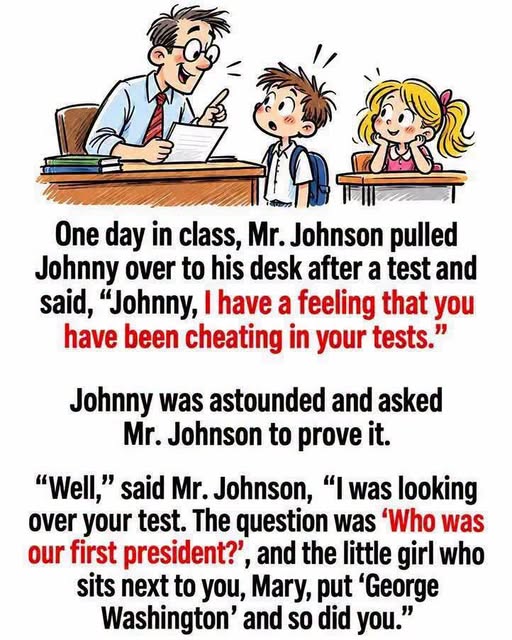
Johnny thought he could talk his way out of almost anything. He was quick with excuses, confident in his answers, and rarely admitted defeat when someone challenged him. But one day, after a history test, his teacher decided to take a closer look at Johnny’s paper. What began as a simple suspicion of cheating quickly turned into a classroom moment Johnny would probably never forget.
Mr. Johnson had noticed something unusual while grading the tests. Johnny and Mary, the student sitting beside him, had submitted answers that matched a little too closely. At first, the teacher wanted to give Johnny an opportunity to explain himself. So, after the test, he called him over to his desk.
Johnny approached without much concern. When Mr. Johnson told him that he suspected him of cheating, Johnny immediately looked offended.
“Cheating? What makes you think I cheated?” he demanded. “If you’re going to accuse me, you need to show me some proof!”
Mr. Johnson calmly picked up the two test papers and began pointing out the similarities.
He started with the first question. Both students had been asked to identify the first president of the United States. Mary had written George Washington, and Johnny had written exactly the same answer.
Johnny barely reacted.
“Well, of course I wrote George Washington,” he explained. “Everybody knows he was the first president. That’s not cheating. That’s just knowing history!”
Mr. Johnson listened without interrupting. He then moved to the next question, which asked who was responsible for freeing the slaves.
Once again, Mary had written Abraham Lincoln. Johnny’s answer was identical.
The teacher raised his eyebrows and waited for an explanation.
Johnny, however, was ready with another defense.
“That’s another easy one,” he said confidently. “I studied my history book last night. I knew that answer before I even walked into the classroom.”
Mr. Johnson looked at him for a moment. The matching answers were certainly suspicious, but Johnny seemed determined to explain every similarity away. He insisted that knowing the same historical facts as another student did not make him a cheater.
The teacher decided to move on to the final piece of evidence.
He turned to a question about the Louisiana Purchase. The students had been asked to identify the president of the United States at the time of that historic acquisition.
Mr. Johnson pointed to Mary’s paper.
Unlike the previous questions, Mary had not provided a historical name. Instead, she had written a simple response:
“I don’t know.”
Johnny watched as his teacher moved his finger to the corresponding answer on Johnny’s test.
There, directly beneath the same question, Johnny had written:
“Me neither.”
For a moment, there was nothing left to explain.
The first two answers might have been defended as common knowledge. George Washington was indeed the first president, and Abraham Lincoln was associated with the end of slavery in the United States. But the final answer revealed something much more difficult to dismiss.
Johnny had apparently copied not only Mary’s correct answers but also her uncertainty.
His attempt to prove that he had worked independently had fallen apart because he had repeated the one response that no amount of historical knowledge could explain away.
Mr. Johnson finally had the evidence he needed, and Johnny’s confident argument had reached an unexpected ending.
The lesson was simple: sometimes, trying too hard to defend yourself only makes the truth more obvious. Johnny had walked into the conversation believing he could explain his way out of trouble. Instead, one tiny phrase on his test paper delivered the answer his teacher had been looking for all along.
And perhaps the funniest part was that Johnny could have avoided the entire situation by simply admitting he didn’t know the answer in the first place.