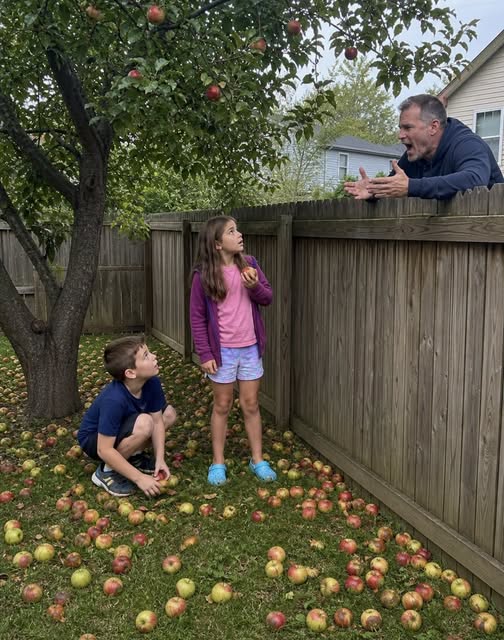
He called my children thieves, and the word shattered our quiet Sunday like breaking glass. One moment, they were giggling beneath the old apple tree, chasing each other through fallen leaves and collecting the bruised fruit that had dropped into our yard. The next, they were clutching those apples like evidence in a trial they had never agreed to attend. My daughter’s chin trembled. My son looked up at me and whispered, “Are we in trouble?” in our own backyard. I watched a grown man turn gravity into a weapon, our fence into a witness stand, and my kids into defendants in a case they didn’t even understand.
The man was Dale, our neighbor.
He had lived next door for years, and the apple tree had stood along the property line for longer than some of us had been alive. Its branches stretched over the fence, dropping fruit into both yards every autumn. It had never been a major problem before. We had always picked up what fell on our side, and Dale usually did the same on his.
But that Sunday was different.
The apples had been falling heavily for days. Some were perfect, others were bruised from the impact, and several had rolled beneath the fence into our yard. My children had gathered a few and were laughing about which ones looked the funniest.
Then Dale appeared.
He pointed toward the apples in my children’s hands and accused them of stealing from his tree.
The laughter stopped immediately.
My daughter tried to explain that the apples had fallen into our yard. My son looked at the ground, suddenly afraid to touch anything. But Dale wasn’t interested in hearing them. He spoke as though the matter had already been decided.
“They’re thieves,” he said.
That word stayed in the air long after he walked away.
My children had never been called criminals before. They didn’t understand why a piece of fruit could suddenly make them feel guilty. To them, the apples weren’t valuable possessions. They were just apples.
But Dale had turned them into evidence.
That evening, my daughter asked whether she was supposed to apologize.
I told her she hadn’t done anything wrong.
But I could see the confusion in her eyes.
How do you explain property lines and falling fruit to a child who is only trying to play in their own backyard?
I wanted to make the situation disappear. Part of me thought about simply collecting every apple and leaving them on Dale’s doorstep. Maybe we could avoid an argument. Maybe we could keep the peace.
But then I remembered the look on my son’s face.
He had asked me whether he was in trouble.
And I realized this wasn’t only about apples anymore.
It was about what my children would learn from the way I responded.
Would they learn that the loudest adult automatically wins?
Would they learn that accusations should be accepted simply because they come from someone older?
Or would they learn that boundaries matter, even when enforcing them makes life uncomfortable?
I didn’t choose a legal fight to be dramatic.
I chose it because my children needed to see that what happened to them mattered.
Rob, my partner, understood that immediately. He refused to rush outside and rake up every apple that had fallen into our yard simply to make the situation easier for Dale.
Some people saw that as petty.
It wasn’t.
It was a pause.
A way of saying: we will not immediately clean up the consequences of someone else’s behavior just because we’re uncomfortable with conflict.
The apples remained where they had fallen.
Day after day, more accumulated.
Some began to rot.
Others attracted insects.
The smell became unpleasant, and the sight of them made the whole situation impossible to ignore.
But as the apples decayed, so did the illusion that Dale’s age or history with the tree entitled him to our quiet compliance.
He had spent years treating the boundary between our properties as something flexible when it suited him. Now, suddenly, that same boundary had become the most important thing in the neighborhood.
Dale began talking about the tree as though ownership of the trunk meant ownership of every apple, regardless of where gravity carried them.
We began documenting everything.
Photographs.
Dates.
Conversations.
The position of the branches.
Where the fruit landed.
What had been said to the children.
It felt absurd to be collecting evidence over apples, but the accusations had already changed the situation.
Then the law stepped in.
It didn’t magically solve everything.
There were still arguments, uncomfortable conversations, and questions about responsibility. Property lines and the behavior of the tree had to be considered carefully. But for the first time, the discussion moved away from emotion and toward facts.
“Gravity fruit” and property lines became tools, not weapons.
The situation could finally be examined without turning my children into the center of the dispute.
Dale eventually had to confront what his accusations had done.
His apology didn’t erase the fear he had caused my children.
It didn’t erase the Sunday when my daughter stood there clutching a bruised apple as though it were evidence against her.
It didn’t erase my son’s whispered question.
But the apology mattered.
Because it showed our children something vital.
Adults can be wrong.
Adults can say things they shouldn’t.
And adults can take responsibility and try to make things right.
That lesson was more important than the apples themselves.
The tree never stopped producing fruit.
Autumn came again.
The branches stretched over the fence.
The apples continued falling.
But something had changed.
My children no longer looked at every apple as though it were a potential crime.
They understood that they could enjoy their own backyard without being afraid of someone else’s accusations.
They also learned that boundaries aren’t cruelty.
Saying “this is where my responsibility ends” doesn’t make you a bad neighbor.
And refusing to accept unfair treatment doesn’t make you unkind.
There is a difference between kindness and surrender.
Real kindness can exist alongside accountability.
In the end, the apples were never the real problem.
The problem was the belief that keeping the peace required the smaller, quieter person to carry all the discomfort.
We refused to teach our children that lesson.
The apples never stopped falling.
What changed was who carried the shame.
And somewhere between the bruised fruit, the property line, the uncomfortable conversations, and the apology, my children learned something I hope they never forget:
You can be kind without becoming small.
You can forgive without pretending nothing happened.
And sometimes, protecting your peace begins by refusing to carry someone else’s blame.