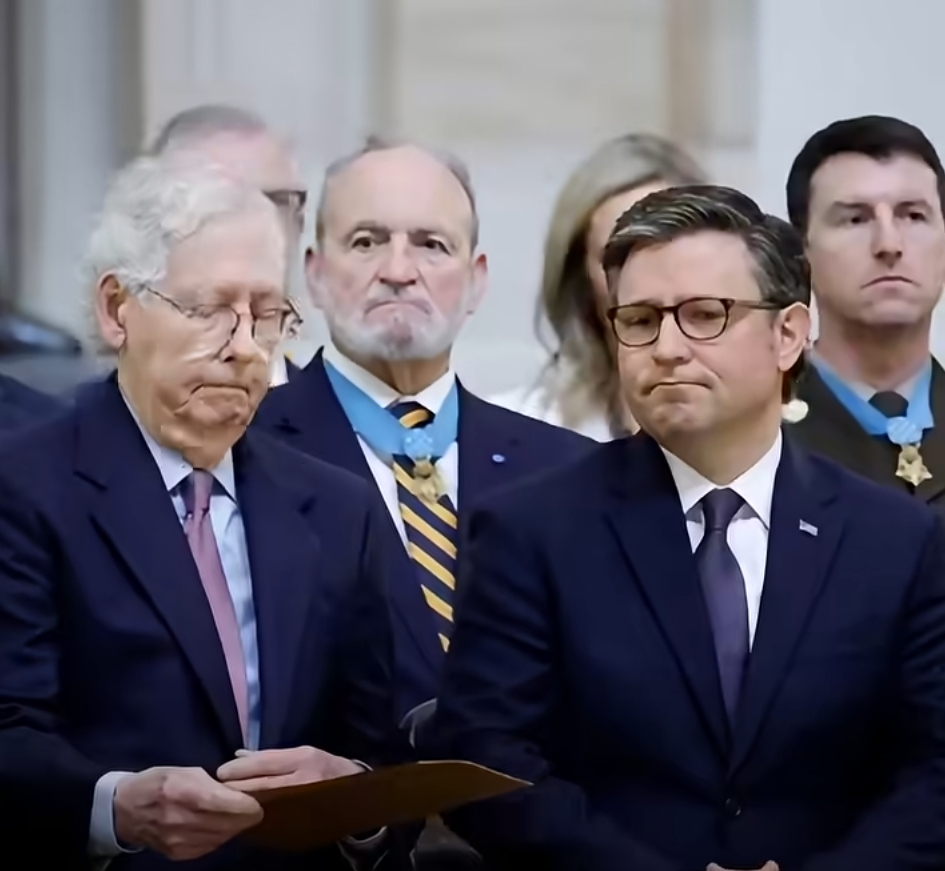
The clash is brutal.
A defiant president. A furious pope. Political leaders invoking God while warships move across strategic waters and military tensions threaten to reshape an already unstable region. What began as a geopolitical crisis has evolved into something even more explosive: a battle over morality itself. The language of politics has merged with the language of faith, turning military decisions into spiritual arguments and transforming ancient religious teachings into weapons in a modern debate.
Words like “justice,” “peace,” “terrorism,” and “just war” suddenly carry enormous weight. They are no longer abstract concepts discussed in classrooms or churches. They now sit at the center of decisions involving missiles, military deployments, economic consequences, and human lives. As American naval forces tighten pressure around key maritime routes and political rhetoric intensifies across television screens and social media platforms, a deeper question continues to emerge.
Can faith justify war?
Or should faith exist to prevent it?
That question now divides not only governments but also congregations, religious leaders, political parties, and ordinary citizens struggling to reconcile national security with moral conviction.
Republican leaders have moved quickly to defend President Trump’s actions regarding Iran, presenting the campaign not merely as a strategic necessity but as a moral obligation. Their argument extends beyond military calculations and enters the realm of ethics, portraying the operation as a reluctant but necessary response to a dangerous adversary.
Among the strongest defenders is Senate Republican leader Mitch McConnell, who describes the Iranian regime as a force responsible for years of violence, instability, and bloodshed throughout the Middle East. In his view, recent actions have weakened a long-standing threat and potentially prevented future attacks. Supporters of the operation argue that allowing such threats to grow unchecked would create even greater suffering in the future.
For them, military action is not presented as an act of conquest.
It is presented as an act of prevention.
House Speaker Mike Johnson has gone even further by invoking centuries of Christian teaching regarding the concept of a “just war.” Drawing from theological traditions developed by figures such as Saint Augustine and Saint Thomas Aquinas, Johnson argues that military force can sometimes be morally justified when used to protect innocent lives from grave danger.
According to this interpretation, force is not inherently evil. Under specific circumstances, it can serve as an instrument of mercy by preventing larger atrocities. Johnson has suggested that confronting terrorist threats and hostile regimes may ultimately save countless innocent people who would otherwise suffer the consequences of inaction.
In this framework, military intervention becomes an unfortunate necessity rather than an act of aggression.
Supporters describe it as reluctant justice.
A burden assumed not because leaders desire conflict, but because they believe avoiding conflict altogether could produce even greater devastation.
Yet not everyone accepts that reasoning.
Standing firmly on the opposite side of the debate is Pope Leo XIV.
While political leaders focus on strategy, deterrence, and national security, the pope has chosen to emphasize the spiritual cost of war itself. His statements have challenged the moral foundation upon which many supporters of the campaign rely.
When he warned that Christ “does not listen to the prayers of those who wage war,” the message resonated far beyond the walls of the Vatican. To supporters of military action, the statement appeared to question the legitimacy of their moral arguments. To critics of the conflict, it served as a powerful reminder that religious faith has often been used not only to justify war but also to oppose it.
The pope’s position reflects a long tradition within Christianity that places extraordinary emphasis on peace, reconciliation, and the sanctity of human life. While acknowledging the realities of violence and conflict in the modern world, he has repeatedly cautioned against allowing military solutions to become the first response to international disputes.
For many believers, his words force a difficult examination of conscience.
Can a nation claim moral righteousness while launching attacks?
Can military force truly coexist with the teachings of Christ?
Or does every act of war inevitably carry a spiritual cost that cannot be ignored?
These questions have become increasingly difficult to avoid as the conflict escalates.
President Trump has responded forcefully to criticism, using public statements and social media posts to defend both the military campaign and those supporting it. His supporters argue that strong leadership requires difficult decisions and that critics underestimate the dangers posed by hostile governments and terrorist organizations.
Meanwhile, military developments continue to intensify international concern.
Reports of increased naval operations and heightened tensions in critical shipping lanes have amplified fears that the conflict could expand beyond its current scope. Global markets, diplomatic partners, and regional governments are closely monitoring every move, aware that even a small miscalculation could trigger far-reaching consequences.
As these developments unfold, the disagreement between political leaders and religious authorities grows sharper.
What began as a debate over foreign policy has transformed into a larger struggle over how faith should influence power.
One side argues that moral responsibility sometimes requires force.
The other warns that force itself may represent a failure of moral responsibility.
Neither position lacks conviction.
Neither side believes it is acting without principle.
And that reality makes the conflict even more profound.
This is no longer merely a confrontation between nations.
It is a confrontation between competing visions of justice, duty, and faith. It asks whether religious belief should provide moral support for military action when leaders believe innocent lives are at risk, or whether faith should remain a constant voice of restraint, warning against the human tendency to solve problems through violence.
The debate reaches beyond Washington, Tehran, and the Vatican.
It echoes through churches, classrooms, military bases, and family dinner tables. It challenges believers of every background to consider where they stand when national interests collide with spiritual convictions.
In the end, the missiles, ships, and political speeches may shape the outcome of the geopolitical conflict.
But another question may endure long after the headlines disappear.
Should faith bless the weapons of war when leaders claim they are necessary, or should it stand firmly in their path, reminding the world that every conflict carries a cost measured not only in lives, but also in conscience?
That question now sits at the heart of one of the most consequential debates of our time.