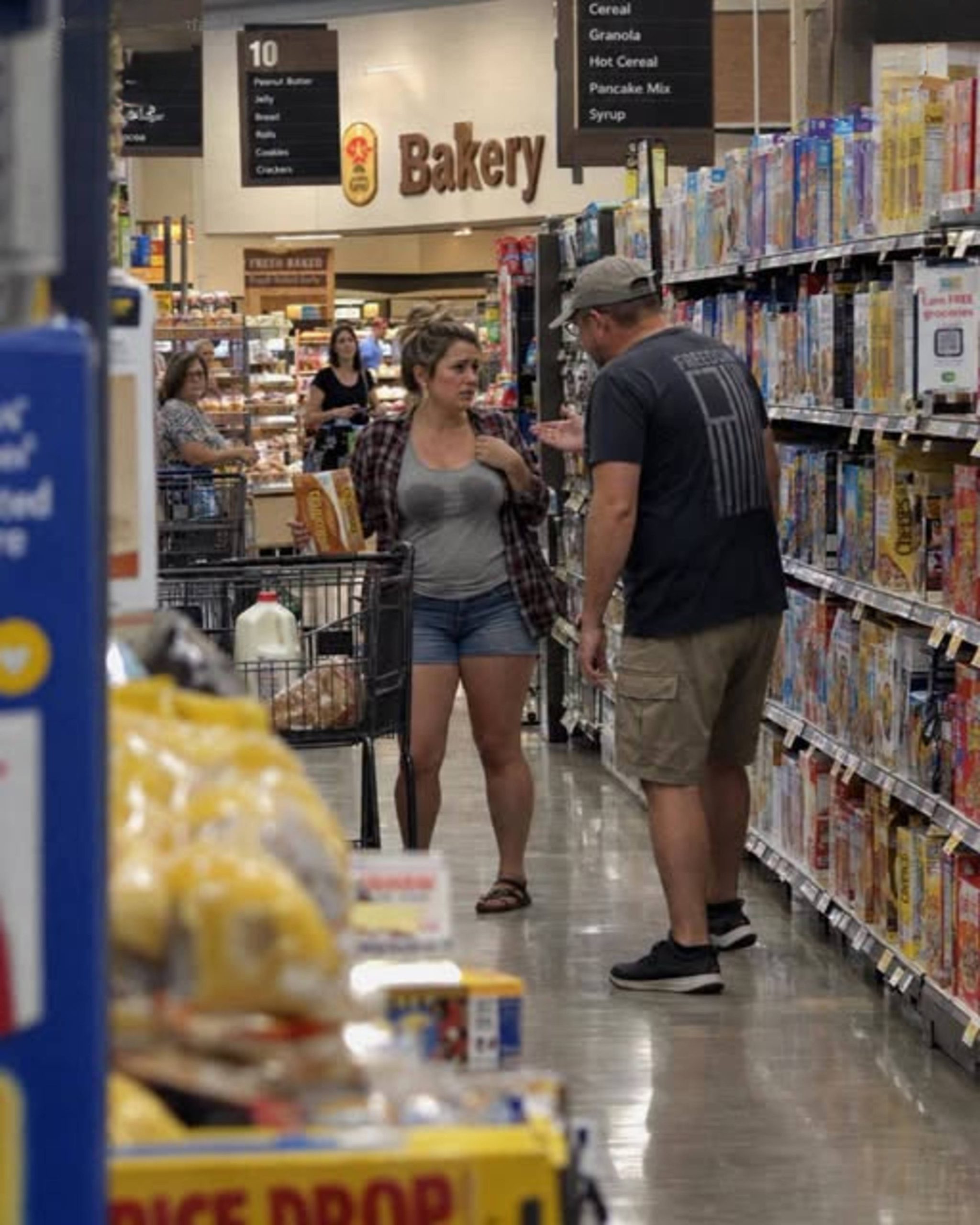
Christy apologized three times to a man who had publicly humiliated her before she even understood what she had done wrong. By the time her best friend Maria reached the aisle, several people were already watching, and Maria had no intention of letting the moment end quietly.
My milk let down in the cereal aisle, and I didn’t feel it happen.
I was six weeks postpartum, and it was the first time I’d left the house alone since the hospital.
My husband, Dan, had my daughter, Nora, sleeping on his chest when I left.
He’d looked at me over her tiny head and said, “Take your time, Christy. Seriously. Don’t rush back.”
Then I was out the door in under four minutes.
I wore denim shorts, a gray tank top, and an old flannel I’d left open.
I’d showered.
I’d put my hair up.
I even remembered deodorant.
At six weeks postpartum, that felt like winning an award.
I had barely made it through the automatic doors before I realized how strange it felt to be alone.
No diaper bag.
No stroller.
No crying.
No one needing me every thirty seconds.
Just me.
I almost laughed at how excited I was to be buying groceries.
Bread.
Milk.
Cereal.
It felt like a vacation.
Maria had been trying to see me since Nora was born, but I’d canceled on her four times.
Her first text that morning said:
*Please tell me you’re actually coming this time.*
I smiled.
*I’m coming.*
Five minutes later, she sent:
*Five minutes, I swear.*
I put my phone away and kept shopping.
I had bread and a gallon of milk in my cart when I stopped in the cereal aisle.
My brain had decided saving 37 cents was the most important task in the world.
I stood there comparing two nearly identical boxes when a strange warmth spread across my chest.
I didn’t notice at first.
Then the man came down the aisle.
He looked to be in his sixties.
Navy polo.
Khaki shorts.
Gray stubble.
He slowed when he saw me.
“Oh, my God.”
I looked around because I thought he’d dropped something.
Then he said, loudly, “Cover yourself. Nobody needs to see that.”
I froze.
Someone near the bakery turned around.
“What?”
The man pointed toward my shirt.
“That’s disgusting.”
I looked down.
That’s when I saw it.
A small wet spot had appeared on the front of my gray tank top.
My stomach dropped.
I immediately crossed my arms over my chest.
“Oh my God.”
The man shook his head.
“Some people have no shame.”
“I’m sorry,” I whispered.
I didn’t even know why I was apologizing.
But I’d been apologizing for everything for six weeks.
Sorry for crying.
Sorry for needing help.
Sorry for waking the baby.
Sorry for not answering texts.
Sorry for taking too long in the shower.
Sorry for being tired.
Sorry for not looking like myself.
So when he stared at me like I’d committed some terrible offense, “I’m sorry” came automatically.
The man didn’t soften.
“Then go home and change.”
“I—I didn’t realize…”
“That doesn’t make it better.”
I could feel people looking at me.
My face burned.
I pulled my flannel closed and held it together with one hand.
“I’m sorry,” I said again.
The man gave a disgusted sigh.
“Young women today have no modesty.”
I stared at the floor.
“I’m really sorry.”
That was the third apology.
And then I heard a voice behind me.
“Why exactly is she apologizing to you?”
Maria.
I turned.
She stood at the end of the aisle holding her purse, her expression completely different from the cheerful woman who had been texting me five minutes earlier.
The man looked at her.
“This doesn’t concern you.”
Maria walked closer.
“Oh, I think it does.”
“She’s walking around a grocery store exposing herself.”
Maria glanced at my shirt.
Then at him.
Then back at me.
Her face changed.
She understood immediately.
“Oh, Christy.”
I felt tears fill my eyes.
“I didn’t know.”
Maria stepped beside me.
“You don’t have to explain anything.”
The man scoffed.
“It’s not appropriate.”
Maria stared at him.
“She’s breastfeeding.”
The man shrugged.
“That doesn’t mean she has to make everyone else look at it.”
“She didn’t make you look at anything.”
Maria’s voice had become dangerously calm.
“She didn’t even know it happened.”
The man folded his arms.
“Well, she should have been paying attention.”
Maria looked around the aisle.
“Did anyone here see Christy deliberately expose herself?”
Nobody answered.
A woman near the bakery shook her head.
“No.”
An older man pushing a cart said, “I didn’t see anything until he started yelling.”
Maria looked back at the man.
“Interesting.”
He shifted uncomfortably.
Maria wasn’t finished.
“My friend is six weeks postpartum. She’s exhausted. She’s been inside her house for weeks taking care of a newborn. She finally leaves for twenty minutes, and you decide to publicly shame her because her body did something completely natural?”
“I was just telling her—”
“No.”
Maria held up a hand.
“You were humiliating her.”
The man looked irritated.
“I’m entitled to my opinion.”
“Absolutely.”
Maria nodded.
“You’re entitled to your opinion. You’re not entitled to make a stranger feel ashamed because you don’t understand what you’re looking at.”
The man glanced around.
Several people were watching now.
His confidence seemed to shrink.
Maria turned toward me.
“Christy, look at me.”
I did.
“You have nothing to apologize for.”
I wiped my cheek.
“But I—”
“No.”
She gently pulled my flannel closed around me.
“You had a baby six weeks ago.”
I nodded.
“You’re feeding her?”
“Yes.”
“Then your body is doing exactly what it’s supposed to do.”
The man muttered something under his breath.
Maria turned.
“What was that?”
“Nothing.”
“No. Say it.”
He shook his head.
“I said she should have been more careful.”
Maria stared at him for several seconds.
Then she said something that made the entire aisle go silent.
“Sir, do you know why women like her apologize so quickly?”
He didn’t answer.
“Because we’ve been taught to apologize whenever someone makes us uncomfortable.”
She pointed gently toward me.
“She didn’t hurt you. She didn’t insult you. She didn’t expose herself intentionally. But you made her feel like she’d done something wrong, and within thirty seconds she apologized three times.”
The man’s face changed.
Not much.
But enough.
Maria continued.
“That should bother you more than a little milk stain ever could.”
The older woman near the bakery nodded.
“She’s right.”
Another customer quietly said, “Very right.”
The man looked around and realized the aisle wasn’t on his side.
He grabbed his cart.
“This is ridiculous.”
Maria stepped aside.
“You’re right about one thing.”
He stopped.
“This shouldn’t have happened.”
Then she looked at me.
“You should have been able to buy cereal without being humiliated.”
The man walked away.
I stood there holding my flannel closed, crying quietly.
Maria wrapped an arm around my shoulders.
“Come on.”
“I didn’t even get the milk.”
Maria looked at the cart.
“Forget the milk.”
“But Dan needs—”
“Dan can survive without milk.”
That made me laugh through my tears.
We walked toward the checkout.
Halfway there, Maria stopped.
“Wait.”
“What?”
She looked at me seriously.
“You apologized three times.”
I looked down.
“I know.”
“Promise me something.”
“What?”
“Next time someone makes you feel ashamed for something your body is doing, don’t apologize before you even ask yourself whether you did anything wrong.”
I swallowed.
“I’ll try.”
Maria smiled.
“No. Try isn’t enough.”
She squeezed my hand.
“Practice.”
And for the first time since Nora was born, I realized something.
I hadn’t been struggling because I was failing at motherhood.
I was struggling because I was still learning how to recognize myself again.
That night, when I told Dan what happened, he listened without interrupting.
Then he looked at me and said, “You apologized?”
I nodded.
He reached across the couch and took my hand.
“Christy, you never have to apologize for feeding our daughter.”
I started crying again.
He pulled me closer.
And somewhere between his arms and the soft sounds of Nora sleeping in the next room, I finally understood what Maria had been trying to teach me.
My body wasn’t something I needed to hide.
It wasn’t something I needed to be ashamed of.
And I certainly didn’t owe an apology to a stranger who had decided that my most vulnerable moment was something he had the right to judge.