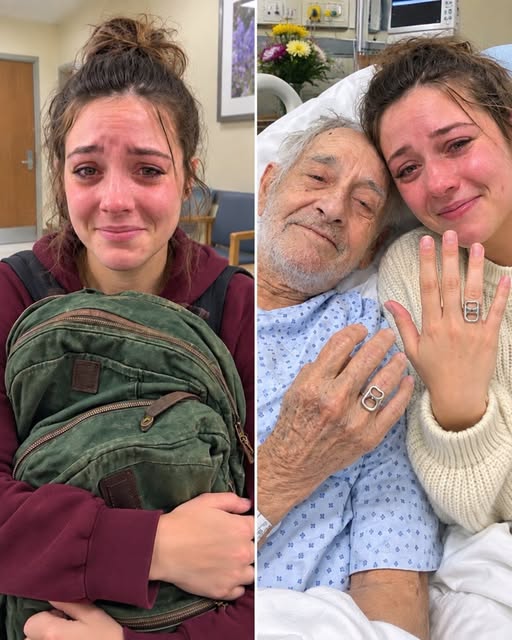
He was supposed to die and disappear.
No loose ends.
No inheritance.
No miracle cure.
Just a quiet funeral for a man I had barely learned to love.
Instead, a lawyer slid an old green backpack into my lap and told me Thomas wasn’t who I thought he was.
I remember staring at it without touching it.
It looked ordinary.
Faded fabric. A broken zipper. A small stain near one of the straps.
Nothing about it suggested that it contained anything capable of changing my understanding of a person I had spent years believing I barely knew.
There was no money inside.
No secret bank account.
No dramatic confession.
No letter explaining why Thomas had kept so much of himself hidden.
There were only envelopes.
Dozens of them.
Each marked with the name of a place you might forget as soon as you leave it.
**Bus Stop.**
**Laundromat.**
**Waiting Room.**
**Grocery Store.**
**Hospital Corridor.**
I opened the first envelope expecting an explanation.
Instead, I found a tiny object and a short sentence.
A receipt.
A button.
A visitor sticker.
A folded piece of paper with only a few words written across it.
“She finally went.”
I didn’t understand.
The next envelope was just as strange.
Then another.
Then another.
One contained a visitor sticker with my name on it.
And the exact date I had almost given up.
I stared at it for a long time.
“How did he know?”
The lawyer didn’t answer immediately.
He simply looked at me.
“I think,” he said quietly, “Thomas wanted you to discover that for yourself.”
At first, the backpack felt like a riddle I didn’t deserve to solve.
I was grieving.
I didn’t want riddles.
I wanted Thomas back.
I wanted the years I had lost with him returned.
I wanted an explanation for all the things he hadn’t said while he was alive.
Instead, I had a backpack full of objects that seemed meaningless.
Until I found the notebook.
That changed everything.
The notebook didn’t turn Thomas into the tragic hero I expected to find.
It did something stranger.
It turned the world into one.
Page after page, he had written about ordinary people.
People standing at the edges of themselves.
People who looked exhausted.
Lost.
Lonely.
Afraid.
People whose lives were apparently insignificant to everyone around them.
But Thomas had noticed them.
He had watched.
And when something small happened—a decision, a gesture, a moment of courage—he recorded it.
No speeches.
No dramatic revelations.
No grand declarations about the meaning of life.
Just moments.
A father choosing to walk into a delivery room even though he was terrified.
A lonely woman standing in a grocery store aisle, hesitating before finally putting a container of soup into her cart.
A boy sitting at a bus stop for nearly an hour before finally climbing aboard the bus that would take him home.
A tired nurse buying coffee at midnight.
An elderly man watering flowers outside a building where nobody seemed to notice them.
Thomas had seen all of it.
And he had considered those moments worth remembering.
One entry described a woman crying quietly in a hospital waiting room.
He didn’t know her name.
He didn’t know why she was crying.
He simply wrote that, after several minutes, another woman sat beside her without saying anything.
Then he wrote:
**Sometimes staying is the whole thing.**
I closed the notebook.
I cried.
Not because Thomas had finally explained himself.
But because he hadn’t.
He had spent his life noticing what most people walked past.
And suddenly I understood something about the way he had loved me.
He had never been good at grand gestures.
He didn’t know how to make grief disappear.
He didn’t give me perfect advice.
He didn’t promise that everything happened for a reason.
Maybe because he knew better.
Maybe he understood that some things don’t have reasons that make them easier to accept.
The lawyer eventually gave me one final envelope.
Inside was a list.
No instructions.
No clues.
Just places.
Gardens.
Markets.
Bus stations.
Libraries.
A pond where ducks gathered.
At the bottom, Thomas had written:
**Go when you can.**
That was it.
I laughed through my tears.
Even dead, he couldn’t resist being cryptic.
But by then, I finally understood.
The list wasn’t a scavenger hunt.
It wasn’t a final puzzle.
It wasn’t a secret message leading to some enormous revelation about our family.
It was permission.
Permission to stop waiting for one enormous moment to make my life meaningful.
Permission to understand that grief doesn’t always need to be solved.
Permission to go outside again.
To notice things.
To sit somewhere without needing a reason.
To let an ordinary day be enough.
Thomas had spent his final years collecting evidence that life continued in small, stubborn ways.
A person got on the bus.
Someone bought soup.
A father showed up.
A stranger sat beside another stranger.
Someone watered flowers.
Someone stayed.
And perhaps that was what he had been trying to teach me without ever actually teaching me.
Life isn’t always waiting for a miracle.
Sometimes it’s waiting for Tuesday.
A completely ordinary Tuesday when you get out of bed even though you don’t feel ready.
You make coffee.
You answer the phone.
You walk through a garden.
You buy something you don’t really need.
You notice the ducks.
You breathe.
And somehow, without realizing it, you have stayed.
The next time I met with Thomas’s attorney, I didn’t ask what Thomas had been hiding.
I asked why he had chosen me.
The attorney smiled sadly.
“I don’t think he thought you needed to know everything,” he said. “I think he thought you needed to know that you mattered.”
That sentence stayed with me.
Because for years, I had thought Thomas’s greatest failure was leaving without giving me enough answers.
Now I wondered if I had misunderstood him completely.
Maybe he knew answers wouldn’t save me.
Maybe he knew there would come a day when I would stop searching for some grand explanation and start living again.
The backpack didn’t contain a fortune.
It didn’t contain a confession.
It didn’t even contain the version of Thomas I had wanted.
It contained something quieter.
Proof that he had been watching.
Proof that he had cared.
Proof that even when I thought nobody noticed what I was going through, someone had.
And that was enough.
Not to erase the grief.
Not to make his death fair.
Not to turn the past into something beautiful.
Just enough to take one more step.
So I carried the green backpack home.
And the following Tuesday, I went to the garden.
I sat on a bench.
I watched people pass.
For the first time in months, I didn’t feel like I had to understand what came next.
I just sat there.
I breathed.
And when an old woman took the empty seat beside me, neither of us said anything.
We didn’t need to.
Thomas had taught me that sometimes the most important thing another person can give you isn’t an answer.
It’s company.
Someone willing to sit beside you while you figure out how to keep going.
And maybe that was the real thing Thomas left behind.
Not a fortune.
Not a secret.
Not a miracle.
Just permission to find a life again in the small, stubborn Tuesdays.
To show up.
To breathe.
And, when possible, to let someone stand beside you—so neither of you has to carry the words you never managed to say alone.