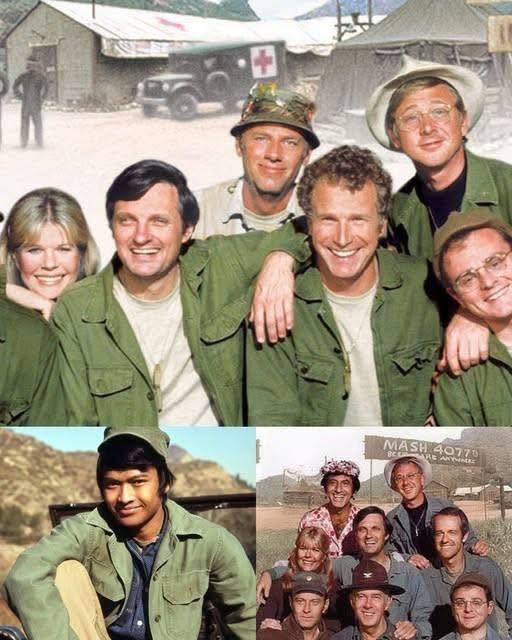
Fame never saved him. If anything, it only made the silence louder—sharper, more echoing, more impossible to ignore. Patrick Adiarte survived things that should have broken a person long before the world ever had a chance to applaud him. He lived through war, endured displacement, crossed an ocean not just in distance but in identity, and somehow found his way into the glow of American television screens. For a time, he became a familiar face—one that people recognized without quite knowing why, one that slipped easily into living rooms and stayed there, quietly present. And yet, as the years passed, that presence faded into something softer, almost invisible. He became what so many artists before him have become: remembered in fragments, recognized without being named, felt without being fully seen. Now, at 82, he is gone, and the world does not erupt in mourning—it barely whispers.
He moved through history in a way that feels almost surreal, like someone existing just slightly out of focus. A Filipino boy shaped by the violence and uncertainty of war, carrying with him experiences that could never fully be translated into words, he stepped into an America that was not built to receive him. The stages he walked onto were not designed with him in mind; the roles he was offered were often narrow, limited, or shaped by expectations he did not choose. And still, he stood there—steady, composed, unblinking. He didn’t storm the gates or demand attention in the ways people often celebrate. Instead, he occupied space with a quiet insistence, a presence that said, simply and powerfully: I am here, and I belong.
There was something quietly radical about that. In an era that often preferred to overlook, to simplify, or to erase people like him, Patrick Adiarte existed without apology. His performances carried a subtle resistance—not loud, not confrontational, but undeniable. Every moment he appeared on screen was a small shift in what audiences were allowed to see, a widening of a space that had long been too narrow. He didn’t just act; he made visibility possible in ways that many may not have recognized at the time, but that mattered deeply nonetheless.
And yet, as with so many careers shaped by forces beyond talent or effort, the roles began to fade. The opportunities grew fewer, the spotlight dimmer. For some, that kind of fading becomes a desperate chase—a need to reclaim what was lost, to hold onto recognition at any cost. But he did something different. He stepped away from the noise, away from the fragile, unpredictable nature of fame, and turned inward instead.
In studios far removed from the bright glare of cameras, he found a different kind of stage. One lined with mirrors that reflected not performance, but truth. There, as a teacher, he offered something far more lasting than applause. He gave discipline, attention, and care—the kind of guidance that shapes not just how someone moves, but how they understand themselves within that movement. He created a space where effort mattered, where growth was seen, where individuals were treated as worthy of time and belief.
Hollywood may never have fully given him what he deserved—may never have recognized the full depth of what he brought—but in those quieter rooms, he built something that did not depend on recognition to exist. His students, many of whom may not fully grasp the weight of his journey, carry pieces of his legacy in ways they may only understand years later. In every movement they refine, in every moment of confidence they discover, there is an echo of his patience, his resilience, his quiet strength.
It is a strange and often unjust truth that names can fade even when impact does not. Patrick Adiarte may not be spoken as loudly as others, may not dominate headlines or dominate memory in obvious ways, but what he contributed did not disappear with him. It lives on in subtler places—in the doors that are now slightly easier to open, in the presence of those who follow paths he helped make possible, in the quiet understanding that simply standing your ground can, in itself, be an act of change.
And so, while the world may only whisper at his passing, that whisper carries more weight than it seems. Because some lives are not defined by how loudly they are remembered, but by how deeply they continue to shape what comes after.