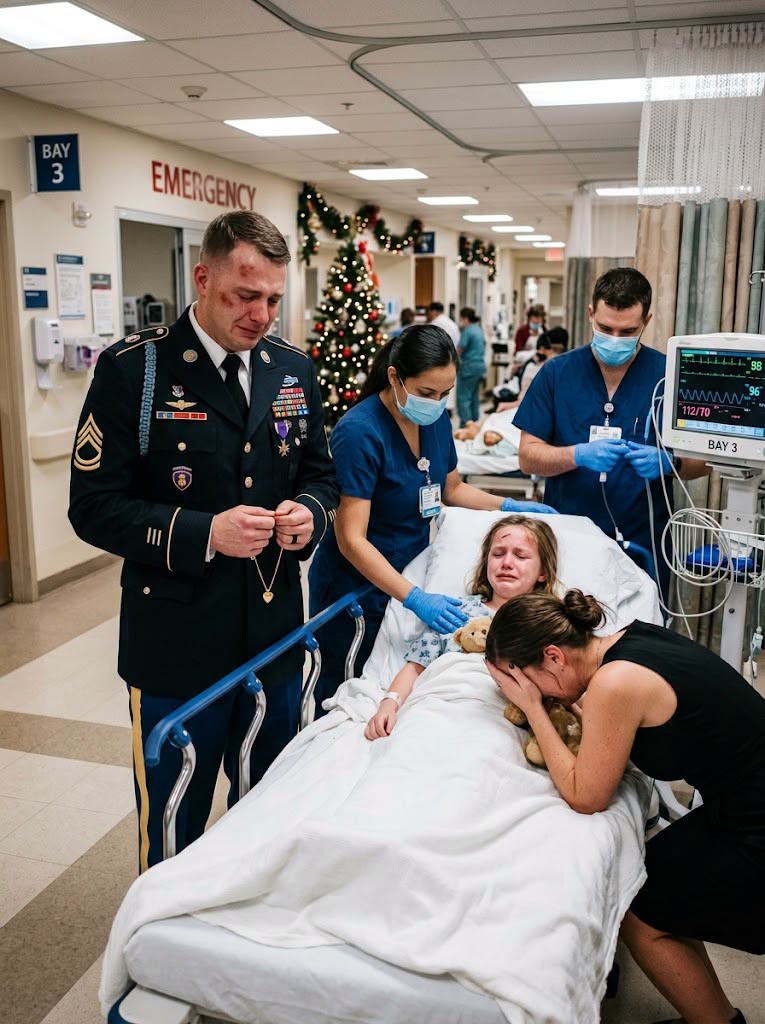
Realizing that my wife had become an active threat and was genuinely hoping for my death, I knew I could no longer handle the situation privately or trust that the truth would somehow reveal itself on its own. I immediately forwarded the digital evidence I had collected to a federal prosecutor I knew and to Chief Thomas, a former colleague who was now leading the local police department. I wanted the evidence to exist outside my control, in the hands of people who could act if something happened to me or my daughter.
At the same time, Victoria rushed into the hospital lobby and began putting on an elaborate performance. She cried loudly, trembled, and told anyone who would listen that I was experiencing a severe combat-induced mental breakdown. She was trying to create a story before I had the opportunity to tell mine. Her hope was that the medical staff and the responding police sergeant would believe her first, have me restrained or arrested, and dismiss anything I said afterward as the confused accusations of an unstable man.
For a few moments, the lobby became a stage.
Victoria played the frightened wife.
I was supposed to be the dangerous husband.
She expected me to argue, shout, or lose control. Instead, I walked calmly into the lobby and approached the officers. I didn’t insult her. I didn’t threaten her. I didn’t even raise my voice.
I simply told them that I had evidence.
Then I played the recording.
The audio file echoed through the hospital corridor at full volume. Victoria’s own voice filled the room as she described fraudulent plans, discussed her actions, and revealed details about the mistreatment she had been trying so desperately to conceal. The performance she had created collapsed almost instantly.
There was no longer a question of whose story sounded more convincing.
Her own words were speaking for her.
The police sergeant listened in silence, his expression changing as the recording continued. The medical staff stopped what they were doing. The people nearby turned toward the sound. Victoria’s tears and accusations suddenly had a completely different meaning.
The narrative she had tried to control had slipped completely out of her hands.
When the recording ended, the sergeant confronted her with what he had just heard. Victoria attempted to explain, but the confidence she had carried into the hospital lobby was gone. The evidence had already changed the situation.
She was placed in handcuffs and arrested on charges that included child endangerment and severe financial fraud.
For the first time in what felt like an eternity, I could breathe.
The legal process that followed was long, exhausting, and emotionally brutal, but the evidence continued to build. Investigators reviewed the recordings, examined financial documents, interviewed witnesses, and considered testimony from medical professionals who had seen the consequences of what had happened to my family.
Victoria could no longer hide behind tears, accusations, or carefully constructed explanations.
The truth was documented.
It was recorded.
And it was no longer something she could control.
In the months that followed, the legal consequences became increasingly serious. Faced with overwhelming video evidence, recorded statements, financial records, and testimony from medical experts, Victoria ultimately accepted a plea agreement.
She received a fifteen-year sentence in a state correctional facility and lost access to our family’s assets.
For me, however, the sentence was never the most important part.
The most important thing was knowing that she could no longer enter our home, manipulate my daughter, or threaten the fragile sense of security we had spent so long trying to rebuild.
The toxic presence that had dominated our lives was finally gone.
But freedom did not immediately feel like happiness.
For a while, it felt strange.
There was no constant fear of what might happen next. No wondering whether another lie would appear. No checking my phone repeatedly because I was afraid of what message might be waiting.
Silence itself felt unfamiliar.
Eventually, that silence became peaceful.
I submitted my permanent retirement papers and made a decision that had been impossible for me before everything happened. I would no longer build my life around a career that required me to spend long periods away from my child.
Instead, I started a small local cybersecurity business.
It allowed me to use the skills I had developed throughout my career while remaining close to home. More importantly, it gave me something I had almost forgotten how to value: ordinary time with my daughter.
I wanted to be there for school mornings.
I wanted to be there when she came home.
I wanted to know what she was worried about, what made her laugh, and what she dreamed about becoming.
I had spent years believing that protecting a family meant providing everything financially.
Now I understood that sometimes protection simply means being present.
A year later, our home felt like a completely different place.
It was Christmas Eve.
The lights on the tree reflected softly against the windows, the house smelled like warm food and cinnamon, and there was laughter in rooms that had once been filled with tension and fear.
Most importantly, Clara was smiling.
The medical treatments that had been funded through my retirement savings had changed her life. At eleven years old, she no longer needed to wear the spinal brace that had once been part of her everyday existence.
She stood straighter now.
Not only physically, but emotionally.
There was a confidence in her that I hadn’t seen in years.
Watching her move around the living room, I realized how much childhood she had been forced to spend worrying about things no child should ever have to understand.
Now she could simply be a child.
She could laugh.
She could make a mess.
She could complain about homework.
She could argue about which Christmas movie we should watch.
Those ordinary moments felt more precious to me than anything I had ever owned.
Later that evening, Clara carried the silver star toward the Christmas tree.
She looked at me and smiled.
I lifted her carefully into my arms so she could reach the top. She stretched upward and placed the star on the highest branch.
For a moment, neither of us said anything.
I simply held her there.
A year earlier, I had been fighting to prove the truth while fearing that everything I loved might disappear.
Now I was standing in my living room with my daughter in my arms, watching her place a star on our Christmas tree.
The contrast was almost impossible to comprehend.
The past had not disappeared.
There were memories we would probably carry for the rest of our lives. Some wounds would always have scars. But the fear no longer controlled our future.
We had survived.
We had rebuilt.
And we had learned that safety is not merely the absence of danger. Sometimes it is the freedom to laugh without looking over your shoulder, to sleep without fear, and to wake up knowing that the person you love is still beside you.
As I lowered Clara back to the floor, she looked at the tree and smiled with pride.
The silver star caught the light above us.
And for the first time in a very long time, I wasn’t thinking about what could go wrong.
I was thinking about tomorrow.
Then next Christmas.
Then all the ordinary days after that.
Our family had finally reached a place where the future no longer felt like something we had to survive.
It felt like something we were finally allowed to live.