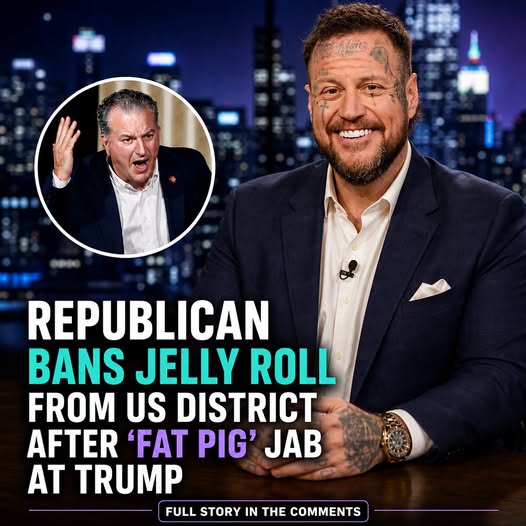
Jelly Roll cracked one joke and a politician tried to erase him. What began as a few minutes of comedy suddenly exploded into a political firestorm, with a Florida Republican publicly declaring the Grammy-winning singer unwelcome in his entire district after Jelly Roll mocked Donald Trump’s weight on live television. Within hours, the joke had become a national argument. Old tweets resurfaced, political supporters piled into the fight, and Jelly Roll made it clear he had absolutely no intention of backing down.
The controversy began during a monologue that initially sounded like classic Jelly Roll self-deprecation. The singer has been remarkably open about his dramatic weight-loss journey, and he started by making himself the target. After losing more than 300 pounds, he joked about the transformation and the enormous amount of weight he had left behind. But then he turned the joke toward Donald Trump.
“From one fat pig to another,” Jelly Roll said, before taking the punchline even further. He joked that losing weight might finally allow the former president to “see [his] penis again,” a deliberately outrageous line that instantly guaranteed a reaction. But he was not finished. Jelly Roll followed it by joking that he had “lost an entire Donald Trump,” turning his own weight-loss story into a political punchline.
Then came another jab, this time aimed at Trump’s approval ratings. Jelly Roll connected the idea of losing weight with the idea of losing Trump politically, suggesting that if the country wanted to lose something, perhaps the former president could be next. What might have disappeared as a late-night joke instead became the spark for a much larger confrontation.
Florida Republican Jimmy Patronis was furious.
Patronis publicly declared that Jelly Roll was “100% not welcomed” in his panhandle district. He went even further, dismissing the singer’s country credentials and sneering that he “ain’t country, never was.” It was a remarkable escalation. A celebrity had made a joke about a politician, and the politician responded as though the singer had crossed a line that demanded an official punishment.
Almost immediately, social media users began digging through Patronis’s old posts. And then they found something that made the situation even more awkward.
An older tweet reportedly showed Patronis praising Jelly Roll.
Suddenly, the internet had a new storyline. What had started as a joke about Trump had transformed into a spectacle about political outrage, celebrity culture and alleged hypocrisy. Users circulated the old post, contrasting Patronis’s earlier praise with his new declaration that Jelly Roll was supposedly not welcome in his district.
The backlash only made the story bigger.
Instead of apologizing or quietly moving on, Jelly Roll doubled down. He argued that whoever occupies the White House should be capable of taking a joke, especially when the person telling it is also willing to make himself the punchline. His point was bigger than one insult. He suggested that presidents have far more serious responsibilities to deal with than a comedian or musician making jokes about their appearance.
Jelly Roll pointed toward issues such as gas prices, healthcare and wars, essentially asking why anyone in power would spend so much energy fighting with a tattooed singer over a punchline.
And that became the strange heart of the controversy.
Jelly Roll was not presenting himself as a polished political insider. Quite the opposite. His entire public identity has been built around being imperfect, surviving difficult circumstances, changing his life and refusing to hide where he came from. He has openly discussed his past, including time as a convicted felon, while building a completely different future through music.
That history made the confrontation even more surreal.
Here was a heavily tattooed former felon who had lost more than 300 pounds, become a major country and rap star, and collected three Grammys, suddenly at the center of a political battle because he made jokes about the president’s weight.
And Jelly Roll seemed genuinely amazed by the situation.
His final punchline was essentially disbelief that a man who had transformed his own life so dramatically could somehow become a bigger problem for a president than some of the president’s most famous critics. He invoked Rosie O’Donnell as another example, joking about the sheer absurdity of the political outrage.
The argument also raised a much more practical question: can a politician actually “ban” a private citizen or entertainer from an entire district simply because he does not like what that person said?
The answer is far less dramatic than the political declaration made it sound.
A public statement from a politician does not automatically create a legal prohibition preventing Jelly Roll from entering an entire congressional district. A district representative can criticize someone, refuse invitations or express that someone is unwelcome, but that is very different from possessing the legal authority to physically bar a person from a geographic area.
So what was presented as a “ban” quickly became another layer of the spectacle.
A joke became a political statement. The political statement became an internet investigation. The investigation uncovered an old compliment. The old compliment became accusations of hypocrisy. And then Jelly Roll turned the entire thing back into another joke.
That may be exactly why the controversy resonated so strongly.
Jelly Roll has never fit neatly into one box. His music crosses genres, his appearance challenges traditional country-star expectations, and his life story is filled with contradictions. He has gone from a troubled past to Grammy-winning success, from extreme weight loss to one of the biggest stages in American music.
And now, apparently, he has also managed to become a political controversy without even running for office.
For his critics, the Trump jokes were disrespectful. For his supporters, they were simply comedy. For everyone watching from the sidelines, the escalating feud became almost impossible to look away from.
The bigger irony may be that Jelly Roll’s entire message has often been about transformation. He knows what it means to be judged by an old version of yourself. He knows what it means for people to decide who you are based on your past, your appearance or your mistakes.
So when someone tells him he “ain’t country,” he is unlikely to forget the fact that he has already spent years proving people wrong.
And that is why the feud may not end with a politician’s declaration.
Because you can criticize a joke. You can call it offensive. You can argue about whether it crossed a line. But announcing that a Grammy-winning artist is “not welcomed” does not make the joke disappear.
If anything, it gives the joke a second life.
Jelly Roll made one punchline.
The internet made it a headline.
And the attempted political “ban” may have only made sure that millions more people heard it.