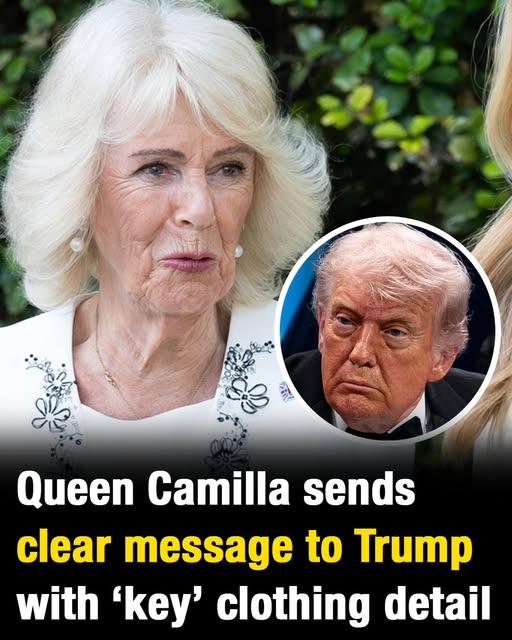
In the midst of unprecedented transatlantic tension, the eagerly awaited arrival of King Charles III and Queen Camilla on American territory last Monday was more than just a formal event; it was a high-stakes diplomatic ploy. The atmosphere was heavy with the weight of tense ties that have pushed the historic “Special Relationship” to its limit in recent months as the royal plane landed for the start of a four-day state visit. The Royal Family is renowned for a more subdued, ancestral style of communication, whereas the machinery of foreign policy and military planning frequently grinds loudly in public forums. This time, Queen Camilla took the lead in the silent drama of diplomacy, sending a clear message to the White House and the American people with a carefully selected piece of jewelry.
The poetic warmth shown in earlier years has drastically changed in the current condition of affairs between the United States and the United Kingdom. Donald Trump seemed to be the ultimate defender of the Anglo-American alliance and the British monarchy during a high-profile visit to the United Kingdom in September. With Melania Trump at his side, he spoke with a flourish of rhetorical grandeur, implying that the term “special” did not adequately convey the strength of the relationship between the two powers. He emphasized a sense of predetermined harmony and artistic unity by famously comparing the nations to two notes in a single chord or two verses of a same poem. The coalition appeared to be unbreakable at the time, based on a common cultural identity that went beyond the complex reality of partisan politics.
But since those poetic proclamations, the political atmosphere has considerably chilled. Strong differences over Middle Eastern policy and international security, particularly with regard to how to deal with Iran, have been a major factor in the change. The relationship between the Trump administration and 10 Downing Street has deteriorated as a result of the President’s public, scathing criticism of Prime Minister Keir Starmer. Trump’s criticism has been nothing short of harsh; after the Prime Minister refused to commit British military resources to some U.S.-led missions, he called Starmer a “loser.” Trump even went so far as to say that Starmer was “no Churchill,” drawing a derogatory parallel to Neville Chamberlain—a name associated with weakness and unsuccessful appeasement in British history—in a move that particularly hurt the British ego.
Leadership figures were not the end of this rhetorical attack. Eventually, Trump shifted his attention to the British military itself, claiming that the United Kingdom was no longer the “Rolls-Royce of allies” and questioning its capacity for contemporary warfare. When the media questioned him about the alliance’s state, his response was brief and dire: “Not good, not good at all.” The King and Queen have been entrusted with the enormous responsibility of utilizing soft power to heal a divide that hard politics has only worsened in this volatile environment of insults and policy deadlocks.
Despite adhering to a stringent vow of political neutrality, the British monarchy is adept in using the “silent nudge.” When Queen Camilla got off the plane, royal observers and diplomatic experts noticed that she was wearing a particular historical brooch. This was a deliberate effort of “brooch diplomacy,” not a haphazard choice from the jewelry box. The accessory included the Union Jack and the Stars and Stripes entwined in a delicate, glittering embrace, according to Grant Harrold, a former royal employee with close knowledge of the family’s customs. The piece’s real strength is found in its provenance: in 1957, the Mayor of New York City gave it as a gift to the late Queen Elizabeth II.
In order to remind her hosts of a period when the alliance was formed in the furnace of post-war reconstruction, Camilla reached back over seven decades of history by selecting this particular object. The most important part of the gesture, according to Harrold, was the timing. The Queen made it clear that the goal of this tour was reconciliation by donning the brooch as soon as her feet set foot on American soil. The message was unambiguous: the fundamental connection between the two countries is an inherited legacy that belongs to the people and the monarchy, dating back long before the current administration and meant to endure long after it, despite the transient animosity of the current political leaders.
The brooch serves as a tangible representation of the King’s more general message of “reconciliation and renewal.” Camilla’s attire acts as the visual frontier for Charles’s remarks as he gets ready to address Congress, a unique honor meant to evoke the shared history of the two legislative houses. The King is expected to remind the American government that the two countries have always found a way to bridge their divides, no matter how deep the ideological chasms may seem at the time. Moving past the “Rolls-Royce” images of the past to concentrate on a future of mutual respect, his address will probably highlight that the alliance is a living organism that needs ongoing maintenance.
According to Grant Harrold, Donald and Melania Trump will notice this little nod. The addition of a present from New York, the President’s hometown, is a masterful act of both political and personal flattery. The President has long been a student of symbols and television optics. For their private discussions, it offers a neutral, historical common ground, enabling a discussion that starts with shared heritage rather than present military disputes. Camilla is successfully utilizing the late Queen’s long popularity as a shield and a bridge by bringing up the memories of Queen Elizabeth II, a person Trump held in the highest regard.
The world’s attention is still on these minor aspects as the four-day visit progresses. The Royal Family still relies on the age-old technique of the “visual statement” in a time when a single social media post may ruin a market or a treaty. The interwoven flags on Camilla’s lapel serve as a reminder that although presidents and prime ministers come and go, the institutional connection between the United States and the United Kingdom is based on a foundation that is meant to last. The Queen has undoubtedly made the first move on the diplomatic chessboard with grace and historical accuracy, but it remains to be seen if this display of soft power can actually counteract the “not good” state of contemporary ties.
Whether the American leadership choose to accept the olive branch concealed in the glitter of a 1950s brooch will determine the outcome of this visit. This “key” element will be the necessary icebreaker to get past the “loser” language and return to the “two notes in one chord” harmony that Trump once praised, if Harrold’s prophecies come true. The simplest item can sometimes have the biggest impact in the high-stakes arena of international relations.