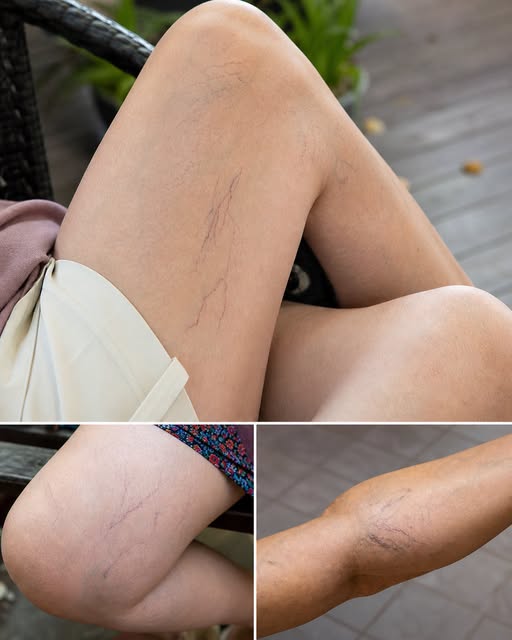
Purple veins on your legs can look harmless—until they aren’t.
They may begin as faint purple, blue, or reddish lines that resemble delicate webs beneath the skin. At first, they can seem like nothing more than a cosmetic change. But as time passes, those tiny vessels may become more noticeable, spread across the thighs or calves, or appear around the ankles and behind the knees.
For many people, spider veins cause no symptoms and pose little immediate concern.
But sometimes, visible veins are accompanied by signs that deserve attention.
The important thing is knowing the difference.
Spider veins are typically small, flat blood vessels that appear close to the surface of the skin. They can form in branching patterns or clusters and are generally much smaller than varicose veins, which are larger, twisted, and often raised above the skin.
Their appearance can be influenced by several factors.
Age is one. As we get older, the veins and their valves can become less efficient. Genetics also play an important role, meaning some people are simply more likely to develop visible veins than others.
Pregnancy and hormonal changes can contribute as well. Extra pressure on the veins, changes in circulation, and prolonged periods of sitting or standing can all make the vessels in the legs more noticeable.
Body weight may also place additional stress on the circulatory system.
But the appearance of a few purple lines does not automatically mean something is seriously wrong.
The key is to pay attention to changes.
If the veins are accompanied by aching, heaviness, burning, itching, or swelling, particularly if these symptoms become persistent, it is worth discussing them with a healthcare professional.
One detail matters especially: whether both legs are behaving the same way.
If one leg suddenly becomes noticeably more swollen, painful, warm, or red than the other, that should not simply be dismissed as another cosmetic vein problem.
Sudden one-sided swelling, warmth, redness, or significant pain can be signs of a blood clot and require urgent medical assessment.
There are also slower changes that deserve attention.
Darkening or discoloration around the ankles, hardened areas of skin, persistent swelling, or wounds that heal unusually slowly can occur with chronic problems involving the veins and circulation. These changes are different from ordinary spider veins and should be evaluated rather than ignored.
That does not mean every visible vein is dangerous.
It means the surrounding symptoms matter.
A small network of purple lines without pain or swelling may simply be a cosmetic issue. But when visible veins appear alongside discomfort, swelling, skin changes, or wounds, the situation deserves a closer look.
Fortunately, there are practical steps that can support healthy circulation.
Regular movement can help. If you spend long periods sitting or standing, changing position and walking periodically can encourage blood flow through the legs.
Elevating the legs when resting may also help reduce discomfort and swelling for some people.
Compression stockings can be useful in certain situations, but they are not appropriate for everyone and should be properly fitted. A healthcare professional can help determine whether compression is suitable, particularly if there are underlying circulation problems.
And despite what advertisements may promise, creams cannot repair a damaged vein valve.
When treatment is appropriate, clinicians have several options depending on the type and severity of the veins. Some people may need nothing more than observation and lifestyle measures. Others may consider treatments such as sclerotherapy or laser-based procedures for troublesome or unwanted veins.
The right approach depends on what is actually causing the problem.
That is why it is better to understand the signs than to panic at the sight of a purple line.
Your legs are constantly working against gravity to return blood toward the heart. When the valves and veins are under strain, changes can sometimes become visible on the skin before other symptoms appear.
The goal is not to fear every spider vein.
It is to recognize when something has changed.
A few tiny purple lines may simply be part of aging, genetics, or normal variation.
But persistent swelling, significant pain, skin discoloration, hardened tissue, or wounds that refuse to heal deserve professional attention.
And sudden changes in one leg—especially swelling, warmth, redness, or sharp pain—should never be casually ignored.
Your skin can sometimes provide clues about what is happening underneath it.
Learning to recognize those clues does not mean assuming the worst.
It means knowing when to watch, when to ask questions, and when to seek medical care.
The safest approach is neither panic nor dismissal.
It is awareness.