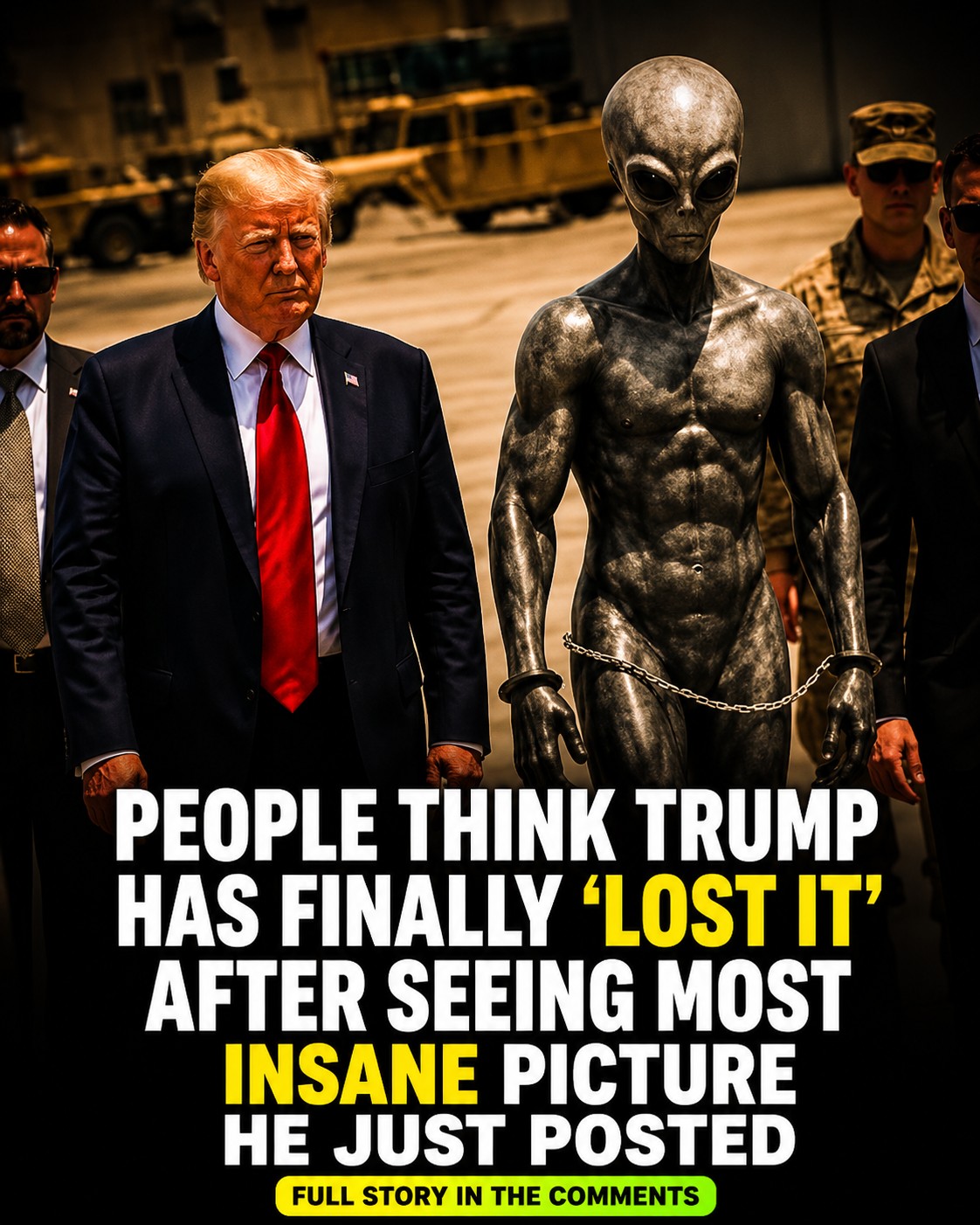
The posts began appearing just after midnight, one after another, fast enough to feel less like communication and more like a digital avalanche. Anyone scrolling through Donald Trump’s social feed that night was suddenly pulled into something that looked less like politics and more like the trailer for a science-fiction apocalypse. Explosions over Earth. Missiles raining from orbit. Towering spacecraft suspended above cities. Shadowy “classified” images suggesting extraterrestrials walking beside world leaders under armed escort.
For a few surreal hours, the internet stopped arguing about ordinary scandals and started asking a stranger question:
What exactly was this supposed to be?
To supporters, the flood of AI-generated imagery felt deliberate, provocative, even visionary. Some claimed the posts hinted at hidden truths long buried by governments and intelligence agencies. Others insisted Trump was mocking secrecy itself by forcing conversations about UFOs, military technology, and information control directly into the mainstream. Online communities already obsessed with unidentified aerial phenomena exploded with speculation. Every image became “evidence.” Every detail was analyzed frame by frame.
But critics saw something entirely different.
To them, the timing felt impossible to ignore.
At the very moment international tensions were intensifying and political pressure surrounding war casualties, investigations, and public outrage continued mounting, Trump’s feed suddenly transformed into a theater of cosmic chaos. The imagery was bizarre enough to dominate headlines instantly. Instead of debates about policy or conflict, people were now arguing about aliens, secret files, orbital weapons, and whether the President was intentionally blurring reality with AI fantasy.
That may have been the point.
One image in particular spread faster than the others. Styled like a grainy leaked photograph, it appeared to show Trump walking across a dimly lit tarmac beside a tall, thin extraterrestrial figure while Secret Service agents followed behind. The composition looked intentionally imperfect — blurred edges, shaky lighting, distorted focus — exactly the kind of image modern audiences instinctively associate with forbidden leaks and hidden truths. It triggered the same psychological reaction conspiracy culture has always relied on: if something looks unofficial enough, people start wondering whether it might be real.
Another image showed Trump seated before a glowing control console in space while military generals stood silently around him. A massive red button dominated the center of the frame. Missiles streaked across digital maps behind him as Earth floated below like a target. The symbolism was impossible to miss. He was not being presented as a politician anymore. He was being mythologized into something larger — a commander of hidden wars beyond ordinary human conflict.
The unsettling part was not the images themselves.
It was how quickly people emotionally responded to them.
In earlier eras, such obvious fantasy might have been dismissed instantly. But modern audiences exist inside a constant flood of manipulated media, AI imagery, deepfakes, edited clips, conspiracies, and algorithm-driven outrage. The internet has trained people to consume emotional spectacle faster than factual reality. By the time viewers stop to question authenticity, the emotional reaction has already happened.
That is what made the campaign of images feel so effective to some observers.
It did not matter whether anyone truly believed aliens were secretly advising world governments. The content succeeded because it redirected attention, generated confusion, and triggered emotional intensity powerful enough to overwhelm rational discussion. In a media ecosystem fueled by outrage and fascination, spectacle often travels farther than truth.
Supporters argued the posts connected symbolically to recently discussed government files involving unidentified aerial phenomena and decades of military secrecy surrounding strange sightings. Over the years, declassified documents and congressional hearings have genuinely reignited public curiosity about UFO reports, unexplained encounters, and intelligence investigations into aerial anomalies. That existing curiosity created fertile ground for the imagery to spread rapidly.
But the leap from public fascination to extraterrestrial alliances was enormous.
Critics warned that the imagery represented something more dangerous than simple trolling or internet performance art. They argued it reflected the growing collapse between entertainment, propaganda, and political messaging. AI-generated fantasy can now be produced faster than fact-checking can keep up. Emotional reactions arrive instantly. Corrections arrive later — if audiences care about corrections at all.
And perhaps that is the deeper fear behind the entire episode.
Not aliens.
Not orbital warfare.
Not secret photographs.
But the realization that modern politics increasingly functions like narrative warfare, where attention itself becomes the battlefield.
Every shocking image pulls focus away from something else.
Every viral distraction reshapes public conversation.
Every emotionally loaded fantasy competes with reality for dominance.
To supporters, Trump’s surreal online barrage looked fearless and disruptive, a deliberate challenge to institutional control and media narratives. To opponents, it resembled calculated chaos — a strategy of overwhelming audiences with spectacle until exhaustion replaces scrutiny.
Either way, the effect was undeniable.
For one strange night, the internet stopped feeling grounded in ordinary reality. Politics blurred into science fiction. AI fantasy blended with genuine public distrust. Millions of people stared at obviously artificial images while still asking themselves, even briefly:
What if?
And that may be the most unsettling part of all.
Not that people believed every image.
But that the boundary between performance, propaganda, satire, distraction, and reality has become thin enough that many no longer know where one ends and the next begins.