PART 3
I kept my thumb on the edge of the photograph.
“Who is he?” Hale asked.
“I don’t know.”
“You’re in the picture.”
“So are you.”
His eyes remained fixed on the scratched-out face. “Evan never mentioned a fifth man.”
“Evan wasn’t authorized to mention most of what happened at Glass Harbor.”
“Then why would he leave this?”
“Because he wanted someone to ask the right question.”
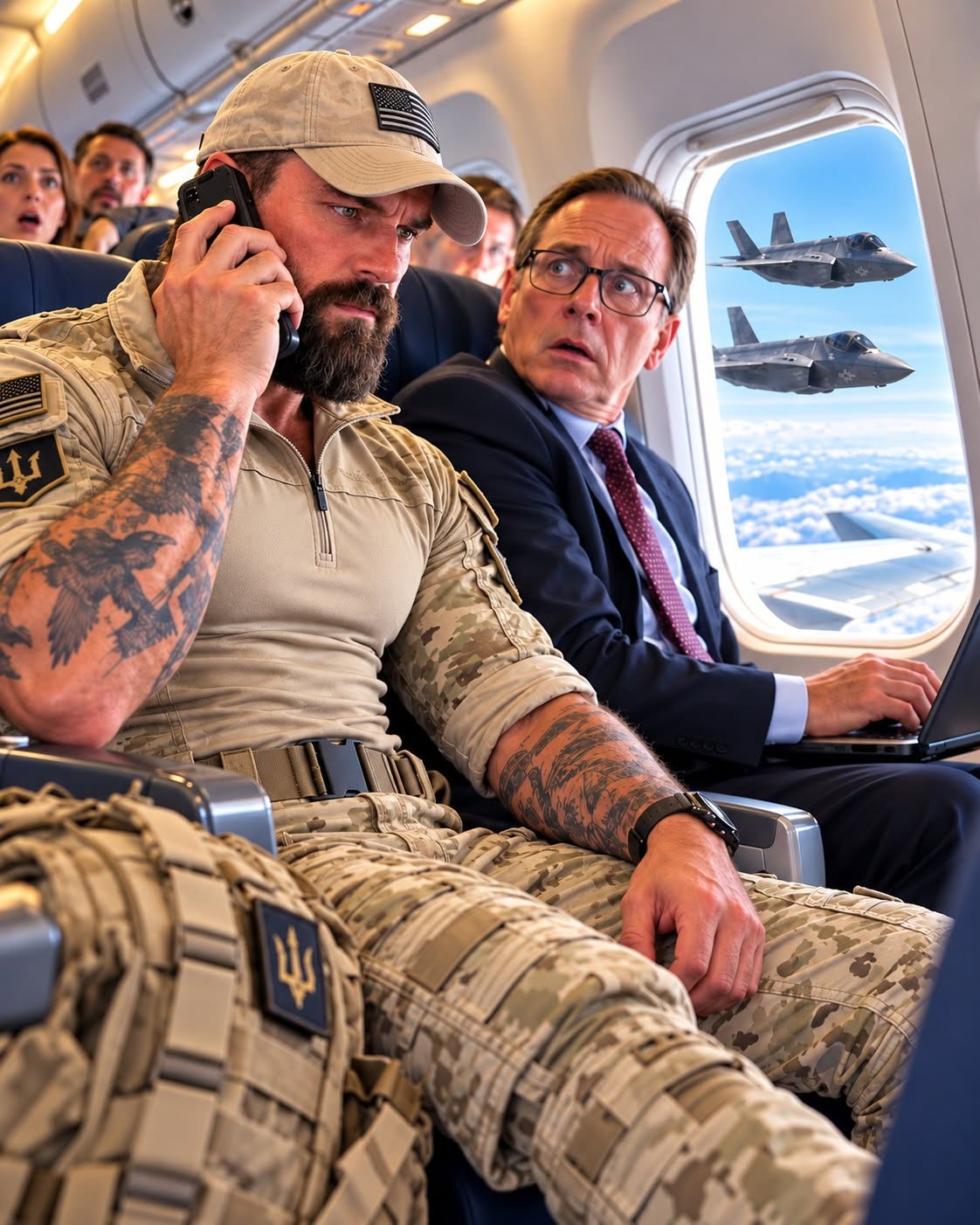
The aircraft continued through the clouds, the cabin lights reflecting faintly across the window. Somewhere behind us, a passenger coughed. A child whispered to her mother. The ordinary sounds made the photograph feel even more unreal.
I examined it again.
The image had been taken outside Building Four at the temporary operations compound. I recognized the cracked concrete, the sandbags stacked along the wall, and the faded blue stripe painted near the entrance. The date was three days before the mission.
I remembered the photograph being taken.
Or thought I did.
Jake had been complaining about the heat. I had told him to stop standing in the sun like he was waiting for a portrait. Evan had laughed and lifted his tablet to shield his face.
But the fifth man had not been part of that memory.
I turned the picture toward the overhead light.
The scratch marks were deliberate. Someone had used a sharp object to remove the face, but not the body. The man wore a dark field jacket without visible insignia. His left hand rested against the wall, and on his wrist was a narrow black band.
I leaned closer.
“That’s not a military watch,” I said.
Hale looked over. “What is it?”
“A medical identification band.”
“From a hospital?”
“Possibly.”
The man stood slightly apart from the rest of us, his shoulders angled toward the doorway. He wasn’t looking at the camera. He was looking toward the compound.
Watching.
“Can you identify him by his build?” Hale asked.
“Not reliably.”
“You spent years working with people. Surely you remember—”
“I remember the mission.”
The sharpness in my voice made him pause.
I softened it. “Memory isn’t a recording, Richard. It changes when you go back to it.”
He nodded, though disappointment stayed on his face.
The flight attendant returned and crouched beside our row.
“Sir,” she said to me, “the captain has asked whether you require any assistance.”
“No, thank you.”
Her gaze flicked toward the photo, then to the encrypted phone in my hand. She was trying not to look concerned.
“Would you like some water?”
“Yes.”
“For both of us,” Hale said.
She gave a small nod and moved away.
Hale watched her go. “You know she’s been looking at you since the fighters appeared.”
“People notice what they don’t understand.”
“Do you ever get tired of being misunderstood?”
The question was too personal for someone I had met less than three hours earlier.
Then again, the day had stopped behaving normally a long time ago.
“Yes,” I said. “But being understood can be dangerous too.”
He considered that. “Evan used to say something similar.”
“What did he say?”
“That people confused secrecy with importance.”
I almost smiled.
“That sounds like him.”
“You really did know him.”
“Yes.”
“Were you close?”
I looked down at the photograph.
“Not in the way you mean.”
“I don’t know what I mean.”
“Neither do I.”
That answer seemed to satisfy him more than anything else I had said.
The flight attendant returned with two bottles of water. I thanked her and handed one to Hale. His fingers were still unsteady, but he opened the cap without spilling.
I placed the photograph back on the tray table and lifted the envelope.
The paper had softened at the corners, as though it had been carried in a pocket for a long time. My name was written in block letters, each one carefully formed.
Evan’s handwriting had always been smaller than this.
I turned it over once more.
“Where did the lawyer get it?” I asked.
Hale held the bottle between both hands. “He wouldn’t tell me.”
“Why not?”
“He said the instructions protecting the source were stronger than anything I could compel him to disclose.”
“That doesn’t sound like a civilian lawyer.”
“He wasn’t a civilian lawyer.”
I looked up.
“He was a former Army attorney,” Hale continued. “Now he handles estate work and security clearances. Evan contacted him eight months before the accident.”
“Did Evan tell you he had hired him?”
“No. I didn’t know about him until three weeks ago.”
“Why did the lawyer wait?”
“He said Evan gave him a set of conditions. If Evan returned safely, the envelope would be destroyed. If he died, it would be delivered to me. If his death couldn’t be verified, it would be held until someone from the operation came forward.”
“Someone came forward.”
“He said you did.”
I felt the muscles in my neck tighten. “I haven’t spoken to him.”
“No. But the lawyer received a message from a number connected to your old unit.”
“Who sent it?”
“He didn’t know.”
“Did you see the message?”
Hale reached inside his jacket again, but this time he removed his phone. He unlocked it and scrolled through several screens before handing it to me.
The message was brief.
THOMAS COLE IS TRAVELING TO WASHINGTON ON FLIGHT 237. RELEASE THE PACKAGE TO RICHARD HALE.
There was no signature.
The timestamp was six weeks old.
I looked at him. “You booked this flight six weeks ago.”
“Yes.”
“Why this one?”
“It was the only direct flight that worked with my schedule.”
“Did the lawyer know your itinerary?”
“I sent it to him.”
“Then whoever sent this already knew I would be on this aircraft.”
Hale took the phone back. “That’s what I’ve been trying to tell you. I didn’t choose the seat beside you. The airline changed my original seat this morning.”
“Why?”
“Equipment adjustment.”
“Did the lawyer tell you to take this flight?”
“No. He told me to go to Washington and wait for instructions.”
“From whom?”
“I assumed from you.”
“You didn’t know me.”
“I knew your name.”
“That’s not the same thing.”
“No.” Hale looked down at his phone. “But Evan trusted you. I thought that would have to be enough.”
A soft chime sounded overhead. The captain announced that the flight had passed through the weather system and would be cruising smoothly for the remainder of the trip.
The announcement calmed the cabin. A few passengers began speaking again.
The fighters remained with us.
I placed the envelope against my knee and studied the seal. It had been closed with clear adhesive, not wax. Whoever had opened it had wanted the envelope to appear untouched.
“Did anyone else handle this?” I asked.
“Only the lawyer.”
“Did he open it?”
“No.”
“Did he tell you what was inside?”
“He said Evan had left written instructions and a storage device.”
I felt a small weight shift inside the envelope.
“A storage device?”
“A memory card, maybe. He wasn’t certain.”
“Why didn’t you tell me that sooner?”
“Because I didn’t know if I could trust you.”
I gave him a level look.
He met it without flinching. “You were a stranger with a military history I didn’t understand. Then a fighter pilot called you by name, an admiral suspended your ceremony, and you started asking whether my son was alive. I had to make decisions too.”
There was no accusation in his voice. Only exhaustion.
I respected him for that.
“Fair enough,” I said.
He breathed out slowly. “You don’t have to say that.”
“I do when it’s true.”
For the first time since we had met, the tension between us eased.
I slid one finger beneath the envelope flap.
Before I could open it, my phone vibrated.
A secure message appeared.
DO NOT ACCESS DIGITAL MEDIA UNTIL GROUND SUPPORT CONFIRMS CONTAINMENT.
I showed Hale.
His expression changed. “Containment?”
“Military language for making sure information doesn’t leave a controlled environment.”
“Or making sure people don’t.”
I looked at him.
“I’m not trying to frighten you,” he said. “I’m trying to understand what kind of situation my son was pulled into.”
“So am I.”
“Then let me help.”
I almost told him no.
That had been my instinct for most of my adult life. Keep civilians away. Carry the weight alone. Decide what others could handle.
It had seemed like protection at the time.
Now, looking at Evan’s father, I wondered how much of that instinct was really fear—fear that if I told the truth, I would have to admit what I had missed.
“You can help by telling me everything Evan said about Glass Harbor,” I told him.
Hale nodded.
“He called me from overseas twice before the operation. The first time, he asked how my back was doing.”
“Your back?”
“I’d had surgery. Nothing serious.”
“Go on.”
“The second time, he asked whether I still had the old blue toolbox from our garage.”
“That sounds personal.”
“It was. He built a radio inside it when he was a teenager. He took it apart, modified it, and nearly burned out the electrical system in our house.”
Despite himself, Hale smiled.
“I grounded him for a month. He said the radio had taught him more than school.”
“Did he say why he was asking about it?”
“No. I told him I’d kept it. He said, ‘Good. Keep it somewhere no one thinks to look.’”
“Did he sound afraid?”
Hale’s smile disappeared. “He sounded careful.”
“Those aren’t always the same thing.”
“After that, he stopped calling. I received two emails, both ordinary. He asked about his mother’s garden and complained about the coffee.”
“Your wife?”
“She died before Evan joined the Army.”
I waited.
“He never talked about her much,” Hale continued. “Not because he didn’t love her. He carried grief quietly. I think he believed bringing it into the room would make it heavier for everyone else.”
The description felt familiar.
“Like father, like son,” I said.
Hale gave me a tired look. “That obvious?”
“To someone who does the same thing.”
He glanced at my left leg, then away. “You lost people there.”
“Yes.”
“And you never talk about them.”
“I talk about them with the people who were there.”
“Are there many left?”
“Not enough.”
The answer sat between us.
The aircraft gave a brief shudder. This time, the fighters moved ahead of us, no longer tight against the wing. One passed beneath the cloud layer and disappeared from view.
My secure phone rang again.
“Cole,” I said.
“Chief, this is Ortiz.”
Her voice was clearer than before, though static still threaded the connection.
“Go ahead.”
“We’re changing formation. There’s been no additional activity.”
“Was there supposed to be?”
A pause. “We detected an unauthorized query against the flight manifest thirty-two minutes ago. It was blocked before any passenger information was released.”
“Where did it originate?”
“An old Defense Department relay.”
“Old as in decommissioned?”
“Old as in it shouldn’t have been connected to anything.”
I looked at Hale.
“Can you trace it?”
“We’re working on that.”
“Does it relate to Glass Harbor?”
“We don’t know.”
“You’re escorting us.”
“We were ordered to ensure your aircraft reached its destination.”
“That isn’t an answer.”
“No, Chief. It isn’t.”
I heard another voice in the background, too faint to distinguish.
Ortiz came back on the line. “There’s one more thing.”
“What?”
“The query included a passenger identifier.”
My grip tightened around the phone. “Mine?”
“No.”
I looked at Hale.
“Richard Hale,” she said.
Hale had heard his name through the speaker. The color drained from his face again.
“Why would anyone be searching for him?” I asked.
“We don’t know.”
“Major, I need you to find out.”
“We’re trying.”
“Try faster.”
“I understand.”
The line clicked off.
Hale stared at me. “They’re looking for me.”
“They searched for you.”
“Is there a difference?”
“Yes.”
“Not to me.”
I placed my hand flat on the tray table. “You’re not being accused of anything.”
“Then why does every answer sound like one?”
“Because the people giving them don’t know enough yet.”
“Do you?”
“No.”
That honesty seemed to steady him more than reassurance would have.
He looked at the photograph. “The fifth man. Could he be the one they’re looking for?”
“Possibly.”
“Could he be Evan?”
I studied the figure again.
“No.”
“Why not?”
“The height is wrong. Evan was taller.”
“You’re sure?”
“I’m sure.”
“What about the face?”
“Too much was removed.”
Hale lowered his voice. “What if the scratched-out man wasn’t meant to hide his identity? What if he was meant to hide the fact that he was there?”
I looked at him.
He continued, “Evan took the picture. If he wanted to conceal someone, why leave the body?”
“To make sure the image still meant something to the person receiving it.”
“Which person?”
I didn’t answer.
“Maybe you,” he said.
I remembered Evan’s message from three days before the reported accident.
You were right to trust the first map. Don’t let them rewrite it.
At the time, I had believed he was warning me that the evacuation route had been changed after the mission. Now the photograph suggested something else.
The first map.
The missing corridor.
The man we had been told to rescue.
I closed my eyes and forced myself back into the operations room.
The satellite image had shown a convoy moving through a dry riverbed north of Al-Qarah. Intelligence identified the convoy as humanitarian workers held by an armed faction. Our assignment had been to locate the lead vehicle, extract the hostages, and destroy sensitive equipment before it could be moved.
Evan had questioned the image.
I had told him the source had been verified.
He had said, “Verified by whom?”
I had dismissed him because we were running out of time.
Then the route changed.
The convoy wasn’t where the map said it would be.
Two of my men died in the confusion.
I was wounded.
And the supposed hostages were never found.
For eight months, I had blamed bad intelligence.
But if the man in the photograph had been at the compound before the mission, and if Evan had left the picture for me, then perhaps the map hadn’t been wrong.
Perhaps it had been designed to make us look in the wrong place.
I opened my eyes.
Hale was watching me.
“You remembered something.”
“Yes.”
“What?”
“The mission wasn’t built around finding the convoy.”
“What was it built around?”
“I don’t know yet.”
A chime sounded from the seatback screen. The aircraft had begun its descent toward Washington.
Passengers shifted in their seats. Window shades lifted. Flight attendants moved through the cabin, checking trays and seat belts.
The fighters were no longer visible.
For the first time since the escort began, we were alone.
My phone vibrated.
A new message appeared from Captain Morrison.
Ground team is in position. I’ll meet you at the gate. Do not surrender the envelope to anyone except me or Admiral Warren.
A second message followed almost immediately.
If anyone claims the admiral has changed instructions, ask for the phrase “blue lantern.”
I showed it to Hale.
“What does that mean?” he asked.
“It means we have a way to identify the right person.”
“Wouldn’t the wrong person know that if they saw the message?”
“Which is why I’m not saying it aloud.”
He nodded.
The descent continued. Clouds broke beneath us, revealing the familiar gray spread of the capital—roads, buildings, the Potomac catching the afternoon light.
Washington looked peaceful from above.
It always did.
I tucked the photograph into the envelope but kept my hand on it.
Hale glanced toward the aisle. “What happens when we land?”
“I stay with you until Morrison arrives.”
“And after that?”
“I don’t know.”
“Will they let me see what Evan left?”
“If it’s addressed to you, yes.”
“And if it’s classified?”
“Classification doesn’t erase family.”
“Doesn’t it?”
The question was quiet.
I looked at him. “It shouldn’t.”
The aircraft touched down smoothly. Applause rose from somewhere near the front, the usual reaction to a safe landing. The captain thanked us for flying United and reminded everyone to remain seated until the seat-belt sign was turned off.
No one moved.
Through the window, I saw two dark vehicles waiting beyond the gate. Their engines were running.
A man in a navy suit stood beside the closest one. He was older, broad-shouldered, and held himself with the rigid stillness of someone accustomed to being obeyed.
Morrison.
Even from a distance, I recognized the way he stood.
The seat-belt sign went dark.
Around us, passengers reached for their bags. The normal rhythm of travel resumed, but I stayed where I was.
Hale didn’t move either.
A flight attendant approached and asked us to remain seated for a moment longer. Her expression was polite, but her eyes kept shifting toward the forward galley.
Then a man in a gray airport-services uniform appeared at the end of our row.
He carried no luggage.
“Chief Cole?” he asked.
I didn’t answer.
“I’m with Admiral Warren’s office,” he said. “We’ve been instructed to escort you and Mr. Hale.”
“What’s the phrase?” I asked.
His expression barely changed.
“Blue lantern.”
Hale started to stand.
I caught his wrist—not roughly, just enough to stop him.
The man in gray looked at my hand, then at me.
“You can verify with the admiral,” he said.
“I will.”
I reached for the encrypted phone.
Before I could place the call, the man’s radio hissed. A voice came through, low and indistinct.
His eyes shifted toward the envelope.
Not toward me.
Toward the envelope.
Something in that small movement settled the matter.
I stood, placing myself between him and Hale.
“Step away from the row,” I said.
The man’s face remained calm. “Chief, that isn’t necessary.”
“Then you won’t mind waiting.”
Passengers nearby had begun to notice. Hale’s breathing quickened, but he stayed behind me.
My phone rang.
Morrison’s name appeared on the screen.
I answered without taking my eyes off the man in gray.
“Tell me you sent someone,” I said.
“I did,” Jake replied. “Where are you?”
“Still in 12A.”
“Who’s with you?”
“Richard Hale and a man claiming to be from the admiral’s office.”
There was a pause.
Then Jake said, “Chief, no one from the admiral’s office is on that aircraft.”
The man in gray heard the answer.
For the first time, his composure slipped.
Not fear.
Recognition.
His eyes moved to Hale.
And Hale whispered, “I know him.”
The man turned toward the aisle.
I caught his shoulder before he could disappear into the crowd, but he didn’t struggle. He simply looked back at Richard Hale with an expression so familiar that Hale went completely still.
“Evan?” he said.
The man in gray lowered his voice.
“Your son asked me to tell you something.”
Hale’s lips parted.
“What?”
The man glanced at me.
“He said the fifth man in the photograph wasn’t our informant.”
He reached into his jacket and removed a small blue memory card.
“He was the person who sent us there.”
-END OF PART 3–PRESS NEX PART IN BOTTOM OF PAGE TO READ NEXT PART