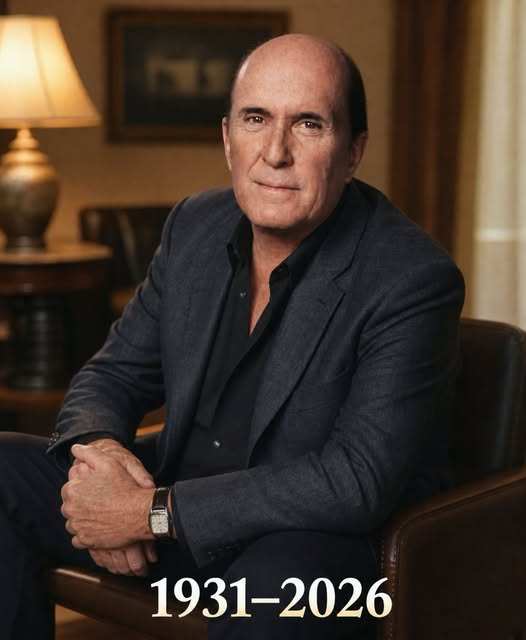
The news hit like a punch to the chest.
Robert Duvall, the quiet force behind some of cinema’s most unforgettable characters, is gone at 95. Fans are reeling. Hollywood is mourning. Tributes are pouring in from across the industry, remembering an actor whose presence could transform even the smallest scene into something impossible to forget. Duvall died peacefully at home in Virginia on February 15, 2026, according to his wife, Luciana Duvall.
But behind the headlines lies a story far richer than a list of famous films. It is a story of discipline, persistence, faith in the craft, and an almost stubborn commitment to authenticity.
Robert Duvall’s life was a rare blend of quiet discipline and towering artistry. Born in 1931 into a military family, the son of a Navy rear admiral, he grew up with a strong sense of duty and structure. Yet acting became the path that ultimately defined him. Rather than chasing celebrity, Duvall spent decades building something more enduring: a reputation for disappearing completely into the people he played.
He could become Tom Hagen in *The Godfather*, the controlled and calculating consigliere whose silence often said more than another actor’s speech ever could. He could become the volatile Lieutenant Colonel Bill Kilgore in *Apocalypse Now*, a character whose strange intensity became one of the film’s most recognizable performances. And in *Tender Mercies*, he delivered the deeply human performance that earned him the Academy Award for Best Actor.
The range was extraordinary.
But what connected those characters was Duvall himself: an ability to observe people closely, understand their contradictions, and communicate enormous emotion without needing to announce it.
Colleagues and critics repeatedly admired his commitment to truth in performance. He wasn’t interested in simply looking impressive on camera. He wanted the character to feel lived-in. Every line, pause, hesitation, glance, and flicker of doubt had a purpose.
He understood that sometimes the most powerful moment in a scene isn’t what a character says.
It’s what they cannot say.
That philosophy helped make him one of the most respected actors of his generation. His career stretched across more than six decades and included more than a hundred films, along with television, directing, writing, and producing. Even when he wasn’t the central figure in a story, he had a way of making audiences remember that he had been there.
And despite his enormous success, Duvall never seemed consumed by the machinery of fame.
That may be one of the most remarkable parts of his legacy.
He became famous without allowing fame to become the point.
In Middleburg and the surrounding Virginia horse country, far from the constant glare of Hollywood, he built a later life that was deeply connected to home, family, horses, and the people around him. His death at home felt fitting for a man who had spent so much of his life protecting the separation between the performer and the private person.
When his wife announced that he had died peacefully at home, surrounded by love and comfort, the words carried a particular weight. There was no dramatic final scene worthy of Hollywood. There was simply the end of a long life, lived largely on his own terms.
And perhaps that is exactly how Robert Duvall would have wanted it.
His legacy does not depend on a final performance.
It lives in the characters.
In Tom Hagen’s controlled silence.
In Kilgore’s unsettling intensity.
In the wounded soul of *Tender Mercies*.
In the countless other men he brought to life across decades of American cinema.
Those characters will continue breathing on screen long after the man who created them is gone. New audiences will discover his performances without having known the world in which he made them. They will watch, listen, and wonder how an actor could communicate so much without ever seeming to force the moment.
That is the strange gift of great acting.
The performer disappears.
The character remains.
Robert Duvall spent a lifetime proving that real power in acting doesn’t always arrive loudly. Sometimes it sits quietly in a chair. Sometimes it appears in a pause between two sentences. Sometimes it is nothing more than a look that lasts half a second longer than expected.
He understood those moments.
He trusted them.
And because he did, generations of viewers will continue to feel the weight of his work.
Robert Duvall is gone.
But the people he created are not.
They remain frozen in film, forever speaking, waiting, watching, and breathing through the performances of a man who understood one of cinema’s simplest truths:
**You don’t have to shout to leave an echo.**