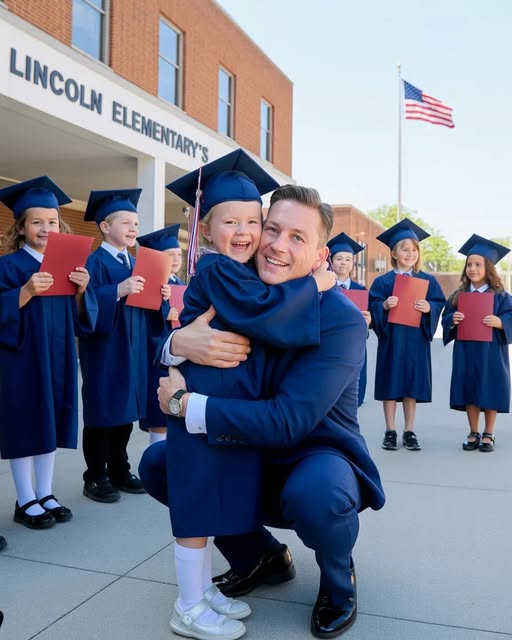
Just for Today
She had been watching him for almost five full minutes before she finally gathered enough courage to cross the street.
The man stood beside a silver sedan parked along the curb opposite Carver Primary School, tall and sharply dressed in a dark charcoal suit despite the growing June heat. Every thirty seconds or so he checked his phone, stared at the screen briefly, slipped it back into his pocket, then pulled it out again moments later like someone waiting for a message that was becoming less likely each time he looked.
From where Lila Carter sat on the front steps of the school, he looked strangely familiar despite being a complete stranger.
Not familiar in appearance.
Familiar in feeling.
Like someone who had arrived somewhere important and already suspected nobody was coming for him.
It was the first Tuesday of June.
In less than two hours, the fourth-grade graduation ceremony would begin inside the school auditorium, and nearly every child in Lila’s class already had family arriving in waves all morning long.
The parking lot overflowed with noise and celebration.
Parents carried balloons tied with curling ribbons. Grandparents balanced flower bouquets and paper gift bags. Younger siblings chased each other through the grass while teachers hurried around taping final decorations inside the gymnasium.
Lila watched all of it quietly from her usual spot near the front entrance.
Marcus Williams had both parents and all four grandparents attending. They arrived in two separate SUVs carrying matching “Congratulations Marcus!” signs made with glitter that kept falling onto the sidewalk.
Sophie Chen’s relatives practically filled an entire row during rehearsal last Friday. Her mother cried halfway through the practice ceremony before Sophie even received anything.
Even Jordan Reeves — who complained constantly about living with his uncle and once announced dramatically that his entire family was “basically useless” — still had his uncle, his uncle’s girlfriend, and a cousin driving in from Worcester carrying a full sheet cake with “Way to Go Jordan!” written in blue frosting.
Everyone had someone.
Everyone except Lila.
Her mother died three years earlier on a Thursday evening in November when a driver lost control during freezing rain on Route 9.
Adults described the accident carefully around children, but Lila understood enough.
Car accident.
Instant.
Nothing doctors could do.
She was six years old when grief first entered her life and rearranged it permanently.
What surprised her most afterward was not how painful loss felt at first.
It was how specific the emptiness eventually became.
At the beginning, grief seemed enormous and shapeless, like darkness filling every room all at once. But over time it changed into something more structured. More architectural.
An absence with routines.
Corners.
Hallways.
Certain moments where the emptiness appeared predictably every single time.
Mother-daughter breakfasts at school.
Permission slips requiring emergency contacts.
Birthday candles.
The quiet ten seconds after concerts when children searched crowds for familiar faces.
Lila moved around those empty spaces every day now almost automatically.
After the accident, her grandmother Bea took her in without hesitation despite already struggling with worsening lung disease.
Bea lived in a small second-floor apartment on Maple Street filled with crocheted blankets, old mystery novels, and the constant faint smell of lavender lotion. An oxygen tank sat permanently beside her recliner now, humming softly through most evenings while visiting nurses rotated through the apartment several times each week.
The nurses always spoke to Bea in the same careful patient voice adults use when they fear age has made hearing fragile too.
But Bea still heard plenty.
Especially loneliness.
She tried hard to protect Lila from it.
On better mornings she braided Lila’s hair slowly while telling stories about her mother as a little girl. On difficult days she simply squeezed Lila’s hand longer than necessary while coughing into tissues she thought nobody noticed piling beside the chair.
When graduation invitations arrived last month, Bea smiled bravely.
“Wouldn’t miss it for the world,” she promised.
But two days ago, the doctor adjusted her oxygen again.
Yesterday morning she became too weak to stand without help.
And this morning, while Lila buttoned her graduation dress beside the kitchen table, Bea tried unsuccessfully to hide tears while explaining she could not leave the apartment safely today.
“I’m so sorry, baby,” she whispered hoarsely.
Lila hugged her carefully around the oxygen tubing.
“It’s okay.”
But both of them knew it wasn’t.
Now she sat alone on the school steps watching everyone else belong visibly to someone.
And across the street stood the man beside the silver car looking almost exactly how she felt inside.
Lost.
Uncertain.
Trying to decide whether leaving would hurt less than staying.
Finally, before courage disappeared completely, Lila stood up and crossed through the slow morning traffic toward him.
He noticed her halfway across the street and straightened immediately, startled.
“Hi,” she said softly once she reached the curb.
The man blinked down at her.
“Hi.”
Up close, he looked older than she first thought. Maybe mid-forties. Tired around the eyes in the particular way people become tired after too many sleepless nights rather than too many late ones.
Lila twisted her fingers together nervously.
“Are you waiting for somebody?”
Something flickered briefly across his face before he answered.
“I was supposed to be.”
He glanced at his phone again automatically, though no new messages appeared.
“My daughter,” he explained quietly. “Or at least… I thought maybe she’d want me here.”
Lila stayed silent.
Adults usually filled silence quickly around children, but this man didn’t seem interested in pretending things were simpler than they were.
“She goes here?” Lila asked.
He nodded.
“Fourth grade graduation.”
“Oh.”
Another silence.
Then:
“She didn’t invite you?”
A faint sad smile touched his face.
“Not exactly.”
He looked toward the school entrance where families continued gathering beneath blue graduation banners fluttering gently in the breeze.
“Her mother and I divorced years ago,” he explained carefully. “I moved away for work after that. I kept thinking I had more time to fix things between us.”
The words sounded less like explanation and more like confession.
“I called last week,” he continued. “Asked if she wanted me to come today.”
“And?”
“She said she’d text me this morning if she changed her mind.”
Lila looked at the phone still resting in his hand.
No text.
No invitation.
Just waiting.
Something inside her chest tightened painfully because suddenly she understood him perfectly.
Not the divorce part.
The hoping part.
The terrible quiet hope people carry when they want someone to choose them back.
“My grandma couldn’t come either,” she admitted softly.
The man looked down at her fully for the first time then.
“Oh.”
“She’s sick.”
“I’m sorry.”
Lila shrugged with practiced smallness.
“She wanted to.”
He nodded slowly like he understood the difference between absence caused by illness and absence caused by choice.
Around them, families continued flowing toward the school entrance carrying flowers and cameras and excitement.
Lila glanced toward the doors.
Then back at him.
“You could come sit with my family,” she blurted suddenly.
The man looked genuinely startled.
“What?”
“Well…” She hesitated. “It’s just me. And you’re alone too.”
A laugh escaped him softly before he could stop it.
“I don’t think that’s how graduation seating works.”
“It’s folding chairs,” Lila replied seriously. “Nobody checks.”
For the first time since she approached him, the sadness around his eyes shifted slightly into something warmer.
“What’s your name?” he asked.
“Lila.”
“I’m David.”
She nodded once.
“Do you want to come?”
David looked toward the school again.
Then at the little girl standing beside him in a graduation dress trying very hard not to feel abandoned today.
And something inside him seemed to break quietly open.
“Just for today?” he asked gently.
Lila smiled for the first time all morning.
“Just for today.”