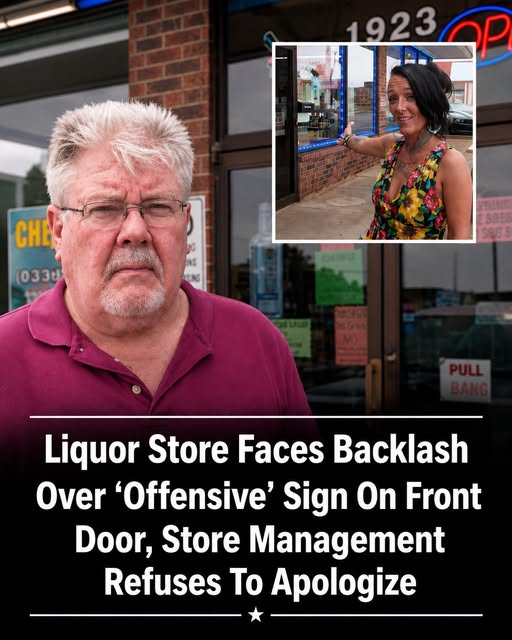
A liquor store in Oklahoma City has made headlines after creating a blunt sign and posting it inside the store demanding customers to “Pull your pants up!” The message doesn’t stop there. It also warns customers who choose to wear their pants sagging that they are not welcome inside the establishment. Although some people have described the policy as controversial and even potentially discriminatory, store management continues to stand behind it, saying they simply consider the fashion choice disrespectful, inappropriate, and unpleasant for other customers.
In an interview with KFOR, management at Midwest Wine and Spirits explained that they felt compelled to put up the sign because too many customers were entering the store with their pants hanging extremely low. In some cases, employees said customers’ underwear and parts of their backsides were clearly visible while they walked through the aisles.
For management, the issue was less about fashion and more about what they considered appropriate behavior inside a business. They said they did not want customers exposing themselves while shopping and believed the sign was the simplest way to establish expectations before anyone entered.
“I realize wearing pants low is a fashion statement for some, but it doesn’t work for me, and I find it somewhat offensive,” Chad Gilbert, one of the managers, said.
Management maintained that customers were free to dress however they wanted elsewhere, but argued that a privately operated business should also be allowed to establish reasonable standards of dress and behavior inside its own property.
Not everyone who encountered the sign agreed with the reasoning behind it.
One customer, Sunshine Weatherby, questioned whether a liquor store was really the kind of establishment that should be making moral judgments about how customers choose to dress.
“I can see that if it was like a church,” Weatherby said. “There are families there, you might have a problem with that, but this is a liquor store. I’ve seen worse at a liquor store.”
Still, Weatherby stopped short of demanding that the sign be removed. She acknowledged that the owners have a right to decide whom they serve, provided those rules are enforced consistently and fairly.
For her, that distinction was important. If every customer wearing sagging pants was treated the same way, she could accept the policy even if she personally disagreed with it. However, she argued that it would become a much more serious issue if the rule were selectively used as an excuse to discriminate against customers based on race or another unrelated characteristic.
Employees at the store also argued that sagging pants could create practical concerns beyond appearance. Some workers said the loose clothing could potentially make it easier for someone attempting to conceal merchandise.
“Usually, when people come in with their pants sagging, it’s easier for them to steal bottles,” employee Shana Wiessner said.
Wiessner said she tends to pay closer attention when someone enters wearing extremely loose or sagging clothing because bottles or other merchandise might be easier to conceal. From the employees’ perspective, the additional attention is about preventing theft rather than making assumptions about someone’s character.
The sign nevertheless sparked a broader debate about where businesses should draw the line between enforcing dress standards and allowing customers to express themselves through fashion.
Sagging pants have been controversial for years. Some people consider the style harmless personal expression, while others see exposing underwear or parts of the body in public as disrespectful, especially inside stores, restaurants, and other shared spaces.
Those supporting the Oklahoma City store argue that customers entering a private business should respect the standards established by its owners. They believe asking someone to pull up their pants is no different from other establishments requiring shirts, shoes, or certain levels of appropriate dress.
Critics, however, worry that dress codes can sometimes be applied unevenly. They argue that businesses need to make sure any rules are clearly defined and enforced consistently rather than allowing employees to decide selectively who appears “appropriate.”
Whatever side people take, there is little doubt that the store’s sign is direct and impossible to misunderstand. Customers know the expectation before they begin shopping: if their pants are sagging enough to expose their underwear or backside, management wants them pulled up.
The controversy raises a simple question that continues to divide opinion: should the sign stay up, or should the store take it down?
Meanwhile, hundreds of miles away, another small business has attracted attention for reasons of its own.
Lake Fork, the famous East Texas reservoir located roughly 65 miles east of Dallas, is best known for one thing: big bass. Anglers travel there hoping to land the kind of record-breaking fish that has helped give the reservoir its reputation.
But recently, a small convenience store in the area has been generating some buzz of its own.
Star Mart, owned by Frank Hemani, a self-described “people person,” sits along Farm Road 515 between Lake Fork and Emory. From the outside, it may look like another ordinary roadside convenience store serving a rural community.
Inside, however, it has become a familiar stopping point for locals and visiting anglers alike.
The store mainly caters to people living around the area and fishermen traveling to Lake Fork in search of their next memorable catch. Customers stop for supplies, refreshments, and everyday necessities before continuing toward the water.
For many anglers, places like Star Mart become part of the Lake Fork experience itself—a quick stop before sunrise, a conversation about where the fish might be biting, or a place to return after spending a long day chasing the bass that made this corner of East Texas famous.