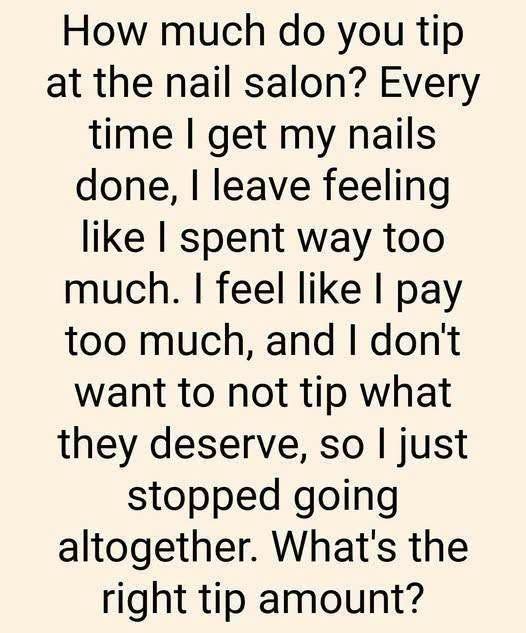
Tipping at the nail salon can feel like a quiet test you never know you’re taking.
You leave with freshly polished nails, a design you love, and that satisfying feeling of looking put together. Then you reach the checkout counter and suddenly face the question: Was my tip enough?
Should you leave 15%?
20%?
More?
Or was tipping expected at all?
For many customers, the decision can feel awkward because there isn’t always a clear rule. Yet behind every manicure, pedicure, gel set, or detailed design is a technician whose time, skill, and attention made the service possible.
A tip is one way customers recognize that work.
For many nail technicians, tipping can make a meaningful difference in their overall income. The service may appear simple from the customer’s perspective, but creating a polished result requires concentration, precision, patience, and often hours of repetitive work.
Technicians spend much of their day sitting in specific positions, working with their hands, filing, shaping, painting, cleaning, and paying close attention to tiny details.
A small mistake can affect the entire appearance of the finished set.
That is why a standard tip of around 15–20% is often considered a reasonable starting point for nail services in the United States.
For example, if your service costs $50, a 15% tip would be $7.50, while 20% would be $10.
If the technician provides exceptional service, spends significantly more time than expected, creates intricate nail art, or accommodates a last-minute appointment, some customers choose to tip more.
There isn’t necessarily one universal amount that everyone must follow.
Your budget matters too.
Tipping should be generous when you can afford it, but you shouldn’t feel pressured to spend beyond your means simply because someone else has a different tipping habit.
The important thing is understanding the local expectations and making a thoughtful decision.
Detailed nail art is one situation where an additional tip can make sense.
A simple coat of polish may require relatively little time, while elaborate designs can involve multiple colors, careful lines, tiny decorations, hand-painted details, or other techniques that require significantly more concentration.
If you asked for something complicated and the technician spends extra time getting it right, recognizing that additional effort can be appropriate.
The same can apply when a technician helps correct a problem or spends extra time making sure you’re satisfied with the result.
Even a quick appointment, however, still involves someone’s time and skill.
A polish change may be faster than a full set, but the technician still has to prepare your nails, apply the product carefully, clean up the edges, and make the finished result look professional.
That work deserves consideration.
Another important factor is consistency.
If you regularly visit the same technician, developing a predictable tipping habit can help make appointments feel more comfortable.
You don’t have to stand at the register calculating percentages from scratch every time.
Choose a percentage or amount that feels fair for your budget and use it as your general guideline.
If the service is particularly good, you can always increase it.
If you’re unsure about the etiquette at a particular salon, asking is perfectly reasonable.
You might simply ask, “What’s customary for tipping here?”
There is nothing embarrassing about wanting to understand the local practice.
Different salons and countries can have different expectations, and some businesses may include service charges or have specific policies about tips.
Cash can also be useful in some salons, particularly if you want the technician to receive the tip directly, although payment options vary.
If you’re unsure whether a tip goes directly to your technician or is pooled among staff, you can politely ask.
The goal isn’t to make tipping complicated.
It’s to make the process transparent.
There is also an emotional side to the experience that customers sometimes overlook.
A nail appointment can be more than a cosmetic service.
For some people, it is a chance to relax after a stressful week.
They may spend an hour talking with their technician, enjoying quiet time, or simply sitting still while someone takes care of something they normally have to do themselves.
The technician is providing not only a physical service but also an experience.
That doesn’t mean customers are obligated to tip enormous amounts.
It simply means the work deserves to be recognized.
A good technician may remember your preferred shape, color, length, or style.
They may notice when something doesn’t look quite right and correct it before you even mention it.
They may accommodate a scheduling problem or squeeze you into an opening when you’re preparing for an important event.
Those small details can build trust over time.
And trust is valuable.
When you find someone whose work you consistently love, returning to that person can make the entire experience easier.
You know what to expect.
They understand your preferences.
You don’t have to explain every detail at every appointment.
A fair and consistent tip can become part of that professional relationship.
Still, tipping should never be used as a substitute for addressing poor service.
If something genuinely went wrong, you don’t necessarily need to silently pay an unusually large tip out of guilt.
If the result isn’t what you requested, the better approach may be to communicate respectfully with the technician or manager and give them an opportunity to correct the problem.
Good communication matters more than simply leaving money and saying nothing.
On the other hand, if the technician has clearly gone above and beyond, acknowledging that effort can be meaningful.
A larger tip isn’t just about the money.
It’s also a message.
It says that you noticed the extra effort.
You noticed the attention to detail.
You appreciated the time they spent making sure you were happy.
And that recognition can matter in a profession where much of the work happens quietly.
At the end of the appointment, you may only see the finished nails.
The technician sees everything that happened to create them.
The preparation.
The filing.
The shaping.
The cleaning.
The repeated movements.
The concentration.
The conversation.
The corrections.
And the final details that make the result look effortless.
Good work often looks easy precisely because someone skilled has made it look easy.
That’s why tipping can be viewed as more than an uncomfortable question at checkout.
It’s one small way of recognizing the labor behind a service.
For many customers, 15–20% is a practical baseline.
From there, you can adjust according to the quality of the service, the complexity of the work, the amount of extra time involved, and what you can comfortably afford.
There is no need to panic when the payment screen appears.
You don’t have to wonder whether you’re breaking some secret rule.
Know the general guideline.
Consider the service.
Consider your budget.
And make your decision confidently.
Because ultimately, a tip is more than a number added to a receipt.
It’s a simple way of saying:
“I noticed the work you put into this.”
And sometimes, that recognition means just as much as the finished manicure.