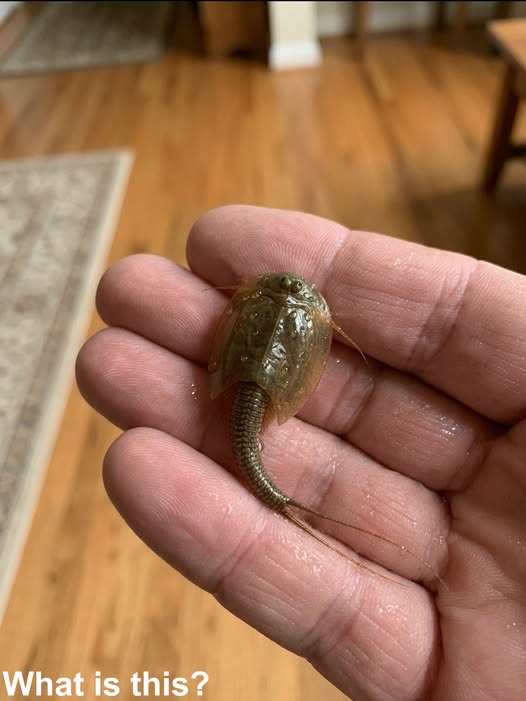
The storm had been unrelenting, a torrential downpour that transformed the ordinary neighborhood streets into a web of overflowing gutters and rushing rivulets. The world seemed to change as the clouds eventually parted, leaving behind the oppressive, petrichor-scented afternoon air. I wandered close to my property’s boundary, where a deep drainage ditch had turned into a makeshift river, during this post-storm silence. I noticed a frenzied, rhythmic activity just below the surface of a stagnant pool that the retreating floodwaters had left behind. The water was dark, whirling with dirt and debris.
Initially, I felt a primordial, instinctive panic as my heart pounded against my ribcage. The thing was foreign, an olive-brown, twitching shape that may have been found in a chapter on deep-sea nightmares or invasive parasites in a medical textbook. Its long, segmented tail whipped through the water with astonishing agility, and its carapace was broad and shield-like. I picked up a glass jar from the garage without thinking, motivated by a mix of morbid curiosity and the need to spot a possible danger. I scooped the thing out of the silt with a quick, unsteady move.
The specimen appeared much more frightening when safely enclosed in glass. With its three eyes—two huge and one little, center spot—it seemed to be looking back at me from an other dimension as it crawled along the bottom of the jar on dozens of frenetic, leaf-like legs. I carried it inside and placed the jar in the bright light of the LED lights on the kitchen counter. Dark possibilities flashed through my head. Was that a huge louse? A fluke with a mutation? Some sort of poisonous aquatic insect that had been agitated by the strange weather? As I got ready to look up “parasitic water monster found in ditch,” I grabbed for my laptop and hovered my fingers over the keys.
But the horrific story I had created in my head began to fall apart as the search results started to appear. It wasn’t a parasite that was in my jar. It was neither a menace nor a monster. It was a Triops, a genus of small crustaceans that paleontologists and biologists often refer to as “living fossils.” As I read on, my immediate disgust gave way to a startling realization. The small, agitated creature swimming in circles in my kitchen belonged to a roughly 300 million-year-old ancestry.
To put that into perspective, long before the first dinosaur ever roared across the ancient plains, the progenitors of this Triops were swimming in shallow pools and puddles during the Carboniferous and Permian periods. The little Triops survived almost unaltered while the powerful Tyrannosaurus rex came to prominence and finally disappeared into the fossil record. It has withstood both the asteroid that terminated the age of the giants and the Great Dying, the Permian-Triassic extinction disaster that wiped out 96% of marine species. Its old, practical design has survived the rise and collapse of mountain ranges, the drift of continents, and the emergence of the human species.
It was a profound epiphany. The creature I had retrieved from a filthy, forgotten ditch was descended directly from a biological success story so strong that it rendered all of human history insignificant. My kitchen, which had previously only been a space filled with modern conveniences and appliances, felt like a transient destination for a wanderer from deep time.
Diapause, a biological marvel, is the key to their amazing survival. Puddles, ditches, and seasonal ponds that only last a few weeks before evaporating in the sun are examples of ephemeral settings in which triops excel. They create “resting eggs” or cysts in order to survive in such an unstable environment. These eggs can remain dormant in dry, sun-baked soil for decades, making them practically unbreakable. They are resistant to the crushing weight of the earth, freezing temperatures, and intense heat. Suspended in a state of biological stasis, they wait for the ideal circumstances to return with a patience that is beyond human comprehension.
For these ancient sleepers, a single powerful storm, such as the one I had just seen, serves as their cosmic alarm clock. The latent eggs rehydrate when rain fills a forgotten hole in the ground. The Triops hatch in a matter of hours after the ancient blueprints are activated. They grow rapidly to guarantee they can procreate before their temporary home vanishes once more. Unaware that an ancient revival is happening beneath our feet, we pass these puddles every day and complain about the muck on our shoes or the humidity in the air.
I took another look at the Triops, but my perspective had changed. I no longer saw a “creature” or a “bug,” but rather a delicate, beautiful artifact from Earth’s far-off past. I witnessed the amazing tenacity of life, how it clings to the periphery and manages to endure catastrophes that destroy entire ecosystems. Its tail lashing was no longer eerie; instead, it was a steady pulse of a past that would not go away.
I was humbled by the silent awe that descended upon me. When we search for wonders, we frequently look to the stars or far into the ocean, assuming that anything genuinely remarkable must be far away or concealed in the shadows. However, an ordinary drainage ditch in a suburban area contained a wonder of evolution—a survivor of the ages. It served as a reminder that the past is never really gone and may still be found in the tiniest details of our daily lives, just waiting to be noticed by an inquisitive eye and a little rain.
I went back outside to the ditch later that night. The makeshift pool was already getting smaller as the water began to seep into the ground. The Triops fell back into the murky water as I cautiously tilted the jar. It started digging into the silt right away, possibly getting ready to lay the next generation of eggs that would endure the upcoming drought years. I was incredibly appreciative as I saw it vanish into the muddy bank’s shadows. I was terrified of a parasite at the beginning of the day, but I ended up with a legend. Compared to a few hours earlier, the world seemed bigger, older, and considerably more enigmatic. Returning to its natural state, the living fossil was a small guardian of deep time, carrying on a journey that started before the world as we know it.