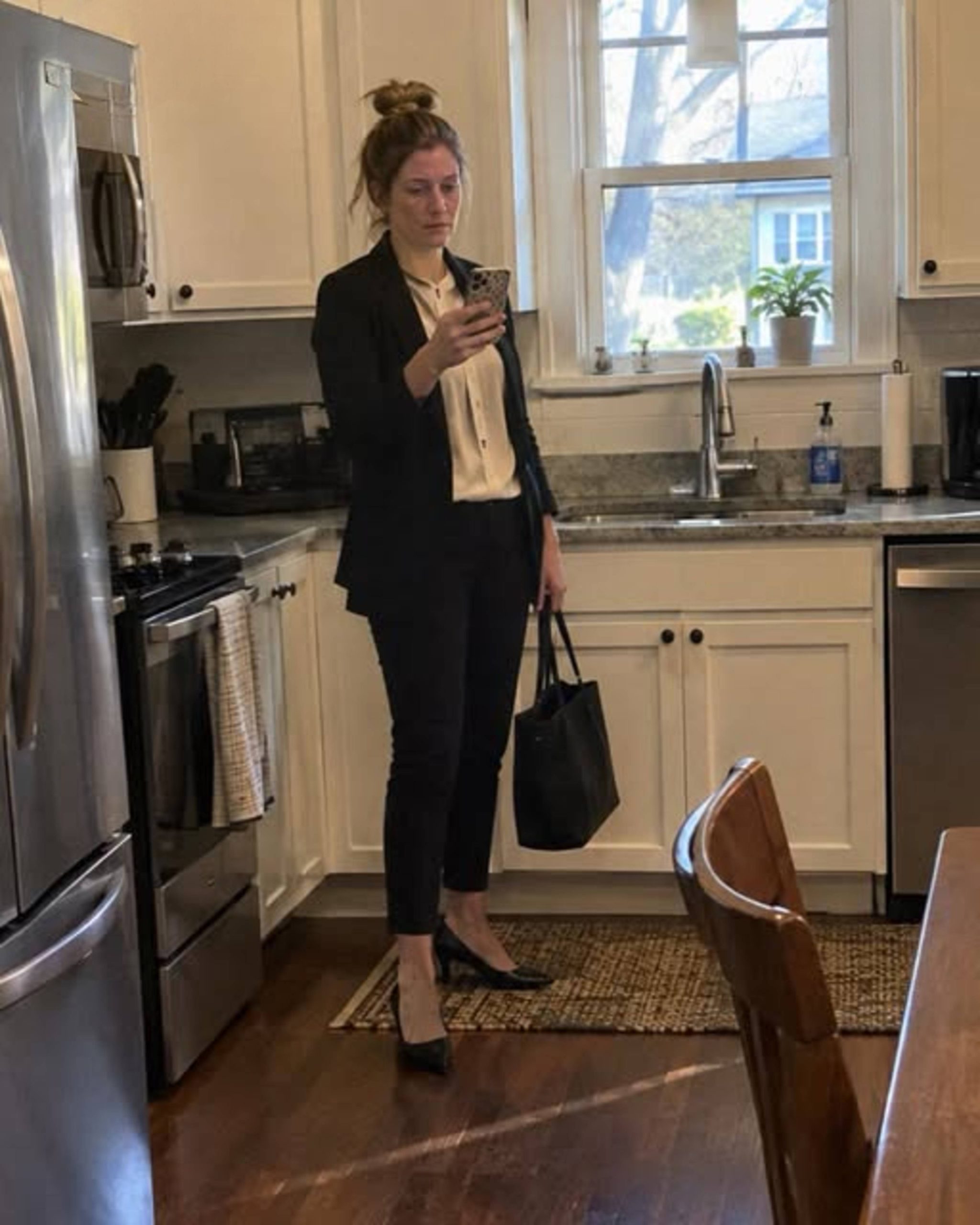
I thought I was a good husband.
At least, I believed I was.
I worked hard. I came home. I helped with the kids. I took out the trash, fixed things around the house, and tried to give Deanna the kind of life we’d always talked about building together.
So when Deanna started photographing our kitchen every morning, I never considered that the reason might have something to do with me.
At first, I barely noticed.
She’d clean up breakfast, gather the kids’ cups, wipe the counter, and then, almost as an afterthought, take out her phone.
Click.
One picture.
Then she’d put the phone away and continue with her morning.
I assumed it was something practical.
Maybe she was keeping track of groceries.
Maybe she wanted to remember how she’d organized something.
Maybe she was sending pictures to someone.
I didn’t ask.
Then I discovered hundreds of those pictures on her phone.
Nearly identical.
The same kitchen.
The same counters.
The same cabinets.
The same angle.
Day after day.
Morning after morning.
Hundreds of photographs.
That was when I realized something was seriously wrong.
The morning after I discovered the album on Deanna’s phone, I couldn’t stop watching her.
I tried to act normal.
I sat at the table while the kids ate breakfast.
I helped one of them find a missing shoe.
I reminded another to brush their teeth.
But the entire time, part of me was watching Deanna.
She moved through the usual morning rush, getting the kids fed and ready while cleaning up behind them.
She wiped spilled milk.
She picked up crumbs.
She loaded dishes into the dishwasher.
She straightened a chair that one of the kids had pushed sideways.
Everything looked completely ordinary.
Then, right before leaving for work, she stood in the doorway and looked back at the kitchen.
She didn’t say anything.
She simply raised her phone.
Click.
I felt something tighten in my chest.
“Have a good day,” she said.
Then she walked over and kissed my cheek.
I watched her leave.
The front door closed.
Her footsteps disappeared down the walkway.
And I stood there feeling strangely accused.
Not angry.
Not exactly.
Just accused.
As though she had taken a picture of something I couldn’t see.
Something that was sitting somewhere in that kitchen besides the chairs, dishes, and appliances.
I’d asked her about it the night before.
She’d looked at me for a long moment before saying quietly:
“It’s for my own peace of mind.”
That answer had bothered me more than if she’d simply told me I was being paranoid.
Peace of mind?
From photographing a kitchen?
I couldn’t understand it.
But after finding hundreds of nearly identical kitchen photos on her phone, I couldn’t let it go.
For the next few days, I became hyperaware of the room.
I noticed everything.
Every cup left on the counter.
Every crumb.
Every wrapper.
Every dish.
Every chair that wasn’t pushed in.
I rinsed my plates immediately.
I put food away.
I made the kids clean up their snack wrappers.
If someone spilled something, I wiped it up.
If the counter looked messy, I cleaned it.
Part of me told myself I was simply being more helpful.
Another part wondered whether I was being tested.
That thought sounded ridiculous.
But once it entered my mind, I couldn’t get rid of it.
Maybe Deanna was trying to see whether I would notice.
Maybe the photographs were some kind of record.
Maybe she was documenting how much work she did around the house because she felt I wasn’t helping enough.
That explanation made the most sense.
At least, I thought it did.
So I tried harder.
One afternoon, after the kids had gone upstairs, I even swept the entire kitchen floor.
Then I wiped the counters.
I cleaned the sink.
I straightened the chairs.
I emptied the dishwasher.
When I stepped back, the kitchen looked almost perfect.
I felt strangely proud of myself.
It wasn’t a big thing.
But I wanted Deanna to know I was paying attention.
When she came home, she walked into the kitchen.
She stopped in the doorway.
Her eyes moved across the counters.
Then she looked at me.
And smiled.
“Thank you.”
I frowned.
“For what?”
She hesitated.
It was only for a second.
But I saw it.
“Nothing.”
Then she walked over and kissed me.
I should have paid attention to that hesitation.
I should have asked what she meant.
Instead, I convinced myself that whatever strange test I’d imagined she was giving me, I’d apparently passed.
The next day, I went back to normal.
I stopped obsessing over the counters.
I stopped checking the floor for crumbs.
I stopped wondering whether every dirty plate had some hidden meaning.
Life returned to its ordinary rhythm.
The kids went to school.
I went to work.
Deanna went to work.
We ate dinner together.
We watched television.
We talked about bills and schedules and the kids’ activities.
Nothing seemed wrong.
And yet the photographs continued.
Every morning.
Click.
Click.
Click.
Sometimes I heard the sound before I even saw her holding the phone.
It became part of the house.
Like the refrigerator humming.
Like the dishwasher running.
Like the clock ticking above the doorway.
A few mornings later, I woke earlier than usual.
The house was still quiet.
The kids were asleep upstairs.
Deanna was already in the kitchen.
I stood at the end of the hallway and watched her.
She didn’t know I was there.
She finished cleaning.
She wiped the counter one final time.
She picked up a small crumb near the toaster.
She threw it away.
Then she stood completely still.
For several seconds, she stared at the kitchen.
Not at the counters.
Not at the dishes.
At the room.
As if she were searching for something.
Then she picked up her phone.
I knew what was coming.
She raised it.
Click.
Something in me snapped.
“Why?”
She froze.
Slowly, she lowered the phone.
“What?”
“The pictures.”
Her face changed.
Not dramatically.
But enough.
“The pictures of the kitchen.”
She stared at me.
I walked closer.
“Every morning, Deanna. You take a picture of this room every morning.”
She didn’t answer.
“Why?”
She looked down at her phone.
Then back at me.
“I told you.”
“For your peace of mind?”
“Yes.”
“That doesn’t explain anything.”
She swallowed.
I could see that she was trying to decide whether to tell me something.
“How many?” I asked.
“How many what?”
“How many pictures have you taken?”
Silence.
Then she whispered:
“Three hundred and twelve.”
My stomach dropped.
Three hundred and twelve photographs of the same kitchen.
I stared at her.
“Why would you need three hundred and twelve pictures?”
Deanna’s eyes filled with tears.
And suddenly I realized something.
She wasn’t embarrassed.
She wasn’t angry that I’d gone through her phone.
She was scared.
Terrified, actually.
I took another step toward her.
“Deanna, what are you looking for?”
She opened her mouth.
Then closed it.
Finally, she whispered:
“I’m not looking for anything.”
I frowned.
“Then what are you photographing?”
She looked toward the kitchen counter.
Then toward the doorway.
Then at me.
And her next words changed the entire meaning of every photograph I’d ever seen.
“I’m documenting what disappears.”
I didn’t understand.
“What disappears?”
She didn’t answer immediately.
Instead, she unlocked her phone.
She opened the album.
Then she turned the screen toward me.
“Look at the first picture.”
I did.
The kitchen looked normal.
Then she swiped.
Another picture.
Another morning.
Another photograph.
She kept swiping.
And slowly, I began to notice what she had been noticing all along.
Something in the kitchen was changing.
Not the furniture.
Not the cabinets.
Not the appliances.
Something smaller.
Something that I had never paid attention to.
Deanna had taken hundreds of photographs because she wasn’t trying to prove that our kitchen was messy.
She was trying to prove that things inside our house were disappearing.
And the more pictures I saw, the more frightening one question became impossible to ignore.
Who had been taking them?