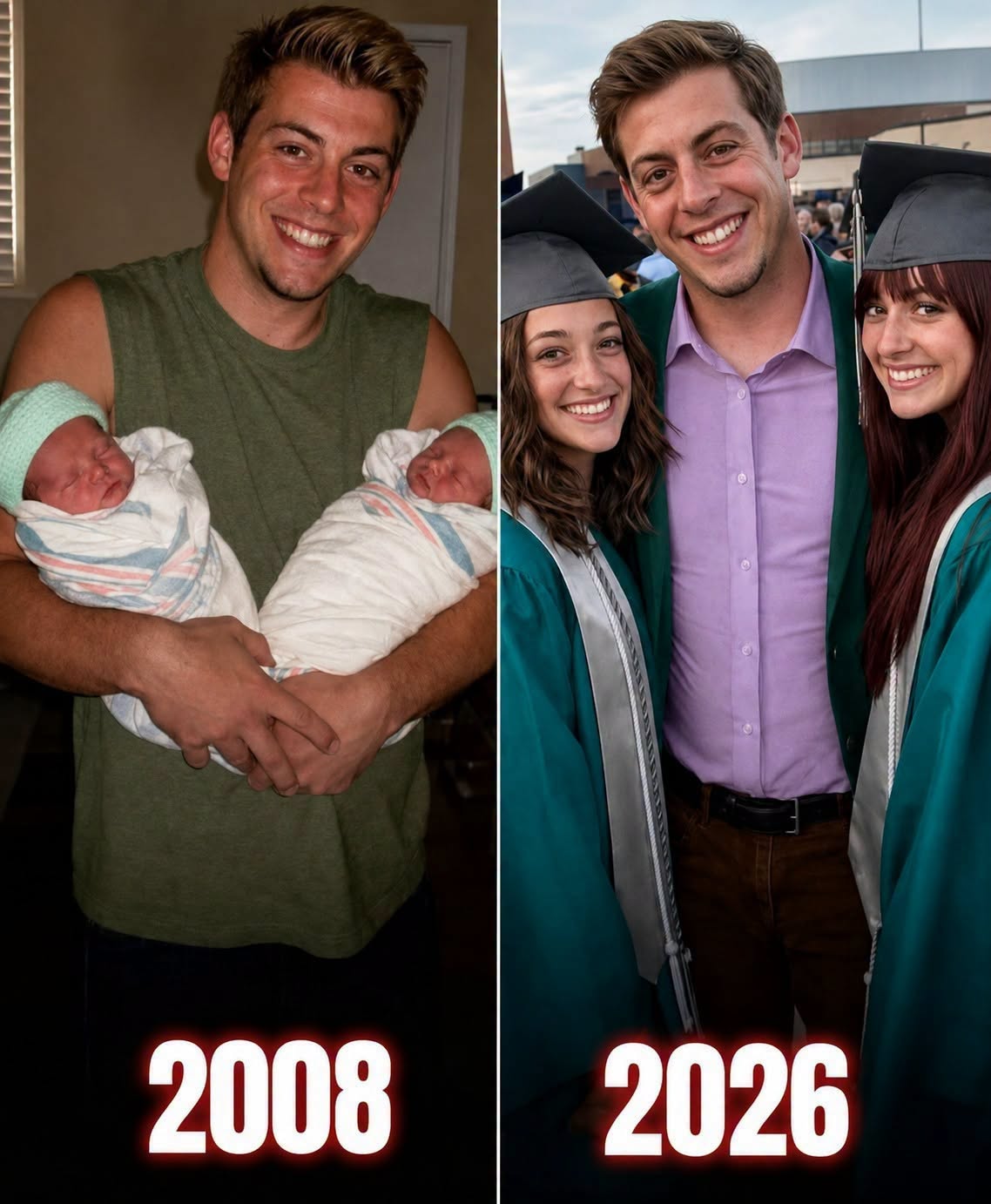
The moment she appeared, the air seemed to change.
Eighteen years too late, standing at the edge of a celebration in a simple gray dress and carrying what looked like a lifetime of regret on her shoulders, she held a small white box tightly between both hands as though it might explode if she loosened her grip. Her daughters noticed her almost immediately. Their smiles disappeared. Their eyes hardened into steel. Around them, people continued laughing, raising glasses, posing for photographs, and calling to one another across the room, completely unaware that only a few feet away, three lives were quietly colliding after nearly two decades apart.
For everyone else, it was still a celebration.
For the three of them, time seemed to stop.
The woman took one careful step forward. Then another.
Her daughters didn’t move toward her.
There was no dramatic embrace. No scream. No movie-perfect moment when years of pain suddenly dissolved because someone had finally returned. Instead, there was an uncomfortable silence filled with everything that had never been said.
Her voice shook when she finally spoke.
She wasn’t asking them to forget.
At least, that was what she said.
She wasn’t asking them to pretend eighteen years hadn’t happened. She wasn’t expecting to walk back into their lives and immediately reclaim the word “mother” as though it had been waiting untouched for her.
She only wanted them to take the box.
At first, neither daughter reached for it.
The object seemed absurdly small compared with what stood between them. How could anything that fit inside a white box possibly explain eighteen birthdays, eighteen Christmases, childhood illnesses, school ceremonies, heartbreaks, graduations, and all the ordinary evenings when two little girls had wondered why their mother wasn’t there?
Eventually, one of them accepted it.
Not as forgiveness.
Not as an invitation.
Simply as information.
Later, away from the celebration and the staring faces they had managed to avoid, the sisters opened the box together.
Inside were journals.
Dozens of pages.
Years of handwriting.
The first entries were old enough that the ink had begun to fade. Others were newer, written in a hand that seemed steadier in some places and almost frantic in others.
The box didn’t fix anything.
But it did something perhaps more honest.
It laid the truth bare.
Page after page, the daughters encountered a version of their mother they had never known. They read the words of a woman who had run away, then spent years trying to explain to pieces of paper why she’d done it.
There was fear.
There was shame.
There was regret.
There were excuses too, and the sisters recognized them immediately.
Some pages made them angry. Others made them cry. A few made them close the journal and walk away because continuing felt impossible.
Their mother wrote about watching important dates pass from a distance. She wrote about birthdays she remembered but didn’t attend. She described moments when she considered reaching out, only to convince herself that too much time had passed and that appearing again would cause more damage than staying gone.
The daughters didn’t know whether to believe every explanation.
And perhaps that wasn’t the point.
What mattered was that the journals finally gave shape to an absence that had dominated their childhood.
For years, they’d been forced to create their own answers.
Maybe she didn’t love us.
Maybe we weren’t enough.
Maybe something about us made leaving easier.
Children are remarkably skilled at turning an adult’s decisions into judgments about themselves.
Now they were adults, reading words written by the person whose disappearance had helped shape them.
The truth was complicated.
Their mother claimed she had loved them.
She had also left.
Both things could apparently exist at the same time.
That realization was painful because it refused to provide the clean answer they had secretly wanted. It would have been easier if she had been completely heartless. It might even have been easier if the journals contained some perfect explanation that erased everything.
Instead, there was only a flawed human being who had made choices with consequences she could never undo.
The sisters talked for hours.
Then days.
They disagreed.
One felt sympathy sooner than the other. The other kept returning to the same question: if she loved us this much, why didn’t she come back?
There was no satisfying answer.
Their mother reached out again, carefully this time.
She said she would wait.
She said they could ask anything.
She said she understood if they never wanted to see her again.
And for once, the daughters realized they didn’t have to make a decision based on what she wanted.
They could pause.
They could be angry.
They could feel compassion without offering reconciliation.
They could understand her reasons without accepting them as justification.
That distinction became important.
People often speak about forgiveness as though it automatically requires reopening the door. As though understanding someone’s pain creates an obligation to give them access to your life again.
The sisters slowly realized those were separate choices.
They could acknowledge that their mother regretted leaving.
They could believe that some of the love described in those journals had been genuine.
They could even grieve the woman she might have been if fear and bad decisions hadn’t controlled so much of her life.
None of that required them to rebuild a relationship.
Their lives had already been built.
Other people had shown up.
There were relatives, friends, mentors, partners, and eventually families of their own. People who had sat beside hospital beds, attended ceremonies, remembered birthdays, answered late-night phone calls, and remained when things became difficult.
Those people had become family through presence rather than biology.
And that mattered.
The sisters eventually met their mother one more time.
It wasn’t dramatic.
They sat together in a quiet place and spoke more honestly than they ever had before.
Their mother apologized.
Not the kind of apology that demanded immediate forgiveness. Not “I’m sorry, but…” followed by another explanation.
Just an apology.
The daughters listened.
Then they told her what her absence had cost them.
They described the questions they had carried through childhood, the anger, the embarrassment when other children talked about their mothers, and the strange mixture of longing and resentment that followed them into adulthood.
Their mother cried.
They cried too.
But tears did not become reconciliation.
When the conversation ended, the sisters made their choice.
They would keep the journals.
They would keep the truth.
They would keep whatever understanding those pages had given them.
But they would not rebuild the relationship.
For the first time, their decision wasn’t fueled by childhood anger.
It came from clarity.
Biology, they realized, did not automatically outrank safety, history, trust, or peace.
Someone could be their mother and still be someone they chose not to include in their daily lives.
That wasn’t revenge.
It wasn’t punishment.
It was a boundary.
Their mother had made a choice eighteen years earlier that shaped their childhood. Now, as adults, the daughters were allowed to make a choice that shaped their future.
So they returned to the lives they had already created.
The journals remained stored safely away. Occasionally, one of the sisters would open them again, reading a page that once made her furious and discovering that time had changed how the words felt.
But neither confused understanding with obligation.
They had learned that healing didn’t always look like a family reunited around a dinner table.
Sometimes healing looked like waking up without wondering whether you owed someone another chance.
Sometimes it meant appreciating the people who had actually stayed.
Sometimes it meant accepting that a person could regret hurting you deeply and still not belong in your future.
The little white box had not repaired eighteen years of absence.
Nothing could.
But it had given them something they hadn’t possessed before: the ability to understand the past without allowing it to control what happened next.
And perhaps that was enough.
Because their power had never been in welcoming their mother back or dramatically slamming the door in her face.
Their power was in realizing that the door belonged to them.
They could open it.
They could close it.
They could leave it exactly where it was.
And in the end, they chose peace.
Not the cinematic peace of a tearful reunion.
Not forgiveness wrapped neatly around a happy ending.
Just the quieter kind—the calm that comes when you finally stop explaining your boundaries, trust the life you’ve built, and understand that sometimes the bravest answer you can give someone from your past is a gentle, unwavering no.