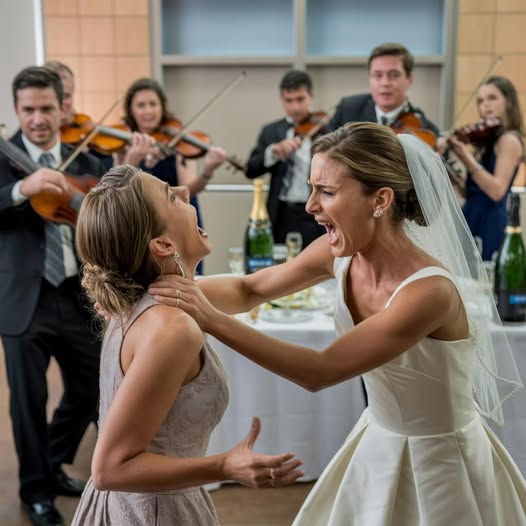
For a brief second, all I saw was light. Gold from the chandeliers, silver from the mirrored wall behind the bar, the glitter of five hundred glasses raised in celebration. My cheek burned. The skin just below my eye throbbed in a hot, immediate pulse. Somewhere a woman gasped. Somewhere else, someone laughed.
Then the laughter spread.
Not everyone laughed. That would be too easy, too cartoonishly cruel. But enough people did. Enough people smiled behind their drinks or leaned toward one another with delighted, hungry expressions—the kind guests wear when a wedding suddenly becomes better entertainment than the band. The hall, which only moments earlier had been filled with music, candlelight, polished speeches, and expensive perfume, sharpened into something mean.
My stepsister stood in front of me with her hand still half-raised, as if even she was surprised by how good it felt to humiliate me in public.
“You don’t belong here,” she said.
Her voice carried.
It always had.
Some people are born with soft voices, and some cultivate them because softness makes others lean in closer. Bianca had never needed either. Her voice was made to rearrange rooms around her. At thirteen, she could cry on command. At seventeen, she could make adults believe almost anything if she widened her eyes at the right moment. At thirty, standing in a gown that likely cost more than my first apartment’s annual rent, she still had the same gift she’d always had: the ability to turn her own ugliness into someone else’s shame.
I did not touch my face.
I did not step back.
I did not say a word.
That was the part she hated most.
If I had shouted, she would have known the script. If I had cried, she would have won in a way she understood. But silence has a way of exposing the naked shape of things, and Bianca had always despised being seen too clearly.
Around us, the ballroom began to shift. Conversations faltered. Heads turned. The string quartet at the far side of the room stumbled through a half-finished phrase and then stopped entirely. A waiter nearby lowered his tray, because even hired staff know when they are suddenly standing inside a story they will retell later.
Bianca took one more step closer.
Her veil trembled faintly behind her shoulders. Diamonds caught the light at her ears. Her makeup was perfect, but color was rising too quickly beneath it—anger fighting champagne, pride fighting panic.
“Look at you,” she said, louder now. “You really thought you could stand here with people like us?”
The words sent another ripple of amusement through the nearest guests. People laugh too easily when they believe judgment has already been decided for them.
I stood there with a glass of water still in my hand, untouched, sweating against my palm, and I thought—not for the first time—that cruelty becomes effortless for a room when it is performed by the bride.
Then a man’s voice cut through the laughter like a blade.
“Do you even know who she is?”
Everything stopped.
Not gradually. Instantly.
The question didn’t just silence the room. It redefined it.
Bianca’s expression shifted first—irritation twisting into confusion as she turned toward the sound. I turned more slowly, already knowing that whatever came next would divide the night into before and after.
Julian Mercer—her fiancé, or perhaps not anymore even then—stood three steps behind her. One hand rested against the back of a gilded chair; the other hung half-curled at his side, as if he had moved without fully deciding to. He looked nothing like the smiling groom from an hour earlier, the man who had greeted guests and hugged relatives and performed his role so convincingly that I had almost felt sorry for him.
Now he looked stunned.
Not embarrassed. Not simply angry.
Stunned.
And his eyes were on me.
He took a breath, the kind a man takes when he is trying to keep his voice steady. Then he said, much more quietly but somehow more dangerously, “Miss Vance.”
A murmur moved through the ballroom.
Bianca gave a short, disbelieving laugh. “What are you doing?”
Julian didn’t look at her.
“Miss Vance,” he repeated, and this time it wasn’t a question. It was recognition settling into place.
For a moment, I considered speaking. I could have ended it there. Smiled faintly, dismissed everything, spared him the collapse gathering at the edges of the room. I could have given Bianca one final gift she did not deserve: ignorance.
But then I felt my cheek again—hot, stinging.
And I heard, as if from very far away, a different voice saying: get out.
And I stayed.
Julian finally turned to Bianca.
“Do you have any idea,” he asked, “what you just did?”
His tone was quiet. Controlled. That made it worse.
“What are you talking about?” she snapped. “Relax. It’s nothing. She’s just—”
“Stop.”
He said it softly. Almost gently. But it cut her off completely.
Then he looked around the ballroom—at guests, families, investors, society friends, the carefully assembled world Bianca believed belonged to her. When he spoke again, it was to everyone.
“The woman you just slapped,” he said, “is Aar Vance.”
Silence deepened.
Then he finished it.
“She is the founder and owner of Vance Global Holdings.”
The room changed all at once.
You could feel it—the way air changes before a storm breaks.
Five hundred people who had just been willing to enjoy my humiliation now looked at me as though trying to reconcile the woman in a simple dark dress with a name they knew from headlines, boardrooms, and financial reports. Whispers spread like widening ripples.
Bianca stared at Julian.
Then at me.
Then back at him.
And for the first time in my life, I saw certainty leave her face.
My name is Aar Vance. I was thirty-one years old the night my stepsister slapped me at her wedding and discovered—too late—that the person she had always treated like nothing had become someone the world stood up to greet.
But the truth is, that night did not begin with a slap.
It began much earlier, in another house, at another table, where I first learned what it meant to be unwanted before I even had words for it.
My mother died when I was fifteen.
Even now, that sentence lands like a stone dropped into a deep well. Ovarian cancer, though I didn’t know the word at first. I only knew appointments. More appointments. Then scarves. Then casseroles from neighbors we barely knew. Then the smell of antiseptic in rooms that once smelled like coffee, laundry soap, and the vanilla lotion she always wore.
Elena Vance believed in softness with structure. She ironed pillowcases. Corrected grammar gently but consistently. Sang while peeling apples. Kept index cards of recipes clipped together with colored paper clips, always writing the date beside anything new she tried, as if even meals deserved memory. She did not announce love. She demonstrated it—quietly, constantly: extra socks in your suitcase, peaches cut over the sink, sitting on the edge of your bed until the story ended.
My father loved her, I think, in the practical way some men love best when life remains stable enough for them to feel competent inside it. But grief frightened him long before death arrived. By the time she died, he had already begun to disappear into a silence that felt less like mourning and more like retreat.
Her funeral was on a gray Thursday.
By Christmas, he had started seeing someone else.
I know this because I heard her before I met her—laughing in the kitchen one evening when I came home from school and found a stranger pouring wine into one of my mother’s glasses.
Her name was Diane.
She wore beige beautifully and sympathy like a tailored suit. Everything about her suggested polished resilience. Pearl earrings. Smooth voice. She told me she was sorry for my loss the first time we met, which would have meant more if she hadn’t been standing in my mother’s kitchen holding my mother’s glass.
She had a daughter.
Bianca.
Fourteen then, exactly my age, though she carried herself with the full-bodied certainty of someone who had never questioned her own importance. Even then, she was beautiful in a way adults forgive too easily. Sharp beautiful. The kind that understands instinctively that the world bends further when you smile before you speak.
The first time she saw me, she studied me slowly, as if deciding whether I was worth remembering.
Then she smiled.
Not warm.
Victorious.
Within six months, Diane moved in. Within a year, she and my father were married. I remember the wedding photos—how Bianca made sure I disappeared from most of them. Whenever a camera turned our way, she repositioned herself: an arm through my father’s, a laugh at the right moment, a request for a mother-daughter shot. By the time the album arrived, I was visible only twice—both accidental, both blurred at the edge of frames like someone who had been almost erased.
My father did not notice. Or if he did, he chose not to.
That became the rhythm of the house.
Easier not to notice when Bianca took my things and never returned them. Easier not to ask why my drawers were empty. Easier not to comment when Diane slowly replaced my mother’s photographs with generic landscapes and curated family portraits where I stood at the edges, already angled like someone expected to leave.
Bianca understood the architecture of the house before I did. She knew I was the leftover piece.
She once leaned against the laundry room dryer, folding her mother’s blouses, and said casually, “You know this is my house now, right?”
I was sixteen.
“It’s my father’s house,” I said.
She smiled without warmth. “Exactly.”
At first, I tried.
I stayed quiet. Helped. Got good grades. Came home on time. I thought, in the painfully sincere way teenagers do, that if I behaved well enough, I would eventually be allowed to belong.
That day never came.
Instead, the rules shifted. Quiet made me moody. Speaking made me aggressive. Staying in my room made me antisocial. Joining dinner ruined the mood. My father said little. When he did, it was usually to ask for peace—as if peace were something children were responsible for producing.