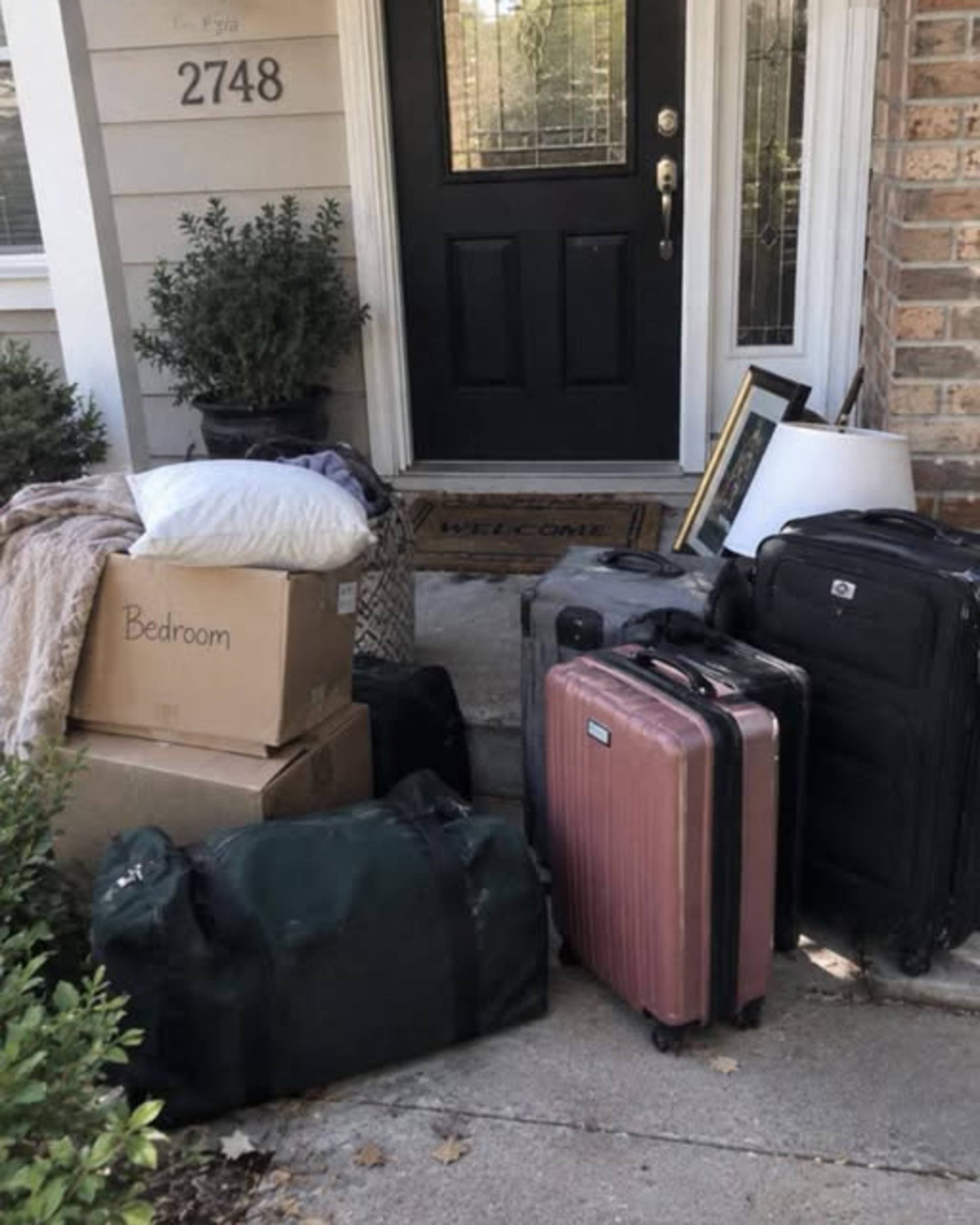
Three days after I buried my father, my stepmother threw all my belongings onto the lawn and told me his house belonged to her now.
I thought losing my last parent was the worst thing that could happen to me.
I was wrong.
Because at two in the morning, a phone call revealed something about my father I had never known.
Something he’d apparently spent years trying to protect me from.
Something that made me question nearly every memory I had of the last twenty years.
Until three days ago, I was still someone’s daughter.
Dad had raised me alone after my mother died when I was nine.
For most of my childhood, it had been just the two of us.
He learned how to braid my hair badly.
He learned which cereal I liked.
He sat through school plays where I had one line.
He stayed awake when I was sick.
When I was sixteen and came home crying after my first real heartbreak, he didn’t tell me I was too young to understand love.
He simply made hot chocolate and sat beside me.
“Some things hurt because they mattered,” he told me.
I remembered those words when we buried him.
I remembered every version of him.
The father who worked long hours.
The father who fixed broken chairs instead of throwing them away.
The father who could never assemble furniture according to the instructions.
The father who kept every birthday card I’d ever given him.
Then I buried him.
Everyone else left the cemetery within an hour.
I stayed beside Dad’s grave for almost four hours.
I couldn’t make myself walk away.
There were things I should have said while he was alive.
Things I’d kept waiting for the right moment to say.
Thank you.
I’m proud of you.
I’m sorry for the times I was difficult.
I love you.
Simple things.
Things that suddenly felt enormous because now there would never be another moment to say them.
Three days later, I was still trying to figure out how to walk into that house knowing he’d never be there again.
I turned into the driveway, bracing myself for another evening without Dad.
Then I saw the front lawn.
And stopped halfway up.
My belongings were scattered across the grass.
Suitcases.
Boxes.
My winter coat still hanging from a hanger.
A stack of books.
The old wooden jewelry box Dad had given me when I graduated college.
Even the framed photograph of Dad and me at my college graduation had been tossed onto the lawn.
For several seconds, I couldn’t move.
Then I saw Denise.
She stood on the porch with her arms crossed.
My stepmother had married Dad eleven years earlier.
I had never been especially close to her, but I had tried.
For Dad’s sake.
For years, I had convinced myself that whatever awkwardness existed between us would eventually disappear.
Now she looked at me like I was a stranger trespassing on her property.
“What is this?”
Her expression didn’t change.
“This is my house now.”
I stared at her.
“What?”
“It’s time you found somewhere else to be.”
I looked at the boxes.
Then at her.
“Three days, Denise.”
“What?”
“We buried him three days ago.”
She sighed.
“Dragging this out won’t make it easier.”
Something inside me cracked.
“This isn’t about making it easier.”
She said nothing.
“That’s my father’s house.”
“It was.”
The word hit me harder than I expected.
*Was.*
I looked toward the front door.
For one ridiculous second, I wanted Dad to open it behind her.
I wanted him to step onto the porch and ask what was happening.
I wanted to hear him say my name.
But there was only silence.
Then I remembered the dirt hitting his coffin.
There was no one left to open that door for me.
So I bent down.
Picked up the first box.
And started loading whatever would fit into my car.
I didn’t cry until I reached my friend Casey’s sofa.
Casey didn’t ask questions.
She simply handed me a blanket and told me to sleep.
I couldn’t.
I lay awake staring at the ceiling, thinking about Dad.
Thinking about the house.
Thinking about Denise.
Thinking about the way she’d said:
*It was.*
At two in the morning, my phone rang.
I almost didn’t answer.
Then I saw the name.
Mrs. Patterson.
Our neighbor.
I answered immediately.
“Hello?”
“Olivia?”
Her voice sounded strange.
Urgent.
“What’s wrong?”
“You need to come back.”
I sat upright.
“I can’t.”
“Olivia, listen to me.”
There was something in her voice that made my stomach tighten.
“Your father asked me to do something if this happened.”
“If what happened?”
A long pause.
Then she whispered:
“If Denise ever made you leave that house carrying your belongings.”
I stopped breathing for a second.
“What did Dad ask you to do?”
“Come back.”
“Where?”
“The workshop.”
I looked at the clock.
2:07 a.m.
“Why?”
“Because your father didn’t trust that you would ever get the chance to find what he left there.”
Thirty minutes later, I was back on my street.
The neighborhood was dark.
Most of the windows were black.
Denise’s bedroom window was dark.
I parked farther down the street and walked the rest of the way.
Mrs. Patterson was waiting beside Dad’s detached workshop.
She held something in her hand.
As soon as I got close, she held it out.
A small brass key.
My hand froze.
“Your father gave me this six weeks ago.”
I stared at it.
“Six weeks?”
She nodded.
“Why didn’t you give it to me?”
“He told me not to.”
My fingers closed around the key.
After Mom died, I’d spent countless afternoons in Dad’s workshop.
He repaired furniture there.
Built shelves.
Fixed chairs.
Sometimes he let me help.
He taught me how to sand wood properly.
He taught me that rushing only created more work.
As I got older, I stopped going inside.
So much between us had become like that.
Not broken.
Just unused.
According to Denise, Dad had started encouraging me to build a life that didn’t revolve around him.
At least, that was how she always explained it.
I’d never asked him whether those were actually his words.
Now I wondered.
“What exactly did he tell you?”
Mrs. Patterson looked toward the house.
“He told me that if Denise ever threw you out, I should bring you here immediately.”
“Why would he think she’d do that?”
She hesitated.
“Because your father had started realizing he’d been wrong about some things.”
I stared at her.
“What things?”
She shook her head.
“He wanted you to find out from him.”
“But he’s dead.”
“I know.”
The key shook in my hand.
I unlocked the workshop.
The door creaked open.
Nothing had changed.
His tools still hung above the workbench.
Sawdust covered one corner of the floor.
His old radio sat beside a jar of screws.
A faded work jacket hung from the same nail he’d used for years.
For one moment, I couldn’t move.
It smelled like him.
Wood.
Coffee.
Machine oil.
Home.
Then I saw the box.
It sat in the center of his workbench.
A plain cardboard box.
My name was written across the top.
*”FOR OLIVIA.”*
I touched Dad’s handwriting.
For one terrible second, I couldn’t open it.
Mrs. Patterson squeezed my shoulder.
“You don’t have to do it tonight.”
“Yes, I do.”
She stepped outside.
I lifted the lid.
The first thing inside was a Father’s Day card.
I recognized it immediately.
I had made it when I was seventeen.
The front had a crooked drawing of the two of us standing beneath a tree.
Inside, I’d written:
*”You’re the best dad in the world. I hope someday I can give you back even half of what you’ve given me.”*
I remembered giving it to him.
I remembered him laughing because I’d spelled one of the words wrong.
I touched the paper.
Then I noticed something tucked behind it.
An envelope.
My name was written on the front.
But beneath my name were three words.
**Read this alone.**
My hands began to shake.
I opened it.
Inside was a letter.
Dad’s handwriting filled both pages.
The first sentence made my heart stop.
*”Olivia, if you’re reading this, then Denise has done exactly what I feared she would.”*
I read the sentence twice.
Then again.
Dad had known.
He had known there was a possibility Denise would throw me out.
But that wasn’t the worst part.
The next line read:
*”I should have told you the truth years ago.”*
I sat down.
There was something about my father’s past that I had never known.
Something involving Denise.
Something involving the house.
And something he had apparently discovered only months before his death.
Then I reached the bottom of the page.
My father’s final sentence was underlined.
**”The house was never meant to belong to Denise.”**
I stopped.
Outside, Mrs. Patterson called my name.
I didn’t answer.
Because beneath the letter was another document.
An official property record.
And beside my father’s name was mine.
I stared at it in disbelief.
My name had been added to the property years earlier.
Without my knowledge.
I turned the page.
There was one more note.
*”There is a reason I never told you. And there is a reason Denise wants you gone before you find it.”*
My heart began pounding.
Then my phone rang.
Unknown number.
I almost ignored it.
But something made me answer.
“Hello?”
A man’s voice spoke quietly.
“Olivia?”
“Who is this?”
“My name is Thomas.”
I didn’t recognize the name.
Then he said:
“I knew your father for twenty-two years.”
I looked down at the documents spread across the workbench.
“How?”
There was a pause.
“Because your father spent the last six months trying to undo something he did twenty years ago.”
My throat tightened.
“What did he do?”
The man exhaled.
“That’s why I’m calling.”
He lowered his voice.
“Your father didn’t leave you that house because he wanted you to inherit it.”
I stared at the property document.
“Then why?”
His answer made the room feel suddenly colder.
“Because he was trying to protect you from the person who originally owned it.”
I looked toward the workshop door.
Mrs. Patterson was standing outside.
Behind her, across the dark yard, I saw the lights of Denise’s house turn on.
And then I heard the sound of a car pulling into the driveway.
Someone had come looking for me.
And suddenly, I understood why Dad had written:
**Read this alone.**