The first thing I noticed at Saint Luke Medical Center was not the panic.
It was the lights.
Harsh fluorescent bulbs buzzed above the emergency waiting room with the kind of steady electrical sound nobody notices until they have nothing else to focus on.
I noticed everything.
The lights.
The vending machine.
The baby crying somewhere down the hall.
A nurse walking past with two clipboards pressed against her chest.
The smell of bleach.
Stale coffee.
Plastic chairs bolted together beneath a television nobody was watching.
And my own hands.
Both fists were clenched so tightly that my knuckles had gone white.
My phone vibrated again.
Isabelle.
Eight missed calls.
My wife.
Still not at the hospital.
That fact kept circling through my mind because I could not make it fit.
Our son had been taken to the emergency room.
Toby was eight years old.
He had been found hurt badly enough that our elderly neighbor, Mrs. Johns, called for help after seeing him stumble down the sidewalk in Birchwood.
One shoe missing.
Face swollen.
Bl00d near his ear.
And Isabelle was still at her father’s house.
I did not understand why.
Not yet.
The doctor had already used the words moderate concussion.
She had also said they were checking for possible brain swelling.
More scans.
More observation.
More waiting.
The language was controlled.
Professional.
Careful.
But I had spent enough years listening to people deliver bad information to hear what lived underneath careful words.
Concern.
Real concern.
I sat in the waiting room and tried to make my life make sense.
Toby played soccer.
He hated peas.
Loved dinosaurs even though he insisted he was too old for them.
He left Lego bricks in the exact places where adults were most likely to step on them barefoot.
On Saturdays, he helped me make pancakes and somehow always burned the first one.
That was my life.
At least, that was the version of it most people knew.
Suburban father.
Work.
School pickup.
Grocery lists.
Grass that needed cutting.
A marriage that had been strained lately but still looked ordinary from the outside.
Nothing about that life belonged in an emergency room at night.
Nothing about Toby belonged behind a hospital curtain with one side of his face swollen.
The phone vibrated again.
Isabelle.
I did not answer.
That sounds cruel.
Maybe it was.
But I was waiting for someone to tell me I could see my son.
Everything else could wait.
A soda dropped inside the vending machine.
The metallic thud made me look up.
Then a doctor came through the double doors.
“Mr. Sinclair?”
I stood so quickly the chair legs scraped.
“He’s awake.”
The room narrowed.
“He keeps asking for you.”
I followed her.
The hallway seemed longer than it probably was.
Pale walls.
Closed doors.
Carts.
Monitors.
The air smelled aggressively clean.
Every step made something inside my chest tighten.
I had seen injured people before.
That was a part of my life nobody in Birchwood knew much about.
There had been years when blood did not shock me.
Years when screaming was information.
Years when the difference between panic and survival sometimes came down to whether one person in the room could keep thinking.
I thought that history would help.
It did not.
Not when the patient was Toby.
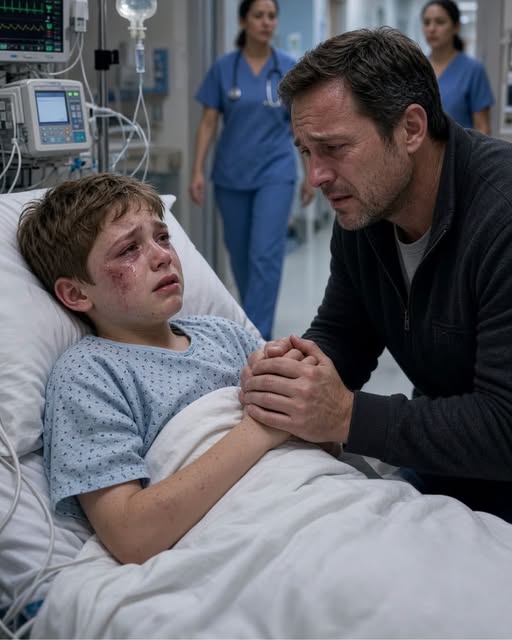
I stepped into the room.
Stopped.
My son looked impossibly small.
Hospital beds have a way of doing that to children.
The right side of his face was swollen.
Dark b:ruis had begun developing beneath the skin.
His hair stuck to his forehead.
Small cuts marked one cheek.
A monitor blinked beside him.
Nothing about the room was dramatic.
That made it worse.
This was not some distant violent place.
This was a pediatric hospital room.
My son was inside it.
Then he saw me.
“Dad.”
His voice cracked.
Everything I had been holding together shifted.
I crossed the room.
Carefully.
Not fast enough to frighten him.
Not slow enough to make him think I was afraid to come close.
I sat beside the bed and took his hand.
“I’m here, buddy.”
His fingers wrapped around mine.
They trembled.
“I’ve got you.”
His eyes filled immediately.
“I tried to run.”
My throat tightened.
“You don’t have to tell me anything right now.”
That was what every reasonable adult would say.
Rest.
Let the doctors work.
Talk later.
But children do not always follow the pace adults prefer.
Fear leaves them full of unfinished sentences.
Toby swallowed.
“Grandpa got mad.”
I stayed still.
“Okay.”
“He said you think you’re better than this family.”
Something inside me cooled.
Not because I was surprised to hear the accusation.
I had heard variations of it for years.
Her father had never liked me.
Jasper did not either.
Kyle followed whatever version of the family story required the least thought.
According to them, I was distant.
Arrogant.
Secretive.
Too calm.
Too private.
They knew I had done work before settling into ordinary civilian life.
They did not know much beyond that.
I preferred it that way.
Toby continued.
“He kept yelling.”
His hand tightened around mine.
“Then Uncle Jasper grabbed my arms.”
I stopped breathing normally.
“Uncle Kyle held my legs.”
I looked at my eight-year-old son.
The words did not belong in his mouth.
I wanted to tell him to stop.
Not because I did not believe him.
Because every sentence created an image I would never lose.
“Toby.”
He blinked tears away.
“Buddy, you can stop.”
He shook his head.
Children sometimes need to complete a terrible story once they have started.
As though leaving part of it unsaid means it is still happening.
“Grandpa s:mash my head on the driveway.”
For several seconds, the room became very quiet.
The monitor continued.
A cart rolled past in the hallway.
Somebody spoke softly outside.
Ordinary hospital sounds.
My mind had gone somewhere else entirely.
I had seen vi0lence.
Real vi0lence.
I had watched men become dangerous under pressure.
I had seen what people were capable of when fear, pride, power, or rage stripped away whatever version of themselves they presented in normal life.
None of that knowledge helped.
Because I had never imagined three adult men using their strength against my child.
Not strangers.
Family.
People Toby had been taught to trust.
My son’s lip trembled.
“Grandpa said your daddy’s not here to protect you.”
I looked down.
My grip around Toby’s hand had tightened.
I relaxed it immediately.
Then leaned closer.
I kissed the safest place I could find on his forehead.
“I’m here now.”
He cried harder.
Not loudly.
That was the sound that hurt.
Small.
Contained.
Then he said the sentence that would stay with me longer than the others.
“Daddy…”
“I’m right here.”
“Grandpa said you weren’t coming.”
I closed my eyes for half a second.
That was the cruelty beneath everything else.
Not only what they had done.
What they wanted Toby to believe.
They wanted my son to believe he was alone.
That nobody was coming.
That the adults hurting him knew more about his father than he did.
That I had abandoned him before I even knew he needed me.
I opened my eyes.
“I came.”
Toby nodded.
But he was still crying.
I stayed beside him until the doctor returned.
She spoke carefully.
They needed additional imaging.
Observation.
They were concerned about the concussion.
They wanted to monitor swelling.
I listened.
Asked questions.
Answered what I could.
The habits from my old life returned in pieces.
Get facts.
Separate emotion from immediate decisions.
Know what is confirmed.
Know what is still unknown.
But when the doctor stepped away, I looked at Toby again and felt something dangerous moving beneath all that discipline.
Anger wants speed.
It wants action immediately.
It wants somebody else hurting because you hurt.
I knew that.
I also knew anger made people stupid when they mistook it for strategy.
I stood.
“I’ll be right outside.”
Toby’s fingers tightened.
“Don’t go.”
“I’m not leaving.”
He searched my face.
“I’ll be right there where you can see me.”
I pointed toward the glass.
He nodded reluctantly.
I stepped into the hallway.
The doctor followed me.
She started saying something.
I heard maybe half of it.
My phone was in my hand.
There were choices available.
Some obvious.
Call Isabelle.
Call police.
Call a lawyer.
Call nobody until Toby’s scans were complete.
But another option existed too.
A number I had not used in years.
Encrypted.
Connected to people from a life I had deliberately left behind.
I stared at the contact.
People in Birchwood thought they knew me.
Commercial clothes.
Ordinary vehicle.
Saturday soccer.
They did not know the younger man who had spent years moving through places where ordinary systems arrived late or not at all.
I had worked beside people trained to secure scenes.
Preserve information.
Separate fact from whatever story frightened people invented afterward.
That was the part of my old life I needed now.
Not revenge.
Proof.
Because one thing had already become obvious.
Three adults had been present.
My wife had not come to the hospital.
Mrs. Johns had seen Toby afterward.
And somewhere across town, people who had every reason to protect themselves were already getting time to decide what version of the story they wanted.
Time changes memories.
Fear changes them faster.
Family loyalty changes them fastest of all.
I opened the encrypted contact.
Pressed call.
The line connected immediately.
No greeting.
I said:
“I need a cleanup team.”
Silence.
In the old days, that phrase could mean many things depending on context.
Tonight, there was only one meaning I was willing to accept.
Preserve the scene.
Preserve evidence.
Preserve whatever would disappear once frightened people started realizing an injured child could talk.
The voice finally asked:
“Who’s the target?”
I looked through the glass.
Toby lay awake.
One hand curled into the blanket.
For a second, I understood how easy it would be to let rage answer.
Names.
Three of them.
I knew them already.
Instead, I said something else.
“The truth.”
Silence.
Then:
“Explain.”
“I want the driveway documented before anyone cleans it.”
The voice changed.
“Understood.”
“Cameras. Doorbells. Neighbor footage. Any messages. Any calls connected to that address tonight.”
“You asking for collection or preservation?”
“Preservation. Nothing illegal. Nothing touched that shouldn’t be touched.”
Another pause.
“You’ve changed.”
“No.”
I kept watching Toby.
“I have a son now.”
That ended the philosophical part of the conversation.
The voice became efficient.
“Do locals know?”
“Not yet.”
“Then they need to.”
I knew that.
The call had not replaced police.
It had reminded me that anger was trying to.
That distinction mattered.
Years ago, I had lived in environments where people survived by moving faster than consequences.
Tonight, my son needed the opposite.
He needed consequences sturdy enough to survive scrutiny.
He needed records.
Doctors.
Witnesses.
Timelines.
Photographs.
A statement taken correctly.
Evidence nobody in Isabelle’s family could laugh away tomorrow.
I ended the encrypted call.
Then stood in the corridor for several seconds staring at my phone.
Isabelle’s name filled the screen again.
Another call.
This time, I answered.
“Where are you?”
She was crying.
That did not soften me.
Not yet.
“I’m still at Dad’s.”
I looked through the glass at Toby.
“Why?”
Silence.
“Isabelle.”
“I didn’t know what to do.”
That sentence made my stomach turn.
“Our son knew what to do.”
She said nothing.
“He ran.”
Still nothing.
“He found help.”
Her breathing broke.
“I’m sorry.”
“Why are you still there?”
“Dad says Toby got confused.”
There it was.
The story beginning.
I leaned one shoulder against the hospital wall.
“He’s eight.”
“I know.”
“He has a concussion.”
“I know.”
“He named your father.”
She started crying harder.
“He named Jasper.”
I continued.
“He named Kyle.”
“Stop.”
“No.”
I had spent years allowing family arguments to stop at the point where discomfort began.
Not tonight.
“He said they held him down.”
Isabelle’s voice went thin.
“I wasn’t outside when—”
I closed my eyes.
“When what?”
Silence.
That was the first moment I realized she knew enough to be afraid of finishing sentences.
“Come to the hospital.”
“Your dad—”
“My son.”
I did not raise my voice.
“Our son is here.”
Another silence.
Then:
“I’ll come.”
I ended the call.
The doctor returned.
She explained more about the scans.
I listened this time.
Asked questions.
Then asked something else.
“Has this been reported?”
Her expression told me she understood immediately why I was asking.
“We have procedures when a child presents with injuries like these.”
Good.
Systems.
Documentation.
People whose job did not depend on whether my father-in-law was persuasive.
I nodded.
“I need to speak with whoever handles that.”
“We’ll arrange it.”
“Thank you.”
I went back into Toby’s room.
His eyes opened immediately.
“You came back.”
Three words.
I sat beside him.
“Always.”
He reached for my hand.
I let him hold it.
For the next twenty minutes, we did not talk about his grandfather.
We talked about soccer.
A kid on his team who refused to pass.
A science project he had forgotten about.
The Lego spaceship still sitting unfinished on his bedroom floor.
Normal things.
I needed him to remember that normal life still existed outside the hospital room.
I needed to remember too.
Eventually, he became tired.
His eyes closed.
His fingers remained around two of mine.
I watched him sleep.
That was when Mrs. Johns called.
I answered quietly.
“Mr. Sinclair?”
“Yes.”
“I’m sorry.”
“You helped him.”
Her voice shook.
“I almost didn’t see him.”
I closed my eyes.
“What did you see?”
“He came down the sidewalk by himself.”
She paused.
“Missing a shoe.”
I waited.
“He kept looking behind him.”
“Did anyone follow?”
“Not that I saw.”
“Did you hear anything earlier?”
Another pause.
“Shouting.”
My attention sharpened.
“From the house?”
“Yes.”
“How long before Toby came out?”
“I don’t know. Maybe several minutes.”
“Did you see cars?”
“Yes.”
“Whose?”
She hesitated.
“Your wife’s was there.”
I knew that.
“Anything else?”
“Jasper’s truck.”
My stomach tightened.
“Kyle?”
“I think his SUV was around the side.”
Three adults.
Exactly as Toby said.
“Mrs. Johns, did you tell anyone else this?”
“No.”
“Please don’t delete anything from your doorbell camera.”
“My camera?”
“If it caught Toby on the sidewalk, it may matter.”
She inhaled.
“I won’t touch it.”
“Thank you.”
I ended the call.
Another piece.
Small.
Ordinary.
Potentially important.
The old me understood how a story was built.
Not through dramatic revelations.
Through details that agreed with one another.
Toby said Jasper was there.
Mrs. Johns saw Jasper’s truck.
Toby said Kyle was there.
His SUV may have been there.
Toby ran.
Mrs. Johns saw him alone afterward.
Now the driveway needed to speak too.
My phone vibrated.
A secure message.
Scene still intact. Local contact pending. Doorbell coverage likely from two neighboring homes.
I stared at it.
No names.
No threats.
No revenge.
Just information.
That was enough.
Because for the first time since I walked into Saint Luke, I understood exactly what I had to do.
Not become the man my father-in-law expected.
Not answer cruelty with something worse.
Become the father Toby needed after someone told him I was not coming.
I leaned closer to the bed.
His breathing was steady now.
Outside the room, footsteps approached.
Then voices.
One belonged to Isabelle.
Another belonged to someone official asking her to wait.
I looked toward the door.
The night was not over.
But the story her family wanted to tell was already running out of places to hide.