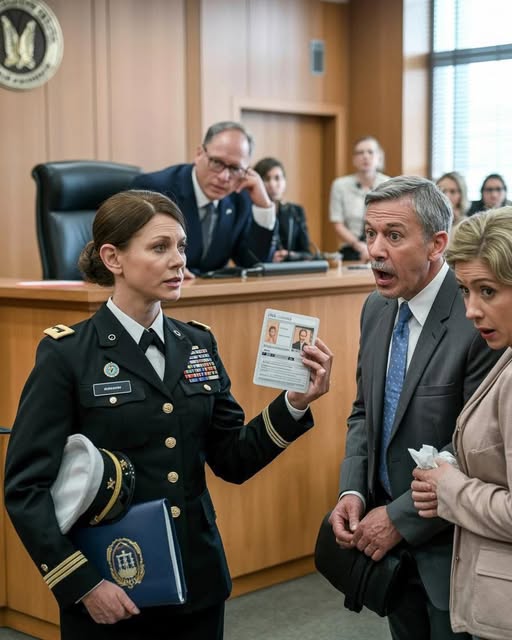
The judge’s voice dropped so low that for a moment I wondered if I had only imagined hearing it. “Captain Bates, from Yemen?” A second earlier, the courtroom had been filled with small, ordinary sounds—the faint tapping of the clerk’s keyboard, a quiet cough from somewhere in the back, the soft slide of paper shifting under someone’s arm. Then all of it seemed to thin out and disappear. My military ID rested between the judge’s fingers. Behind me, my father’s chair scraped once against the floor before going still.
The judge studied the card, then glanced at the ribbon bar pinned to my chest, and finally looked back down at the file in front of him. “I’m going to ask one question before we continue.” Their lawyer began to stand halfway. “Your Honor, if this concerns military service, I fail to see how it relates to the property dispute.” “You’ll sit down, counsel.” He did. The judge’s attention returned to me. “At Al Hudaydah, were you assigned to the evacuation corridor outside the embassy annex?”
The brass compass in my pocket pressed lightly against my thigh as I shifted my weight. “Yes, Your Honor.”
He held my gaze for a long second, then gave a small nod, almost as if confirming something to himself. “That is what I thought.”
My father exhaled sharply through his nose, as though the exchange were nothing more than theater. My mother leaned again toward their attorney, but this time she didn’t whisper—she simply stared at the judge’s hand resting on my ID. The judge instructed the clerk to mark my records as admitted and to retrieve Exhibit Fourteen from the supplemental packet. That was the moment my father paid attention. Because Exhibit Fourteen did not belong to them. It belonged to me.
The clerk removed the tabbed document from my binder. Heavy ivory paper. A county seal stamped clearly at the top. Two notarized signatures at
the bottom. The judge adjusted his glasses and began reading the opening lines in silence. A subtle change passed over his face—not sympathy, not quite surprise, but the recognition of something firm and undeniable. Across the aisle, my parents’ lawyer reached quickly for his own copy of the petition, flipping through the pages faster now. He hadn’t expected a supplemental packet. He had expected a daughter in uniform, maybe a few emotional words about service. He had not expected documentation. He had not expected a sequence of proof. He had not expected my grandfather.
Long before the farm turned into a legal dispute, it had simply been a place—a porch that creaked under wet boots, a kitchen window that never quite shut in January. The first thing my grandfather ever taught me there wasn’t how to drive a tractor or repair a fence. It was how to stand still long enough to listen. In summer, the soybeans whispered when the wind passed through them. In winter, the well pump let out a tired groan before sunrise. Every room carried its own memory through scent—motor oil near the mudroom, cedar in the hallway closet, coffee so dark it almost looked blue in his chipped mug. As a child, I would sit beneath the kitchen table tracing the knots in the wood while my father and grandfather argued above me—about money, repairs, timing, harvest, weather. My father always spoke like the farm had failed him. My grandfather always spoke as if the land itself was listening.
He was never a sentimental man. He didn’t give speeches about legacy or family heritage. He was practical in the way farmers are practical, understanding that survival is not an idea but a series of decisions made early enough to matter. And the people you trust with those decisions are not always the people you love most—they are the ones who show up when the work is difficult and the outcome uncertain. He trusted my father to charm others. He trusted my brother Ryan to sell an idea. He trusted me with the parts that needed to remain standing.
That difference was clear even when I was young. My father visited the farm the way people visit museums—appreciating what they see, but not caring about what holds it together. He would stand on the porch, looking over the fields, talking about what the land could become if someone would just think bigger, which was his way of wishing it were something else entirely. Ryan came even less often and with even less effort. He liked the idea of the farm the way people like the idea of exercise—as something that improves their image without requiring any actual participation. He called our grandfather “the old man” and spoke about the property’s potential like a real estate agent selling a future that might never exist.
I was the one who came back between semesters and fixed what needed fixing. I was the one who called every Sunday evening, listening to my grandfather talk about the weather, the soybeans, the fence post that had rotted near the creek. I understood that what he was really saying was that the farm was still alive, and that he was still the one keeping it that way. And that one day, that responsibility would pass to someone. He wanted that someone to understand what it meant to keep something alive.
At thirteen, I learned how to read a tax notice before I properly learned algebra. At sixteen, I was the one he called when a storm tore shingles from the equipment shed. By nineteen, after I left for Annapolis, he had me set up online access to the property account because, as he put it, “Your father confuses wanting something with owning it.” He said that casually, peeling an apple with a pocketknife on the back steps, juice drying on his wrist in the heat of August while cicadas screamed in the trees. His old hound slept under the swing. He never raised his voice when he told the truth. He simply placed it there and let it remain.
The farm itself was two hundred and forty acres in tidewater Virginia—mostly soybeans, some timber along the western edge, and a creek that flooded every third spring, leaving the lower field too wet to plant until May. It wasn’t valuable in a way that sparked envy. It was valuable in a way that made people careless—which is worse. Envy recognizes worth. Carelessness assumes it will take care of itself. My father had been careless about the farm his entire life. He had grown up on it, left for a sales career in Richmond, returned occasionally to complain about the driveway, and spent the rest of the time acting as though his inheritance required nothing from him.
My grandfather understood this about his son. He understood it without anger, the way a farmer understands soil that will never hold. There was a quiet sadness in it—the understanding that the person who would inherit the land did not understand the difference between owning something and keeping it alive.
I found Exhibit Fourteen two weeks after my grandfather’s funeral, though at the time I didn’t yet know how important it would become. The house had been full that day—casseroles, damp handshakes, people who spoke loudly about their love only after he was gone. My mother filled every room with flowers until the air felt thick. Ryan spent most of the afternoon near the hallway, taking calls, sounding busy. My father stood near the mantle discussing maintenance costs before the minister had even left the driveway.
Late that night, after everyone was gone, I went into my grandfather’s study to close the windows. Rain had started, and the curtains moved with each gust. The room smelled of old tobacco, paper, and the faint metallic scent of the safe behind the cabinet. The safe wasn’t fully closed. Inside were the deed folder, survey maps, and a sealed envelope with my name written in his familiar handwriting.
“Not open unless there is pressure.”
That was all it said.
No one saw me take it. No one noticed because downstairs my mother was saying the military had made me distant, and my father was already talking about selling the land.
I didn’t open the envelope until three months later, in a barracks room filled with humming lights and dust that found its way into everything. Inside were three documents.
The first named me managing beneficiary of the farm trust. The second required my written consent for any sale or transfer. The third was a handwritten note:
Use paper. Not anger. You understood what it means to keep something alive.
I carried that note through deployments, through exhaustion, through decisions that mattered. And when I returned home and learned my father had filed to claim the farm, I understood exactly what to do.
Back in the courtroom, the judge read the document carefully. Then he looked up. “Counsel, were you aware of this trust restriction?”
Their lawyer hesitated. “No, Your Honor.”
The judge turned to my father. “Were you aware?”
My father’s face flushed. “He was old. He signed things.”
“People?” the judge asked.
“She influenced him,” my father said. “She made him think she was the only capable one.”
“That is not an answer,” the judge replied.
My mother added quickly, “He was confused.”
That was their mistake. Because confusion could be disproven.
I presented the next document—a medical assessment confirming my grandfather was fully competent. Then another—evidence of financial redirection into an LLC my father had created.
The room grew quiet as each document was read.
The judge finally spoke. “The record shows otherwise.”
Their case unraveled without shouting, without drama—just paper, one piece after another, placed in order.
And in the end, the truth stood where it always had.
Not in words. Not in arguments.
But in what could be proven.