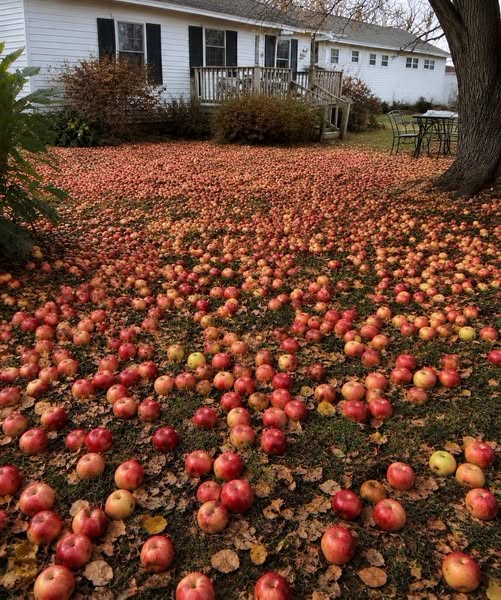
The night was silent when I realized someone wanted my husband’s tree dead.
Not pruned. Not moved. Erased.
The apples we once planted with hope were now at the center of a quiet war between grief, memory, and a bitter man next door. But the tree had its own way of fighting back, turning strangers into allies and slowly becoming something much bigger than the private memorial I had always believed it would be.
At first, I couldn’t understand why anyone would care so much about one old apple tree. To me, it wasn’t just a tree. It was the last living thing Dean and I had planted together. We had stood in that yard with our hands covered in dirt, laughing about how long it would take before we could finally eat an apple from its branches.
Dean never got to see that day.
After he died, the tree became part of the way I remembered him. I would sit beneath its branches, especially on quiet evenings, and imagine what he would have said about the first blossoms, the first tiny green fruit, and eventually the bright red apples that appeared each year. It was as close as I could get to watching something we started together continue growing without him.
Then the trouble began.
Someone had damaged the tree. Branches were broken, sections of bark had been scraped, and things around the roots had been disturbed. I suspected Ryan, the man next door, but proving it was another matter. He had complained about fallen leaves, overhanging branches, and children occasionally reaching through the fence for apples.
What began as irritation slowly became something more bitter. We stopped greeting each other. Conversations across the fence became accusations. The tree seemed to sit between us like a silent witness to every argument.
I was determined to protect it, but I never expected the tree itself to become the thing that changed everything.
As the seasons passed, neighbors began noticing how beautiful it had become. What had once been a small sapling was now large enough to provide shade across part of the yard. When the apples ripened, children began gathering on late summer evenings, running beneath the branches while their parents filled bags with fruit.
People started asking about the tree.
So I began telling Dean’s story.
I told them how we planted it together, how long it took to bear fruit, how Dean used to joke that he would probably need a ladder before the first apple ever appeared, and how he never lived to see the harvest. What had once been a private story became something I shared with neighbors who had never even met him.
The tree stopped feeling like a private relic of my grief and became a living part of the neighborhood’s rhythm.
Children came back each year. Families waited for the apples to ripen. Neighbors began bringing pies and jars of homemade preserves. People who had once simply walked past my yard now stopped to talk. Without realizing it, the tree had created a small community around itself.
Even Ryan changed.
He kept his distance at first. I could still feel the awkwardness whenever we crossed paths, and neither of us seemed ready to reopen the old arguments. But one fall, I saw his young daughter staring through the fence at the bright red apples.
She looked at them with the same kind of wonder Dean and I had felt years earlier.
I walked over and handed her a small basket.
Ryan hesitated. For a moment, I thought he might refuse. Instead, he quietly thanked me. His daughter smiled, and the tension between us suddenly felt a little less important than it had the day before.
The next year, Ryan helped me rake the leaves.
We never spoke about the damage or the lies. We didn’t need to. There are some apologies that begin long before the words are spoken. Sometimes they begin with a gesture, a shared task, or simply the decision to stop carrying an old fight into every new day.
The tree had done what Dean promised.
Given time, it grew.
It survived the damage, the arguments, the seasons, and the grief. More importantly, it gave something back. It gave children a place to gather, neighbors a reason to talk, and two people who had once been enemies a reason to finally lower their guard.
I still think of Dean whenever I stand beneath those branches. But now, I don’t only feel the ache of what was lost. I hear children laughing. I see families carrying baskets. I watch neighbors talking beneath the leaves.
The tree became his legacy in a way neither of us could have imagined.
It didn’t erase the past. It simply grew beyond it.
And every year, when the apples turn red, I remember the promise Dean made when we first planted it: that if we gave it enough time, it would surprise us all.
He was right.