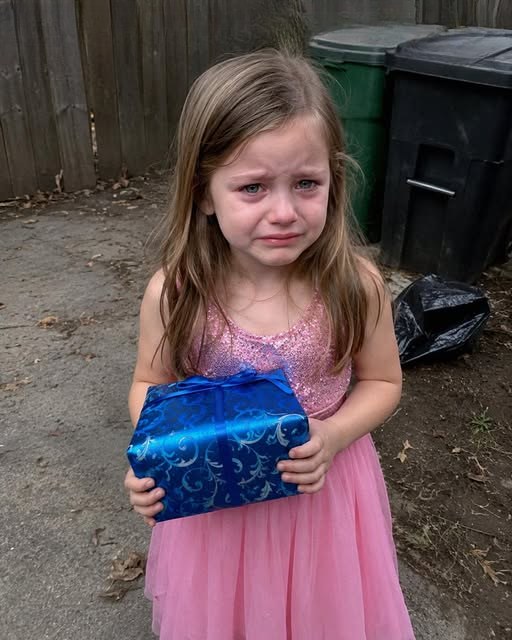
The moment I found my daughter crying alone near a backyard fence, something inside me changed forever.
Parents spend years trying to teach their children that they are loved, valued, and accepted. We tell them they belong. We promise to protect them. We assure them that family is supposed to be a safe place.
That afternoon, someone tried to take all of that away from my little girl.
And I wasn’t about to let it happen.
I was twenty-eight when I met Daniel.
At the time, I was already divorced and raising a young daughter on my own. Ellie was only two years old when she accompanied me on my first date with him. Some people thought bringing a toddler along was unusual, but for me it was necessary. Anyone who wanted a place in my life had to accept the most important person in it.
Most men were polite around Ellie.
Daniel was different.
Instead of treating her like an obligation, he immediately got down on her level. Within minutes, he was talking to her about the rabbit pattern on her socks and helping her decorate a paper craft while I watched in amazement.
That was the first time I realized he might be someone special.
Over the following years, their connection only grew stronger.
When we married, Ellie proudly stood beside us during the ceremony. Later, she announced to the guests that Daniel was her “almost dad,” making everyone laugh while Daniel quietly wiped tears from his eyes.
A year later, he officially adopted her.
The day became one of the happiest memories of our lives.
Sitting on his lap after the celebration, Ellie looked up at him and asked a question she had clearly been carrying for a long time.
“Can I call you Dad now?”
Daniel hugged her tightly.
“You can call me Dad forever.”
At that moment, I believed every wound from the past would eventually heal.
I believed love would be enough.
Unfortunately, not everyone shared that love.
Daniel’s mother, Carol, never openly argued with us. Instead, she practiced a quieter kind of cruelty.
She rarely acknowledged Ellie.
Holiday cards conveniently forgot her name.
Family conversations somehow excluded her.
The rejection was subtle enough that many people ignored it, but obvious enough that I noticed every single time.
Daniel always asked me to be patient.
“She’ll come around,” he would say.
For years, I tried.
Then came Jason’s birthday party.
Ellie was excited for days beforehand.
She carefully picked out a gift, helped wrap it, and spent an entire week wondering whether her cousin would like it. The morning of the party, she wore her favorite blue dress and couldn’t stop smiling.
When we dropped her off, everything seemed normal.
Children were laughing.
Parents were chatting.
The backyard was filled with decorations.
Daniel and I left for lunch, expecting to return a few hours later and pick up a happy child.
Instead, less than an hour later, my phone rang.
It was Ellie.
The second I heard her voice, I knew something was wrong.
“Mommy,” she sobbed. “Can you come get me?”
My heart dropped.
“What’s wrong?”
There was a pause.
Then the words that still make my blood boil.
“Grandma said I’m not really family.”
For a moment, I couldn’t even process what I had heard.
Daniel immediately turned the car around.
Neither of us spoke during the drive.
The only thing that mattered was getting to Ellie.
When we arrived, we found her sitting alone near the fence.
Her face was stained with tears.
Her beautiful dress was dirty from the grass.
She was clutching her gift as though it were the only thing she had left.
Daniel ran straight to her.
I walked into the house.
Inside, people were eating cake and chatting as though nothing had happened.
Carol sat comfortably at the table.
I looked directly at her.
“Why is my daughter outside crying?”
The room became silent.
Without the slightest hint of regret, Carol answered.
“She isn’t part of this family.”
I felt sick.
Not angry at first.
Just shocked.
How could an adult say something so cruel to a child?
How could anyone watch it happen and do nothing?
I looked around the room.
Several people lowered their eyes.
Nobody defended Ellie.
Nobody stopped Carol.
Nobody thought a little girl deserved better.
That hurt almost as much as Carol’s words.
I left before my anger got the better of me.
Back home, we spent the evening making sure Ellie understood something important.
She had done absolutely nothing wrong.
We took her for ice cream.
Watched her favorite movie.
Stayed close until she finally smiled again.
But once she fell asleep, Daniel and I made a decision.
What happened would not simply be forgotten.
A few weeks later, we hosted a family gathering of our own.
This time, the invitation carried a simple message:
Everyone who loves and accepts Ellie is welcome.
The response told us everything we needed to know.
Friends came.
Relatives came.
Children filled the yard with laughter.
And most importantly, Ellie spent the day surrounded by people who genuinely cared about her.
At one point, her cousin Jason approached her and apologized for what had happened.
Then he said something that surprised everyone.
“You are my family.”
The smile on Ellie’s face was worth more than anything else that happened that day.
For the first time since the party, she looked completely at ease.
Watching her laugh with the people who accepted her reminded me of a truth that many adults forget.
Family isn’t defined only by blood.
It is built through love, loyalty, kindness, and the willingness to stand beside one another.
Over time, Carol attempted to repair the damage she caused.
She apologized.
She made efforts.
She slowly began treating Ellie differently.
Whether the relationship will ever fully recover remains to be seen.
But one thing will never change.
My daughter will never again question whether she belongs.
Not in our home.
Not in our family.
And certainly not in her own heart.
Because no child should ever have to earn a place among people who claim to love them.
Real family doesn’t make children prove they belong.
Real family makes sure they never have to wonder.