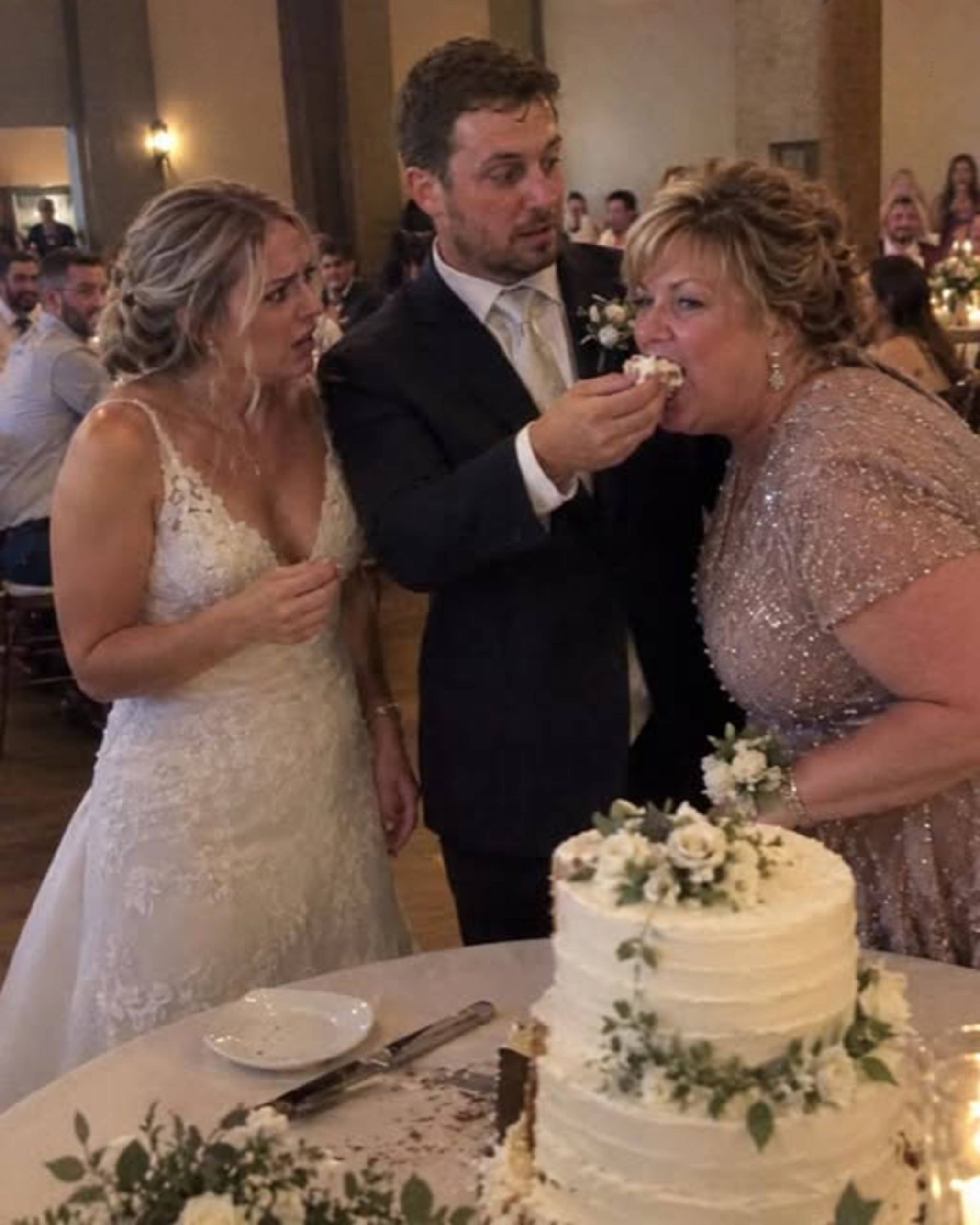
I spent months giving in to my mother-in-law because I didn’t want our wedding to become a family war.
Every time she changed something, I told myself it wasn’t worth arguing about.
Every time she dismissed one of my ideas, I swallowed my frustration.
Every time Mark asked me to “just let her have this one,” I agreed.
I convinced myself that marriage was about compromise, and if making a few sacrifices kept everyone happy, then perhaps those sacrifices were worth it.
But then she humiliated me during one of the most photographed moments of the entire night.
I didn’t confront her.
I didn’t cause a scene.
I didn’t ruin my own wedding by screaming at her in front of our guests.
Instead, I waited.
And before the night was over, I made sure Emmy understood that there are some lines you can cross only once.
When Emmy first offered to help pay for our wedding, she called it a gift.
She smiled when she said it.
A warm, generous smile that made it difficult to object.
“I just want you two to have the wedding you deserve,” she told us.
At the time, I believed her.
I thought she was simply being a loving mother who wanted to help her son begin his marriage without financial stress.
By the end of the reception, I understood something completely different.
It had never been a gift.
It was control.
And somehow, without ever saying the words directly, Emmy believed that because she had contributed money, she had purchased a say in almost every part of our wedding.
The flowers.
The guest list.
The music.
The cake.
The seating arrangements.
The photographs.
And, apparently, partial ownership of her son.
It started slowly.
At first, it was little things.
She suggested a different florist.
Then she said the one we’d chosen was “too modern.”
She wanted different invitations.
Then she asked why we were using “such plain wording.”
She didn’t like our first cake tasting.
She didn’t like the color of the bridesmaid dresses.
She had opinions about the ceremony music.
Then came the guest list.
She handed me a list of people I had never met.
“These are family friends,” she explained.
“There are thirty-seven names.”
She smiled.
“Yes.”
“We invited 120 people.”
“Then you’ll invite 157.”
I laughed because I thought she was joking.
She wasn’t.
Mark tried to smooth things over.
“Mom, we have a budget.”
She looked at him.
“Which is why I’m helping.”
That ended the conversation.
At least for that day.
The wedding we wanted was simple but still more expensive than we had expected.
My parents couldn’t contribute much, and Mark and I were trying desperately not to begin our marriage with debt.
We had already agreed that we would pay for what we could ourselves.
We wanted a beautiful day, but we didn’t want to spend the first five years of our marriage paying for one.
Then Emmy offered to cover the venue and half the catering.
It was a substantial amount of money.
Enough that saying no would have meant making major changes to the wedding.
So we accepted.
That was when everything changed.
“She is going to have opinions,” Mark said one evening.
We were sitting at our kitchen table with spreadsheets open between us.
I had my laptop in front of me.
Mark had a calculator beside his coffee.
There were columns for food, flowers, photography, music, transportation, decorations, and dozens of other expenses I had never imagined would be necessary for a single day.
“The venue deposit is due Friday,” I said.
“I know.”
“And your mom said she’ll cover it?”
“She said she’ll pay directly.”
I looked at him.
“Opinions are fine,” I said. “She is helping us. Of course, she should have some input.”
Mark stared at me with the tired expression of someone watching another person walk toward a hole he had already fallen into.
“I know she can be difficult.”
I smiled.
“No. Difficult is someone who complains about the food.”
Mark didn’t laugh.
“My mother complains until everyone agrees the food was horrible when it wasn’t.”
I laughed.
He did not.
That should have been my warning.
But I ignored it.
I thought I was being reasonable.
I thought I was choosing peace.
What I didn’t understand was that Emmy didn’t see compromise the way I did.
To me, compromise meant both sides giving something.
To Emmy, compromise seemed to mean I gave something and she received it.
She began referring to the wedding as though it were her project.
“My venue.”
“My caterer.”
“My florist.”
“These are my people.”
At first, I corrected her gently.
“Our venue.”
“Our caterer.”
“Our wedding.”
Eventually, I stopped.
It was easier.
That became the pattern.
She wanted the flowers changed.
I agreed.
She wanted six additional tables.
I agreed.
She wanted a different song for our first dance.
I refused.
She called Mark.
The next evening, Mark came home looking exhausted.
“Can we just use her song?”
I stared at him.
“It’s our first dance.”
“I know.”
“Then why are we having this conversation?”
“Because she paid for the venue.”
There it was.
The sentence that eventually became the answer to everything.
She paid for the venue.
She paid for the catering.
She helped with the wedding.
Therefore, according to Emmy, she had earned the right to make decisions.
I changed the song.
Then she wanted to change the seating arrangement.
Then she wanted to move the cake.
Then she decided that some of her friends should sit closer to the head table.
I gave in.
Each time, I told myself the same thing.
*It’s one day.*
*Don’t let this become a family war.*
*After the wedding, things will be different.*
I believed that last part most of all.
I thought once Mark and I were married, Emmy would finally understand that our marriage was ours.
I was wrong.
The week before the wedding, she called me three times in one day.
The first call was about flowers.
The second was about photographs.
The third was about my dress.
“Your neckline is a little low,” she said.
I looked down at myself.
“It isn’t.”
“I just think you’ll be happier with something more traditional.”
I took a breath.
“Emmy, the dress is already paid for.”
“I know.”
There was a pause.
“That’s unfortunate.”
I almost laughed.
Instead, I said goodbye.
The night before the wedding, Mark found me sitting on the floor surrounded by boxes.
“What are you doing?”
“Trying not to cry.”
He sat beside me.
“I’m sorry.”
I looked at him.
“For what?”
“For my mother.”
I wanted to be angry.
But I was tired.
“I don’t want to fight with her.”
“You won’t.”
“Promise?”
He took my hand.
“I promise.”
The next morning, I woke up nervous but happy.
For all the stress, all the compromises, all the things I hadn’t gotten exactly right, there was still one thing Emmy couldn’t control.
I was marrying Mark.
And when I walked down the aisle and saw him waiting for me, everything else disappeared.
For a few minutes, there was no mother-in-law.
No guest list.
No flowers.
No money.
No arguments.
Just him.
Then the reception began.
People laughed.
Music filled the room.
Glasses clinked.
My parents danced.
Mark’s friends pulled him onto the dance floor.
And for the first time in months, I allowed myself to relax.
Maybe I had been wrong.
Maybe Emmy really did just want everything to be perfect.
Maybe all the tension had been wedding stress.
Maybe once the night was over, we’d all laugh about it.
Then came the photographs.
The photographer gathered us together for one of the most important pictures of the night.
Family.
Parents.
Bride.
Groom.
Everyone was smiling.
I stood beside Mark.
Emmy stood on his other side.
The photographer lifted the camera.
“Everyone look here!”
I smiled.
Then Emmy leaned toward me.
She whispered something so quietly that no one else heard.
But I heard every word.
And when the camera flashed, I realized she had deliberately chosen that exact moment.
The moment that would be preserved forever.
I looked at her.
She smiled for the camera.
A perfect mother-in