My Husband Turned Our Wedding Cake Into a Prank, but My Father’s Calm Response Changed Everything
A wedding day is supposed to be one of the happiest moments in a couple’s life, filled with love, laughter, and unforgettable memories. But for one bride, what should have been a beautiful celebration quickly turned into an embarrassing moment when her husband decided to turn their wedding cake into the center of a prank. What happened next, however, was something no one in the room expected—especially the groom.
The reception had been going wonderfully. Family members and friends gathered around the newlyweds, music filled the room, and cameras captured every smile. After months of planning, the bride finally felt she could relax and enjoy the special day she had dreamed about for so long.
Then came the wedding cake.
Beautifully decorated and carefully prepared for the occasion, the cake stood proudly in the center of the reception area. Guests gathered around as the couple stepped forward to cut the first slice together. Everyone expected the traditional moment: a few photographs, a kiss, and perhaps a playful bite of cake shared between the newlyweds.
But the groom had a different idea.
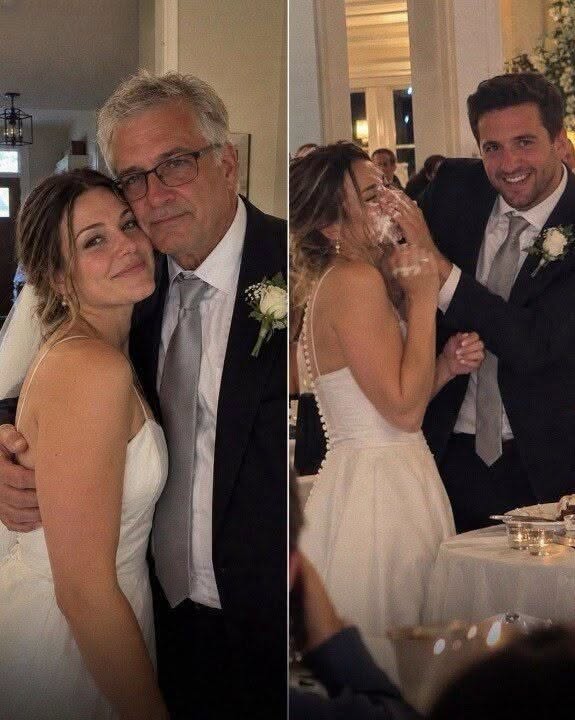
Just as the bride leaned forward, expecting a sweet and romantic moment, her husband suddenly turned the cake-cutting ceremony into a prank. Instead of keeping things gentle and affectionate, he pushed the cake toward her face, smearing frosting across her cheeks and ruining part of her carefully prepared makeup.
For a moment, the room erupted in laughter.
Some guests thought it was hilarious. Others quickly raised their phones to capture the scene. The groom appeared pleased with himself, laughing as though he had just delivered the funniest joke of the evening.
But the bride did not share his enthusiasm.
She stood there, covered in frosting, trying to process what had just happened. She had spent hours preparing for the wedding, choosing her dress, arranging her makeup, and imagining how every special moment would unfold. Now, in front of the people she loved most, she felt humiliated.
What hurt her most was not the ruined makeup or the cake itself. It was the feeling that her husband had chosen to embarrass her publicly without considering how she might feel.
She forced a smile, hoping to avoid turning the reception into an argument. Yet those closest to her could see that something was wrong.
Among them was her father.
He had watched the entire scene from nearby. Unlike some of the guests, he did not burst into laughter or rush forward to criticize the groom. Instead, he remained calm, observing his daughter’s expression and the way her new husband continued to treat the incident as a joke.
Then he stood up.
The room gradually became quieter as the bride’s father approached the couple. He did not shout, raise his voice, or make a dramatic scene. His expression remained composed, and his movements were deliberate.
He looked at his daughter first, making sure she was all right. Then he turned toward his son-in-law.
What he said was brief, but it immediately changed the atmosphere.
Rather than insulting the groom or demanding an apology in front of everyone, the father calmly reminded him that a marriage was built on respect, not on making one another the subject of a joke. A wedding was not an opportunity to embarrass a partner for the entertainment of others. It was the beginning of a shared life in which both people deserved consideration.
His words carried a weight that laughter could not overcome.
The guests who had been amused moments earlier began to look uncomfortable. A few lowered their phones, while others exchanged glances. The groom’s smile gradually faded as he realized that his father-in-law was not going to treat the incident as harmless entertainment.
The father did not need to threaten him or create a confrontation. His calm response made the point clearly enough.
He explained that playful moments could be part of a happy marriage, but a joke was only truly funny when both people could enjoy it. If one person was humiliated while everyone else laughed, then it was worth asking who the joke was really for.
For the first time that evening, the groom seemed to understand that his actions had consequences beyond a few seconds of laughter.
He looked toward his bride and noticed that she was still upset. The excitement of the prank had disappeared, leaving him to face the reality of how his behavior had affected the woman he had just married.
The bride’s father then stepped back, allowing the couple to speak privately. He had made his position clear without taking over his daughter’s moment or turning the reception into a family dispute.
His response was powerful precisely because it was measured.
Instead of escalating the situation, he reminded everyone present that respect should never be sacrificed for entertainment. His daughter did not need a public argument. She needed to know that her feelings mattered and that someone had noticed when a special moment became painful.
As the evening continued, the atmosphere slowly settled. Guests returned to their conversations, and the reception moved forward, although the incident remained on everyone’s mind.
For the bride, the experience became about more than a ruined cake or a prank gone wrong. It raised an important question about the kind of partnership she wanted to build and the importance of communicating boundaries from the beginning.
For the groom, it was an opportunity to reflect on the difference between making someone laugh and making someone the object of laughter. A sincere apology and a willingness to understand his wife’s feelings would matter far more than any attempt to dismiss the incident as harmless fun.
And for the bride’s father, there was no need for a dramatic speech or an angry confrontation. He had simply shown that a person could stand up for someone they loved without losing their composure.
His calm response changed the mood of the room and gave the bride something she desperately needed in that moment: reassurance that her dignity mattered.
The biggest lesson of the evening was simple: love is not measured by how loudly people laugh at a joke, but by how carefully they treat one another when the laughter stops.
A wedding marks the beginning of a marriage, but the way a couple handles uncomfortable moments can reveal just as much about their future as the happiest moments of the celebration.
Sometimes, the most powerful response is not anger or revenge. Sometimes, it is a calm reminder that respect is not optional—even when someone claims they were only joking.