The message contained only one sentence.
“You need to know what my mother has been hiding.”
I read it twice.
Then a third time.
For several seconds, I couldn’t decide whether Donald was trying to frighten me, manipulate me, or warn me.
I looked across the room at Carolyn.
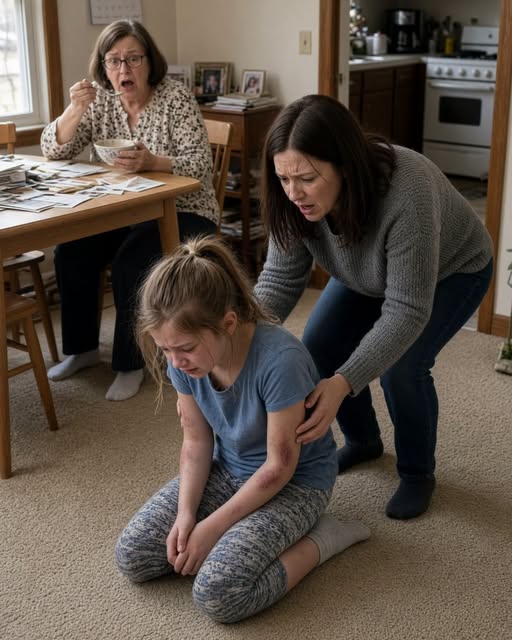
She was asleep on my friend’s couch, one small hand curled around the stuffed bunny she had carried out of our apartment. Her knees were wrapped in fresh bandages. Even asleep, she kept her legs slightly apart, as if she was afraid bending them would hurt.
I lowered the brightness on my phone.
Then another message appeared.
“Don’t tell Nancy I contacted you.”
My stomach tightened.
I typed back.
“What is she hiding?”
The typing indicator appeared almost immediately.
Then disappeared.
Then appeared again.
Finally, Donald sent a photograph.
It was a picture of a document.
At first, I couldn’t understand what I was looking at. There was a school logo at the top, several handwritten notes, and a date from months earlier.
Then I saw Carolyn’s name.
I zoomed in.
The document was from her kindergarten.
It wasn’t a report card.
It was a behavioral incident report.
My eyes moved down the page.
There were several entries.
Carolyn had apparently told a teacher that she was afraid to go home.
She had complained about being punished by her grandmother.
She had mentioned being forced to kneel.
And beside one of the entries, someone had written that Carolyn had become unusually quiet whenever Nancy was mentioned.
My hand went cold.
I looked at my daughter.
How had I never seen this?
Donald sent another message.
“Mom told me the school was exaggerating.”
I stared at the words.
Then came another.
“She said Carolyn was making things up because she wanted attention.”
I felt something twist inside me.
There had been signs.
There had probably been more than I wanted to admit.
Carolyn had started asking me to pick her up earlier.
She had become nervous when Nancy called her into another room.
She had stopped talking about school when Donald’s mother was around.
And every time I had asked, someone had supplied an explanation.
She was tired.
She was sensitive.
She was going through a phase.
She was five.
I had accepted those explanations because accepting them was easier than admitting that something might be wrong inside our home.
I looked again at the document.
At the bottom was a note from a teacher asking that Carolyn’s parents schedule a meeting.
The meeting had never happened.
I knew because I had never been invited.
Which meant someone had kept it from me.
I called Donald.
He answered on the second ring.
“What happened?”
His voice was low.
“Why didn’t I know about this report?”
He was silent.
“Donald.”
“My mother took the letter before I saw it.”
“You’re telling me she received a school report about our daughter and hid it from both of us?”
“I didn’t know she had it until today.”
I stood up and walked toward the window.
Outside, the street was quiet.
“Why did you send this to me now?”
Another silence.
Then Donald said, “Because Mom found out you were leaving.”
“That doesn’t answer my question.”
“She threatened me.”
My fingers tightened around the phone.
“What did she threaten you with?”
Donald breathed out slowly.
“She said if I didn’t make you bring Carolyn back, she would tell people I had known about what was happening.”
I couldn’t speak.
He continued.
“She has more documents.”
The room seemed to become smaller.
“What documents?”
“I don’t know exactly.”
“You don’t know?”
“She keeps everything.”
His voice cracked slightly.
“She keeps copies of messages, school letters, medical papers, everything. She told me she could make it look like you were an irresponsible mother who abandoned the family and took our daughter without permission.”
I closed my eyes.
There it was.
The bigger thing.
Nancy wasn’t simply trying to get Carolyn back because she believed she had done nothing wrong.
She was preparing a story.
A story in which I was unstable.
A story in which I was the parent who walked away.
A story in which my decision to protect my daughter could be turned against me.
“What else?” I asked.
Donald hesitated.
“She has been asking about your finances.”
My eyes opened.
“Why?”
“I don’t know.”
“Donald.”
“I swear I don’t know.”
I believed that he was frightened.
I didn’t yet know whether I believed anything else.
Then he said something that made me sit down.
“Mom already contacted someone about custody.”
“Who?”
“A lawyer.”
The word landed heavily.
I looked at Carolyn again.
She was still asleep.
Five years old.
Bandages on both knees.
And somewhere outside that room, adults were already discussing how to decide where she belonged.
I ended the call.
For the next hour, I did something I should have done much earlier.
I gathered every record I had.
Medical records.
School messages.
Photographs.
Bank statements.
Our daughter’s vaccination records.
Messages from Donald.
Messages from Nancy.
Anything that showed who had actually been caring for Carolyn.
I created copies and saved them somewhere Nancy couldn’t access.
Then I called my friend.
“I need help.”
She sat beside me.
“With what?”
“I need to understand everything that happened before today.”
She looked toward Carolyn.
“Then start with what you know.”
So I did.
I went through the last year.
The first time Carolyn had come home unusually quiet.
The time she had cried when Nancy offered to help her with homework.
The morning she had refused to wear a particular dress because Nancy had called her messy.
The afternoon she had asked whether Grandma would be angry if she got a math problem wrong.
At the time, each incident had seemed small.
Together, they formed a pattern I could no longer ignore.
Then I remembered something else.
A conversation from six months earlier.
Nancy had been sitting at our kitchen table when she told me that Carolyn needed stricter discipline.
“She is becoming spoiled,” Nancy had said.
I had laughed nervously.
“She is five.”
Nancy had looked directly at me.
“Exactly. That is why she still can be corrected.”
I had changed the subject.
I hated myself for remembering that sentence now.
Not because I had known exactly what Nancy intended.
I hadn’t.
But because I had heard something troubling and chosen peace over confrontation.
That night, I barely slept.
At seven the next morning, my phone rang.
It was Carolyn’s teacher.
I answered immediately.
“Is Carolyn okay?”
“She is safe with me,” I said.
There was a pause.
“I’ve been trying to reach you.”
My heart sank.
“About what?”
“I can’t discuss certain matters over the phone. But I need you to know that we have concerns about what Carolyn has reported.”
I sat up.
“Did she tell you about her grandmother?”
“Yes.”
“Why didn’t anyone tell me?”
The teacher was quiet.
Then she said, “We believed the other parent had received the communications.”
My stomach dropped.
“Which parent?”
“Mr. Donald.”
I looked toward my friend.
He had known.
Or at least, the school had believed he knew.
I asked the teacher whether she could send me copies of the relevant records.
She said she would follow the school’s procedures.
Before ending the call, she added one thing.
“There was another incident.”
“What incident?”
“Carolyn told a staff member she was afraid that if she told you the truth, you would leave her.”
I couldn’t breathe for a moment.
That sentence hurt more than anything else I had read.
My daughter had been trying to protect me.
A five-year-old had been carrying fear because she thought telling me would cost her mother.
I went to the couch.
“Carolyn.”
Her eyes opened slowly.
“Mom?”
I sat beside her.
“Can I ask you something?”
She nodded.
“Did Grandma ever tell you not to tell me things?”
Her face changed.
She looked down at her blanket.
I didn’t push.
After several seconds, she whispered, “She said you would be mad.”
“Did she say anything else?”
Carolyn squeezed her stuffed bunny.
“She said Daddy would be sad too.”
I felt tears come to my eyes.
“Did Daddy know?”
Carolyn shook her head.
Then she stopped.
She looked uncertain.
“I don’t know.”
That answer mattered.
I didn’t want to put words in her mouth.
I didn’t want to turn her fear into evidence for something I hadn’t confirmed.
So I hugged her.
“You don’t have to explain anything right now.”
She leaned against me.
“Are we going home?”
I swallowed.
“Not today.”
“Where are we going?”
“Somewhere safe.”
She nodded.
Then, almost too quietly to hear, she asked:
“Will Grandma find us?”
I looked at my daughter.
“No one is going to make you go anywhere just because they want to.”
It was the first promise I felt certain I could make.
Later that morning, Donald called again.
This time I didn’t answer.
He left a voicemail.
His voice sounded different.
Not angry.
Not demanding.
Desperate.
“Please call me. Mom knows you have the school records. She’s going to move first.”
I listened twice.
Then I called him back.
“What does ‘move first’ mean?”
“She wants to file for emergency custody.”
I stared at the wall.
“On what grounds?”
“She says you’re unstable.”
I almost laughed.
“Because I took our injured daughter somewhere safe?”
“No. She has another claim.”
“What claim?”
Donald didn’t answer immediately.
Then he said, “She says you have been planning to leave the marriage for months.”
“I have not.”
“I know.”
“Then why does that matter?”
“Because she’s trying to make it look like this was planned.”
I understood.
If Nancy could turn the night at the apartment into the final step of a secret plan, then the blood on Carolyn’s knees could become part of a completely different story.
Not a mother protecting her child.
A mother looking for an excuse to take her child.
I suddenly realized why Donald had been so insistent that I return home.
It wasn’t only about dinner.
It wasn’t only about his mother.
It wasn’t even only about control.
He wanted me back inside the apartment because the moment I left, there were witnesses, records, photographs, messages, and people outside Nancy’s control.
And Nancy knew it.
“Donald,” I said, “what else haven’t you told me?”
He was silent.
“I’m asking you one last time.”
His breathing became uneven.
Then he said something I hadn’t expected.
“Mom didn’t start this with Carolyn.”
I froze.
“What do you mean?”
“She did something similar to me when I was a kid.”
I couldn’t answer.
Donald continued.
“She used to make me kneel too.”
The room went silent.
“She told everyone I was being disciplined because I was difficult.”
He paused.
“I thought that was normal.”
For the first time since leaving the apartment, I understood why Donald had spent years defending his mother.
He wasn’t simply defending her.
He had learned to call her behavior normal before he was old enough to question it.
But that didn’t erase what he had allowed to happen to Carolyn.
And it didn’t make his choices disappear.
I asked him one question.
“Then why didn’t you stop her?”
His voice dropped.
“I was afraid of her.”
I looked at Carolyn.
She was coloring quietly at the table.
I thought about the five-year-old version of Donald.
Then I thought about the five-year-old version of my daughter.
Fear could explain a person’s silence.
It could not make the silence harmless.
Donald said he wanted to meet me.
Not at the apartment.
Not at his mother’s house.
Somewhere public.
I agreed.
But I brought my friend with me.
Donald arrived twenty minutes late.
He looked exhausted.
He sat across from me and placed a folder on the table.
“What is that?” I asked.
“Everything I found.”
I opened it.
There were school communications.
Old messages.
A copy of a letter I had never received.
And several handwritten notes from Nancy.
My hands stopped moving.
One note was dated months earlier.
It mentioned Carolyn by name.
It described her as “too soft” and said she needed to learn obedience before she became “like her mother.”
I read that sentence twice.
Then I turned the page.
There was another note.
This one contained a line that made my blood run cold.
“If she ever takes the girl away, we need to make sure nobody believes her version first.”
I looked at Donald.
“When did you find this?”
“Last night.”
“And you kept it?”
“I brought everything I could.”
I closed the folder.
For the first time, I knew the fight ahead would not simply be about where Carolyn slept.
It would be about whose version of the past would be believed.
And Nancy had been preparing hers for a long time.
I reached for my phone.
I had one more thing to do.
I opened the message from Nancy.
It had arrived while I was sitting across from Donald.
There was no greeting.
No apology.
Only one sentence.
“If you really want to protect your daughter, come back before I make the truth public.”
I showed it to Donald.
His face went pale.
“What truth?” I asked.
He shook his head.
“I don’t know.”
I stared at the message.
For the first time, I wondered whether Nancy had been hiding something about me too.
And whatever she believed she could reveal next, she clearly expected me to be afraid of it.