For months, I had no reason to question where my husband went every Sunday.
Then, one unexpected conversation left me wondering what else I’d been believing without a second thought.
The first thing I noticed was that Bryson didn’t drive toward the tennis courts.
I stayed three cars behind him, gripping the steering wheel so tightly that my fingers hurt.
Maybe they were playing somewhere else.
Maybe he was picking someone up.
Maybe Owen had been mistaken.
I kept repeating those possibilities because the alternative was too painful to consider.
I was looking for an innocent explanation.
I needed one.
But then Bryson turned toward downtown.
There weren’t any tennis courts there.
My stomach tightened.
I almost turned around.
Here I was, thirty-one years old, married for four years, and suddenly following my husband because his best friend, Owen, had accidentally revealed that Bryson had been lying to me for months.
Not a little lie.
Not the kind of lie people tell when they forget to mention something.
A routine.
Every Sunday.
For six months.
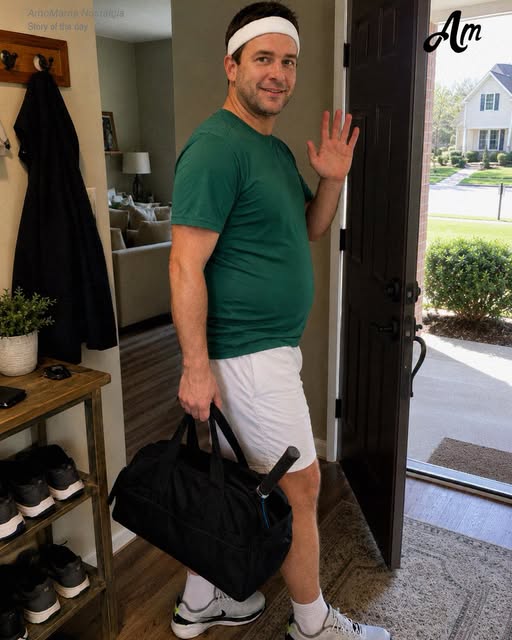
Every Sunday, Bryson left home carrying a racket bag.
He kissed me goodbye and said the same thing.
“Don’t wait for me. The guys might grab food afterward.”
Then he’d come home sweaty.
Sometimes he’d smell like grass.
Sometimes he’d complain about his shoulder.
Once, he came home with a small bruise on his elbow and laughed when I asked what happened.
“Bad return.”
I’d believed him.
Why wouldn’t I?
Owen was his best friend.
They had known each other since college.
Their Sunday tennis tradition was something I’d actually liked.
It gave Bryson something that belonged to him.
Friends.
Exercise.
Time outside the house.
I had never wanted to be the wife who needed to know where her husband was every minute.
Then Owen ruined everything without even realizing it.
It happened at a barbecue.
Owen had arrived late.
He was holding a beer and complaining about traffic.
Bryson wasn’t there yet.
I smiled and said, “He’s probably already warming up at the courts.”
Owen frowned.
“What courts?”
I laughed.
“The tennis courts.”
He stared at me.
Then he laughed awkwardly.
“He hasn’t played tennis with us in months.”
I thought he was joking.
“Very funny.”
“I’m serious.”
The smile disappeared from my face.
“What?”
Owen looked confused.
“Bryson told me he stopped coming.”
I felt the room suddenly become too warm.
“When?”
“Months ago.”
He paused.
“Why?”
I didn’t answer.
Owen seemed to realize he’d said too much.
“Maybe I’m mistaken.”
But I knew he wasn’t.
That night, Bryson came home around seven.
He kissed me.
“How was your day?”
I looked at him.
“Fine.”
“Did you have fun at the barbecue?”
“Yeah.”
He opened the refrigerator.
“What’d you guys talk about?”
I almost asked him.
Instead, I said, “Nothing important.”
That was the first time I realized I was afraid of the answer.
Now, six months of Sunday memories were suddenly being rewritten in my head.
Every time he’d grabbed that racket bag.
Every time he’d told me he was going to play.
Every time he’d come home.
Where had he actually been?
I watched him turn into a small parking lot downtown.
I slowed as I passed.
There was a dentist.
A tax office.
A dry cleaner.
And a small business I’d never noticed before.
Bryson parked.
Then he got out, carrying his racket bag.
“What are you doing?” I whispered.
He walked straight toward one of the businesses.
My heart started pounding.
My first thought was that it was another woman.
Of course it was.
I hated how quickly my mind filled in everything I didn’t know.
A secret apartment.
An affair.
Someone he’d been seeing every Sunday.
Someone who knew a version of my husband I didn’t.
Bryson opened a door and disappeared inside.
I drove around the block.
Then again.
I parked farther down the street where he couldn’t easily see me.
I sat there for nearly ten minutes.
Nothing happened.
No woman came outside.
No one entered.
No one left.
Finally, I got out.
The building had frosted windows.
There was a small sign beside the door.
I read it twice.
It wasn’t a hotel.
It wasn’t a restaurant.
It wasn’t anything I’d expected.
It was a counseling center.
I stood on the sidewalk, completely confused.
Why would my husband be going to a counseling center every Sunday?
And why was he carrying a tennis racket?
I almost left.
Then the door opened.
A man stepped outside.
He was older, maybe in his sixties.
Bryson followed him.
They were talking quietly.
I couldn’t hear the words.
Then the older man placed a hand on Bryson’s shoulder.
Bryson nodded.
The expression on my husband’s face was unlike anything I’d seen in years.
He looked tired.
Not physically tired.
Emotionally exhausted.
Then the older man said something.
Bryson looked down.
And I saw him wipe his eyes.
My heart broke.
I didn’t know what I was seeing.
But I knew it wasn’t an affair.
At least, not the kind I’d imagined.
I returned to my car before Bryson could notice me.
I drove home.
I sat in our driveway for twenty minutes.
When Bryson finally came home that evening, he walked through the front door carrying the same racket bag.
He smiled.
“Hey.”
I looked at him.
“Hey.”
“Sorry I’m late.”
“No problem.”
He put the bag down.
“Long game.”
I nodded.
Then I asked the question I should have asked months earlier.
“Bryson?”
“Yeah?”
“Are you okay?”
His smile disappeared.
For a second, I thought he might tell me.
Instead, he said, “I’m fine.”
Then he kissed my forehead.
And walked upstairs.
That night, I couldn’t sleep.
I kept thinking about the man outside the counseling center.
The hand on Bryson’s shoulder.
The tears.
The racket bag.
The lies.
The next morning, I called Owen.
“I need you to tell me something.”
He went quiet.
“What?”
“Did Bryson ever tell you why he stopped playing tennis?”
“No.”
“Are you sure?”
“Yes.”
I hesitated.
“Did he ever mention someone named Daniel?”
There was silence.
Then Owen said:
“Why do you know that name?”
My stomach dropped.
“Who is Daniel?”
Owen didn’t answer.
“Owen.”
He sighed.
“Daniel was Bryson’s older brother.”
I sat down.
“I didn’t know he had a brother.”
“You didn’t?”
“No.”
Owen was quiet.
Then he said something that made my blood run cold.
“Bryson’s brother died six months ago.”
I stared at the wall.
Six months.
Exactly when Bryson’s Sunday tennis started.
I suddenly remembered something.
The first Sunday he’d supposedly gone to play tennis.
He had come home late.
I’d asked why.
He had smiled and said, “One of the guys wanted to stay for dinner.”
I had believed him.
Because why wouldn’t I?
I hadn’t known there was a funeral.
I hadn’t known there was a brother.
I hadn’t known there was grief.
And I certainly hadn’t known that every Sunday, my husband had been carrying a racket bag into a counseling center instead of a tennis court.
That evening, when Bryson came home, I didn’t confront him immediately.
I waited until we were sitting together.
Then I placed a photograph on the table.
It was one I’d found online.
Bryson and a younger man.
The caption said:
“Daniel and Bryson, brothers forever.”
Bryson stared at it.
His face went completely pale.
“Where did you get that?”
“Who is he?”
He closed his eyes.
“My brother.”
“Why didn’t you tell me?”
He didn’t answer.
“Why have you been lying to me every Sunday?”
His hands began to shake.
“I didn’t know how to tell you.”
“Tell me what?”
He looked at me.
And for the first time in months, my husband stopped pretending everything was fine.
“Daniel didn’t die six months ago.”
I frowned.
“What?”
“He died four years ago.”
I couldn’t breathe.
“Then why did you say—”
“I couldn’t tell you the truth.”
“What truth?”
Bryson looked down.
“Because after Daniel died, my father blamed me.”
I stared at him.
“He said I should have been there.”
Bryson’s voice cracked.
“I was supposed to drive him that night.”
He swallowed.
“I canceled.”
The room became silent.
“And he died on the way home.”
Suddenly, the counseling center made sense.
The Sunday visits.
The racket bag.
The lies.
The man I’d seen with him.
Everything.
Bryson hadn’t been hiding another woman.
He’d been hiding guilt.
For four years, he’d been carrying the belief that his decision had somehow caused his brother’s death.
The counseling center wasn’t a place where he was building a new life.
It was where he was trying to learn how to live with the one he still had.
And the tennis racket?
That part was even harder.
Daniel had been the one who taught him to play.
Every Sunday had once belonged to the brothers.
After Daniel died, Bryson couldn’t bring himself to stop carrying the racket bag.
He couldn’t bring himself to play.
But he couldn’t bring himself to let the tradition disappear either.
So every Sunday, he drove downtown.
He sat with the counselor.
Then he went to the old courts afterward and stood there alone.
He had been pretending to play tennis because admitting the truth felt impossible.
I reached across the table and took his hand.
“You should have told me.”
“I know.”
“You didn’t have to carry this alone.”
“I was ashamed.”
“You were grieving.”
He looked at me.
“I thought you’d see me differently.”
I squeezed his hand.
“I do.”
His eyes filled with tears.
“But not because I think you’re weak.”
I leaned closer.
“I see you differently because now I understand how much pain you’ve been hiding.”
For months, I’d thought my husband was lying because he had another life.
Instead, he had been hiding the life he was afraid to show me.
And that realization changed something between us.
Not because the lies didn’t matter.
They did.
But because I finally understood that sometimes people don’t hide things because they don’t love you.
Sometimes they hide them because they are terrified that if you see the deepest part of their pain, you’ll never look at them the same way again.
Bryson still goes to counseling.
He still carries the racket bag.
But now, on Sundays, I sometimes go with him.
We don’t always talk.
Sometimes we simply sit on the old bench outside the courts.
And sometimes he tells me stories about Daniel.
Stories I should have heard years ago.
Stories about two brothers who grew up believing they’d have forever.
And now I know something I didn’t understand before.
The biggest secrets in a marriage aren’t always about betrayal.
Sometimes they’re about pain.
Sometimes the person sitting beside you isn’t hiding another life.
They’re hiding the pieces of the life they’re afraid you’ll be unable to bear with them.