Chapter 1: The Domestic Illusion
The smell of roasting garlic and rosemary should be the scent of a happy home. For fifteen years, that was the exact aroma of Friday nights in our house. David, my husband, would tie a canvas apron over his work clothes, pour himself a heavy glass of Cabernet, and command the kitchen. He was a contractor by trade, a man who built physical things with calloused hands, but in our kitchen, he fancied himself an artisan.
I sat at the marble island, nursing a glass of sparkling water, watching him chop parsley with practiced, almost militant precision. Leo, our fourteen-year-old son, was slouched at the dining table, eyes glued to a glowing screen, his foot tapping a restless, rhythmic beat against the mahogany chair leg. It was an ordinary, unremarkable evening. Or so I desperately forced myself to believe.
“Dinner in five,” David announced, wiping his hands on a linen towel. He offered me a smile. It was the exact same smile he used in our annual holiday photographs—the one that crinkled the corners of his eyes but never quite reached the dark pupils. “I made your absolute favorite, Sarah. Lemon herb chicken with roasted fingerling potatoes.”
“Smells incredible,” I lied.
The truth was, an unsettling, glacial coldness had taken root in my chest over the past month. It had started with infinitesimally small things. Missing financial statements from the mail. Strange, hushed phone calls David took in the insulated quiet of the garage. The way his eyes darted to my phone with hawkish intensity whenever it buzzed. I had convinced myself it was just marital stress. His contracting business, Oakhaven Builds, had been hemorrhaging money since the spring. I was the one with the trust fund, the one keeping the mortgage afloat.
David plated the food. He always used the heavy, rustic ceramic plates we’d bought on our honeymoon in Tuscany. Two dark grey ones for him and Leo, and the single, distinctive blue plate for me. He set the blue plate in front of me with a theatrical flourish, then carried Leo’s over to the table.
“I’m not eating,” David said casually, leaning back against the granite counter. “I tasted way too much while I was cooking. I’ll just stick with the wine.”
I didn’t think twice about it. Why would I? I picked up my silver fork and took a bite of the chicken. It was tender, perfectly cooked, but there was a faint, almost imperceptible metallic bitterness beneath the sharp tang of the lemon. I chewed, swallowed, and took a long sip of water to wash the strange taste away.
“How is it, buddy?” David asked Leo.
“Good,” Leo mumbled around a mouthful of buttery potatoes.
We ate in a comfortable silence for perhaps three minutes. Then, the rhythmic tapping of Leo’s foot abruptly stopped.
I looked over at my son. His smartphone had slipped from his loose grip, clattering sharply onto the hardwood floor. He didn’t reach down to retrieve it. His head was tilted forward, his eyelids drooping heavily, fighting a losing battle against gravity. He blinked—a slow, agonizingly sluggish movement, as if he were underwater.
“Leo?” I asked, my voice sharp, slicing through the quiet.
He tried to lift his fork, but his hand trembled with violent, jerky spasms. The utensil hit the edge of the grey plate and spun onto the floor. “Mom,” he slurred. The word was thick, misshapen, and entirely unrecognizable. “I feel… fuzzy. Can’t…”
A primal, maternal alarm screamed in my head. I stood up, my chair scraping violently against the floorboards.
As I did, a wave of intense, suffocating dizziness washed over me. The kitchen island seemed to violently tilt to a forty-five-degree angle. My legs instantly turned to wet cement.
The food.
I looked at David. He hadn’t moved a single inch. He was still leaning casually against the counter, his wine glass resting perfectly in his hand, watching Leo with an expression of mild, detached curiosity. Not panic. Not paternal concern. Just a cold, clinical observation.
“David, call 911,” I gasped, my fingers turning white as I gripped the edge of the table to keep from collapsing. “Something is wrong with him.”
“He’s just tired, Sarah,” David replied. His voice was terrifyingly calm. Soothing, almost.
I looked down at my blue plate. The bitter, metallic aftertaste coating my tongue. The way he had insisted I eat. The way he wasn’t eating. The puzzle pieces violently slammed together with the sickening finality of a steel vault locking shut.
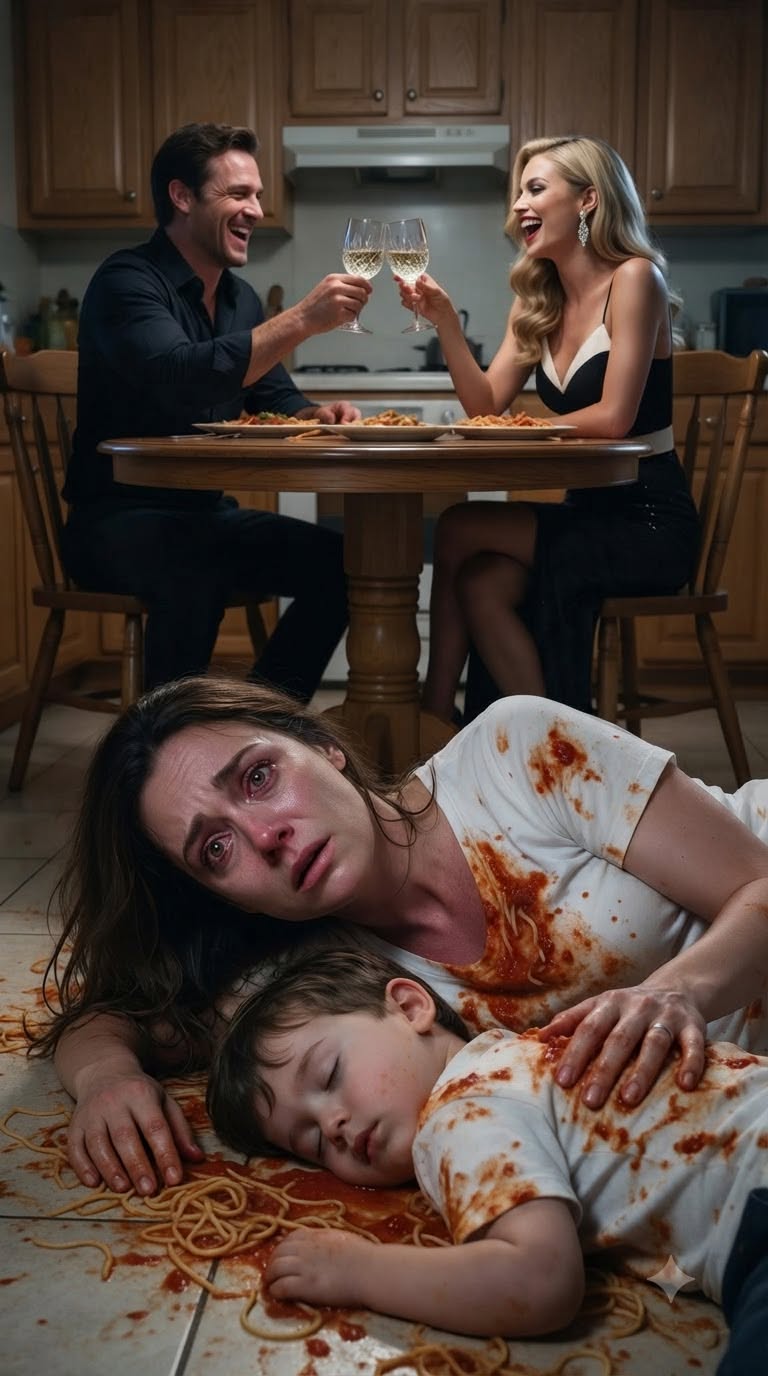
Leo slumped forward, his forehead hitting the edge of the wooden table with a sickening thud before he slid sideways, collapsing onto the floor like a ragdoll.
I tried to scream, but the sound was trapped in a paralyzed throat. My peripheral vision was tunneling into blackness. The drug—whatever heavy narcotic he had laced my food with—was hitting me faster than Leo, pulling me down into a dark, suffocating abyss.
But the sheer adrenaline of a mother watching her child fall is a powerful, temporary counteragent.
If I pass out, we both die.
I knew it in my marrow. I had to secure evidence. I had to outsmart the man I had slept next to for fifteen years.
“I’m… going to be sick,” I groaned, staging a dramatic, heavy stumble toward the stainless-steel sink. David took a step toward me, a predator calculating the fall of its prey, but I waved him off with a weak, trembling hand. “Bathroom,” I choked out.
I deliberately didn’t make it to the bathroom. I let my knees buckle, collapsing heavily behind the massive kitchen island, intentionally dropping out of his direct line of sight. My hands were shaking so violently I could barely control my own fingers. From my cardigan pocket, I yanked out the small, heavy-duty plastic ziplock bag I used to carry my daily vitamins. I dumped the capsules onto the floor.
Reaching up blindly over the counter, my fingers grazed the cool ceramic edge of my blue plate. I frantically scraped a handful of the laced chicken and mashed potatoes into my palm and shoved the greasy, metallic-smelling mess into the plastic bag. I sealed it shut, the air pressing out with a soft pop.
“Sarah?” David’s voice drifted over the island. There was an edge to it now. A razor-thin slice of suspicion.
Where could I hide it? If he found it in my pocket when he dragged my body away, it was entirely over. With seconds to spare, I shoved the sealed bag down the front of my shirt, tucking it tightly beneath the restrictive wire of my bra. The warm, mashed food pressing against my bare skin made my stomach violently heave, but I swallowed the bile down.
I crawled toward Leo, my limbs going entirely numb. “Leo,” I whispered, reaching his side. I grabbed his fragile wrist. His pulse was thready and terrifyingly slow, but he was alive.
Then, the floorboards creaked.
David was walking around the island. The heavy, rhythmic thud of his leather boots grew louder. I immediately closed my eyes, letting my head loll lifelessly against the cold kitchen tile. I forced my erratic breathing to slow, artificially mimicking the deep, rhythmic breaths of the deeply unconscious.
The boots stopped right next to my ear.
I could smell the polish on his leather shoes. I could hear the denim of his jeans rustling as he crouched down beside me. His broad shadow fell over my face, blocking out the warm, amber kitchen lights. A hand, rough and calloused from years on construction sites, brushed against my neck. Two fingers pressed firmly against my carotid artery, feeling for the rhythm of my fading heart.
Please, I begged the universe. Please don’t let him look under my shirt.
The fingers lingered on my neck for what felt like an eternity. Then, they pulled away. I heard the rustle of fabric as David stood up. He didn’t sound panicked. He didn’t sound like a grieving husband. He let out a long, slow exhale of profound relief.
Then, the terrifying silence of the kitchen was broken by the sharp, distinct sound of a phone being unlocked.