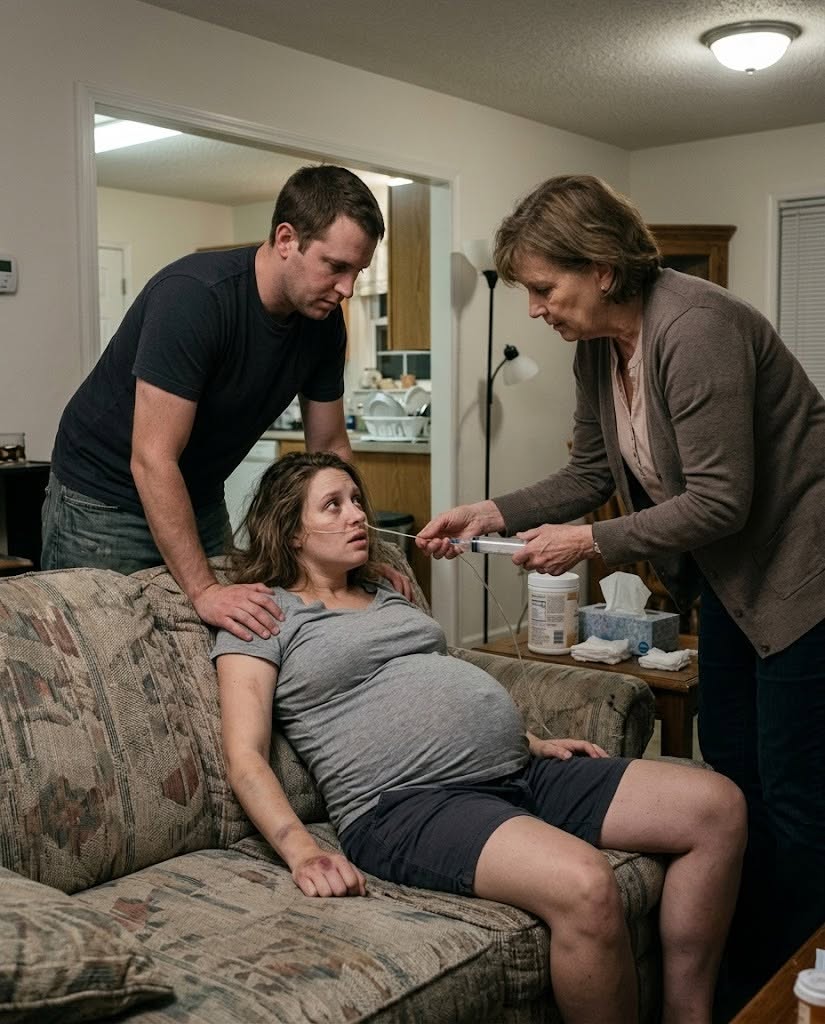
The officer’s gaze settled on the purple bands around my wrists before he looked back at me. “Were your husband and his mother the ones who caused those marks?”
I said, “Yes. Both of them.”
The words came out quietly, but once they were in the room, I couldn’t pull them back.
The officer nodded as if I had given him a fact instead of detonated my marriage. He told me to stay where I was while another officer kept my husband downstairs. I could hear my mother-in-law talking over everyone, insisting there had been a misunderstanding and that she had only been following a medical plan.
She sounded offended now, not frightened.
“She has to eat,” she kept saying. “Someone has to think about that baby.”
I had heard that sentence in a dozen different forms for months. It had been used when she changed what I was eating, when she decided I hadn’t taken enough, when she stood over me while my husband told me to stop being difficult. Whatever happened to me could be justified by adding three words at the end: for the baby.
The officer crouched a few feet away from me.
“Is there anything in this room you need before we leave?”
It took me a second to understand that he was asking me.
Not my husband. Not his mother.
Me.
I grabbed my charger, a sweater, and the small folder where I kept my prenatal paperwork. My hands were still shaking. When I stepped into the hallway, my husband was standing near the stairs with another officer between us.
He looked at me the way he always did when someone else was present—careful, wounded, almost gentle.
“Please tell them what actually happened,” he said.
I stopped.
For a second, the old reflex came back. Explain. Soften it. Make sure nobody thought he was a bad husband. Make sure nobody thought his mother was cruel. Make sure the story hurt them as little as possible, even if telling it that way meant hurting myself again.
Then the officer beside me said, “You don’t have to respond.”
So I walked past him.
My mother-in-law was in the living room holding a binder against her chest. I recognized it immediately. She had been keeping feeding schedules, weight notes, appointment summaries, and lists of what she believed I should consume each day. She opened it for the officers as if organization itself proved innocence.
“Look,” she said. “I document everything.”
One officer took the binder without agreeing with her.
My husband tried again. “She’s been under a lot of stress.”
That was when the first officer looked at him and said, “Your wife called 911 because she said you restrained her. We’ll speak to you separately.”
My husband stopped looking at me.
I was taken to the hospital to be examined and to make sure the baby was all right. During the ride, I kept expecting someone to tell me I had overreacted. I had heard that judgment so many times in my own house that silence almost felt suspicious.
Instead, the paramedic asked before touching my arm.
“Can I put the cuff here?”
I nearly cried over a blood-pressure cuff.
At the hospital, the baby’s heartbeat was checked first. Hearing that steady rhythm did something to me that reassurance hadn’t been able to do. I had spent months being told that obedience was the only way to protect my child. Yet there I was, away from both of them, and my baby was still there.
A doctor examined the bruises on my wrists, my cheek, and the older marks along my legs. She asked how each one happened. When I couldn’t remember every incident in order, she didn’t accuse me of lying. She simply slowed down.
The tube complicated the story, but not in the way my mother-in-law expected.
It had been part of my medical care. That fact was real. What wasn’t real was their claim that its existence gave them control over me.
The doctor pulled up my chart and read through the instructions from my care team. Nothing authorized my mother-in-law to decide when I could refuse. Nothing told my husband to pin me down. Nothing said that physical force was an acceptable response if I was afraid or nauseated or simply said no.
Then she found something else.
Several weeks earlier, someone had called the clinic asking what to do when I “wouldn’t cooperate” with feeding at home. The nurse who took the call had documented the answer clearly: do not restrain the patient; contact the care team if intake becomes a concern.
The number attached to the call belonged to my mother-in-law.
I stared at the screen.
She had asked.
She had been told.
And she had done it anywa
That was the first moment I understood the difference between something feeling wrong and something leaving a trail.
A detective came to the hospital later that night. He told me the 911 dispatcher had remained on the line long enough to hear parts of the conversation outside the bedroom. She had heard my husband tell me to say I was fine. She had also heard him and his mother talking about fixing the situation before officers arrived.
He asked whether there might be messages on my phone.
I almost said no.
Then I remembered how often my mother-in-law texted my husband about me while I was sitting in the same room.
I opened their family group thread first. Most of it looked ordinary—appointments, groceries, reminders. Then I searched my own name.
The messages changed.
His mother had written things like, “She didn’t finish enough.”
My husband had replied, “I’ll handle it when I get home.”
Another night, she wrote, “She keeps pulling away.”
He answered, “Wait for me. It’s easier if I hold her.”
I handed the phone to the detective.
He read without reacting, then asked permission to photograph the screen.
There were more.
Some were months old.
I could see the progression in a way I had never allowed myself to see it while I was living inside it. At first, they discussed what I ate. Then they discussed whether I was being “cooperative.” Eventually, they stopped talking about my choices at all. I had become a problem they managed together.
The worst message wasn’t even the most aggressive one.
It was from my husband.
“Mom knows what she’s doing. Just don’t argue with her.”
He had sent it to me after I told him I was frightened by how much control she had taken over my care.
I had replied with one word.
“Okay.”
For a while, that word devastated me. It looked like agreement.
The detective asked what it meant.
“It meant I wanted the argument to stop,” I said.
He nodded and moved on.
The next afternoon, my mother came to the hospital. Months earlier, after one of the first times I tried to tell her that my husband was letting his mother make decisions for me, she had made one mistake I hadn’t forgotten.
“Maybe he’s scared about the baby too,” she’d said.
She had meant to calm me down. Instead, I stopped telling her things.
Now she stood beside my bed looking at the photographs the hospital had taken of my wrists.
“I should have listened better,” she said.
That was all.
She didn’t defend what she had said before. She didn’t ask me to make her feel better about it. She just stayed.
Within two days, I was released to a place where neither my husband nor his mother was staying. An advocate helped me understand the temporary protections that had been put in place and what I could ask for next. My husband was ordered not to contact me directly while the investigation continued. His mother was told the same.
For the first time in months, nobody was keeping a chart of what I ate.
The freedom was stranger than I expected.
The first morning, I sat at the kitchen table with toast in front of me and waited for someone to comment on it. Nobody did. I ate half, stopped, then ate the rest ten minutes later because I wanted to.
I straightened a stack of unopened mail on the counter even though it wasn’t mine.
Then I went to an appointment with my mother beside me.
The appointment itself gave the investigation another piece of context. My doctor showed me an older note I had never seen. During a previous visit, my husband had answered several questions for me and described me as “extremely anxious about feeding.” The wording had made it into my chart.
For a few minutes, I felt sick.
There it was—the version of me he had been building for other people.
Anxious. Emotional. Uncooperative.
All words that could be true in isolation.
None of them explained why I had bruises.
My doctor added a new note documenting that I reported being restrained and that neither my husband nor his mother had authority to force treatment on me. She also changed my contact permissions so information about my care would not automatically flow through him.
That should have felt like a clean turn forward.
Instead, the next few weeks were quieter and harder.
My husband’s relatives began calling my mother. They didn’t threaten me. They didn’t even openly accuse me. They asked questions that sounded reasonable if you hadn’t been inside that house.
Was I sure he hadn’t just panicked?
Wasn’t his mother trying to help?
Didn’t pregnancy make everything more intense?
I stopped answering through other people too.
The case moved toward a hearing about whether the protective order should continue. I thought the bruises, the messages, and the 911 recording would make it simple.
Then my husband’s attorney produced a message I had sent during one of the worst weeks of my pregnancy.
It said, “Fine. Do whatever you need to do so I can get enough in.”
When it was read aloud, my stomach dropped.
I remembered the night immediately. I had been exhausted and scared. My husband had spent hours telling me that if anything happened to the baby it would be because I refused to cooperate. I had sent the message just to end the argument.
But on paper, separated from everything around it, it sounded like permission.
His attorney argued that my husband believed he was following my wishes during a medical crisis. My mother-in-law’s binder was offered as proof that she had been focused on nutrition rather than punishment or control.
For the first time since calling 911, I wondered whether they were going to succeed.
Not because the truth had changed.
Because I suddenly understood how easily one sentence could be lifted out of months of fear and made to stand in for all of it.
Then the detective asked for the complete message thread.
The rest of that conversation had not been included.
Less than two minutes after sending “Fine,” I had written another message.
“I mean help me stay on schedule. Do not hold me down again.”
My husband had replied, “Then stop fighting us.”
The room went silent when that line was read.
There was no explanation around it. No interpretation needed. I had told him not to restrain me. His answer wasn’t confusion. It was a demand that I stop resisting.
The 911 recording came next.
I listened to my own voice telling the dispatcher I was locked in the bedroom. Then my husband’s voice in the background telling me to say I was fine.
Finally came the sentence I had heard through the DOOR that night.
“We need to fix this before they get here.”
Hearing it played back was different from remembering it. In my memory, I was still trapped on the other side of the wood, wondering what they could do before police arrived.
In that room, with other people listening, the sentence belonged to evidence instead of fear.
The protective order remained in place.
The criminal case did not end that day, and neither did the separation. There were interviews, paperwork, attorneys, and decisions about the baby’s future that I never imagined making while pregnant. My husband and his mother continued to insist through their attorneys that they had been trying to help me.
But they could no longer make that explanation the only one anyone heard.
Months later, both cases ended with court-ordered consequences and continued restrictions on contact. My husband’s access to me remained limited, and any future questions involving our child had to go through the legal process rather than through his demands. His mother no longer had a place in my medical decisions at all.
The biggest change happened before any final paperwork did.
I gave birth with people in the room whom I had chosen.
Before anyone examined me, they asked. Before anyone touched the baby, they explained what they were doing. When I said I needed a minute, I got a minute.
Nothing terrible happened because I was allowed to have a voice.
That realization stayed with me longer than almost anything else.
After the baby and I were discharged, I didn’t return to the house where I had locked myself in the bedroom. My mother helped me move into a small apartment. It wasn’t impressive. The living room barely fit the secondhand couch someone gave me, and for weeks I had boxes stacked beside the wall because I was too tired to unpack them.
But the first night there, after the baby finally fell asleep, I walked to the front entrance and checked the lock.
For one second, the sound of the latch clicking made my whole body tense.
Then I looked down and saw the key in my own hand.
That was the difference.
The night I called 911, a locked DOOR had been the only thing between me and two people who believed they had the right to control my body.
Now the door belonged to me.
I could lock it.
I could open it.
And nobody on the other side got to decide when I had to.