I knew something was wrong before I understood exactly what I was looking at.
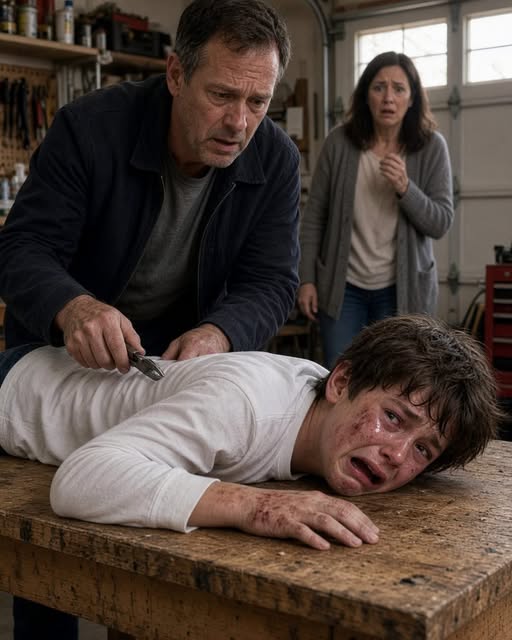
The garage door was open, letting daylight spill across the concrete floor and the wooden workbench my husband used for weekend projects.
Our teenage son was bent over that bench.
My husband stood beside him.
For one disorienting second, the arrangement looked almost ordinary.
Father.
Son.
Tools.
A lesson being taught in the garage.
Then I saw our son’s hand.
Then I saw the industrial nail gun in my husband’s grip.
And then I heard him say that this was what happened when a boy refused to keep his feet where they belonged.
Our son had snuck out of the house.
That was what my husband kept calling the beginning of the story.
He had broken a rule.
He had lied about where he was going.
He had slipped out when he knew we would say no.
Those things were true.
But standing in that garage, looking at the terror on my child’s face, I understood that none of those facts could explain what my husband had chosen to do next.
He had pinned our son’s hand to the wooden workbench with a heavy industrial nail gun.
And while our son was too frightened to move, my husband calmly prepared to use it again.
He raised the tool.
My body moved before my mind caught up.
I stepped directly between them.
“Put it down.”
My husband’s eyes shifted to me.
Not startled.
Not ashamed.
Annoyed.
It was the same expression he had used countless times whenever I disagreed with one of his punishments.
The expression that said I was interfering.
That I was sentimental.
That I was the reason the kids didn’t respect rules the way he thought they should.
“Move,” he said. “He needs to learn that actions have consequences.”
“He’s learned enough. Put it down.”
Behind me, our son whispered my name.
It was barely a voice.
Just one word.
But I heard fear in it that I had never heard from him before.
Not teenage embarrassment.
Not the irritation of a kid caught breaking curfew.
Fear.
Real fear.
The kind that doesn’t ask whether someone is angry.
The kind that asks whether someone is going to stop.
I grabbed the battery pack attached to the bottom of the nail gun.
My husband jerked his hand back, but I had already found the release.
I ripped the battery free.
The nail gun went dead in his hand.
His face changed.
For the first time since I had entered the garage, he looked caught off guard.
“Give that back.”
I threw the battery behind me.
It skidded across the concrete floor and disappeared beneath a shelf.
Then I reached for my phone.
My husband caught my wrist before I could unlock it.
His fingers closed tightly around me.
“Take your hand off me.”
He didn’t.
He squeezed harder.
That was the moment the entire argument changed.
Until then, part of my mind had still been trying to process the scene as a punishment that had gone horrifyingly too far.
As if there were some normal family disagreement underneath it.
As if the problem was only that he had lost control.
But his voice was still controlled.
His breathing was controlled.
His movements had been controlled.
He had not exploded.
He had decided.
And now he was holding my wrist because I had interrupted that decision.
This wasn’t simply about our son sneaking out.
It was about who was allowed to decide what counted as discipline.
Who was allowed to say something had crossed a line.
Who got believed when my husband insisted he was only doing what a responsible father had to do.
Behind him, our son was crying.
He wasn’t pleading with his father anymore.
He was looking directly at me.
Waiting.
That look did something to me.
It made every argument I had avoided because I didn’t want to “make things worse” feel suddenly different.
Every time I had told myself my husband was strict but loved his children.
Every time I had stepped in only after his temper cooled.
Every time I had accepted the explanation that I was simply softer than he was.
My son wasn’t waiting for an explanation.
He was waiting to see whether I would protect him.
So I stopped trying to reason with my husband.
I turned toward the open kitchen door.
“Call 911!”
The words came out so loudly that my own voice startled me.
My husband’s grip loosened.
Then he froze.
I followed his eyes.
Our daughter was standing in the kitchen doorway.
Sixteen years old.
Barefoot.
Her phone already in both hands.
Her face looked almost gray.
But she was moving.
Her thumb hit the screen.
She brought the phone up.
And within seconds, she was talking to a dispatcher.
“My dad hurt my brother,” she said. “Please send someone.”
My husband let go of me.
Then he stepped toward her.
I moved again.
This time I did not hesitate.
I put myself between him and the doorway.
“You are not touching another child in this house.”
He stared at me.
The disbelief on his face almost would have been funny in another life.
He looked betrayed.
As though I had broken a promise.
As though the emergency was not what he had done, but the fact that I had stopped cooperating with his version of it.
Then he started talking.
Our son had lied.
Our son had broken curfew.
Our son had ignored warning after warning.
Teenage boys who never experienced consequences became grown men who thought rules didn’t apply to them.
Mothers who constantly rescued their sons were raising future criminals.
He said it all with the same deliberate tone he used when explaining household rules.
He wasn’t shouting yet.
That almost made it worse.
Each sentence sounded prepared.
Not word for word, maybe.
But the argument itself was familiar to him.
His authority had been challenged, and he already knew how he wanted the challenge described.
I stopped answering.
My son needed me more than my husband needed another argument.
I knelt beside the workbench.
“Don’t move your hand,” I told him.
He was shaking so hard that his shoulders moved under his sweatshirt.
“I’m sorry,” he whispered.
The apology stunned me.
“For what?”
“For sneaking out.”
I almost broke right there.
Even then, with his hand injured and his father standing behind us, he thought he needed to apologize first.
“You do not have to talk about that right now,” I said. “Just stay still.”
My daughter remained in the doorway.
The dispatcher was asking her questions.
She gave our address.
She said there was an injury.
She said the weapon was a nail gun.
She kept her voice low, but she kept answering.
My husband started pacing behind us.
“You’re destroying this family over one mistake,” he said.
I turned my head.
“One mistake?”
He pointed toward our son.
“He knew the rule.”
I stood up.
“You used a NAIL gun on our child.”
The words landed differently when I said them out loud.
There was no soft phrase around them.
No “strict punishment.”
No “teaching him a lesson.”
No argument about curfew.
A nail gun.
Our child.
My husband opened his mouth.
Nothing came out.
Somewhere outside, sirens were getting louder.
My daughter heard them too.
Her eyes flicked toward the driveway.
My husband’s eyes went somewhere else.
Toward the floor.
Toward the workbench.
Toward the nail gun.
He moved suddenly.
I saw what he wanted before he reached it.
Not the battery.
The tool itself.
He was going to move it.
Maybe put it in a drawer.
Maybe carry it deeper into the garage.
Maybe simply make the scene look less obvious before anyone walked in.
I kicked it.
The nail gun slid beneath the far side of the workbench.
“Leave it where it is.”
That broke something in him.
The calm disappeared.
“This is my garage!”
His voice echoed off the walls.
He pointed at the shelves.
The tools.
The bench.
“Everything in here belongs to me.”
My daughter flinched but kept the phone up.
He spun toward her.
“Hang that thing up.”
She didn’t.
“Did you hear me?”
She pressed the phone closer to her ear.
Then my husband looked at our son.
“Tell them it was an accident.”
The garage went very still in my mind, even though I could hear everything.
The sirens.
My daughter breathing.
My own heartbeat.
The scrape of my husband’s shoe against the concrete.
Our son slowly lifted his eyes.
He looked at his father.
For the first time since I had entered the garage, something in his expression was different.
He was still afraid.
But fear was no longer the only thing there.
There was anger.
And underneath it, something like exhaustion.
As though he had been holding up something much heavier than his own body.
“It wasn’t an accident,” he said.
My husband stopped.
Our son swallowed.
His voice was rough when he spoke again.
“And this isn’t the first time he’s hurt me.”
I stared at him.
My mind rejected the sentence before I could even understand it.
“What do you mean?”
My husband stepped forward.
“He’s lying.”
I looked from one of them to the other.
Our son’s face had changed the instant his father interrupted.
Not surprise.
Recognition.
As though he had expected those exact words.
“He’s lying,” my husband repeated. “He knows he’s in trouble and now he’ll say anything.”
The explanation came too quickly.
That bothered me almost as much as the accusation itself.
He wasn’t asking what our son meant.
He wasn’t shocked.
He didn’t look confused.
He immediately knew what story he wanted me to believe.
The sirens were directly outside now.
Red and blue light flashed faintly across the open edge of the garage.
Still, I barely noticed them.
Because our daughter had lowered her phone just enough to look at me.
Her expression stopped me.
There was fear in it.
But not surprise.
“What?” I asked her.
She looked at her brother.
Then back at me.
My husband turned toward her.
“Don’t.”
It was only one word.
He did not shout it.
He didn’t need to.
My daughter’s shoulders tightened.
The phone remained connected in her hand.
I stepped closer to her.
“What do you know?”
She didn’t answer immediately.
My husband did.
“She doesn’t know anything.”
Our daughter’s eyes stayed on me.
My husband moved between explanations so quickly that I could almost see him testing which one might work.
She was confused.
She was dramatic.
She had overheard arguments and misunderstood them.
Teenagers exaggerated everything.
Our son was angry because he had been caught.
I was panicking.
Everyone needed to calm down before strangers came into our house and made things worse.
The more he talked, the less I heard his actual words.
I kept watching our daughter.
Because she wasn’t reacting to his explanation like someone hearing it for the first time.
She looked tired.
Not physically tired.
The kind of tired a person gets from carrying something they are afraid to put down.
Behind me, our son made a small sound.
I went back to him.
“Stay with me.”
“I’m here,” he whispered.
My husband tried again.
“You’re going to regret this.”
I didn’t answer.
“You think police coming here fixes anything?”
I still didn’t answer.
“You think strangers know our family better than I do?”
That one almost pulled me back into the argument.
Almost.
Then I remembered my son whispering my name.
I remembered the battery in my hand.
I remembered my husband ordering him to call the injury an accident before anyone had even entered the garage.
And I realized I did not need to win an argument.
I needed to stop helping him control the story.
My daughter was still holding the phone.
The dispatcher said something I couldn’t make out.
She answered quietly.
“Yes.”
My husband looked at her.
“What did you tell them?”
She didn’t respond.
He took half a step forward.
I stood.
“No.”
He looked at me.
“You don’t get to control what they say now.”
His jaw tightened.
“You have no idea what you’re doing.”
Maybe he believed that.
Maybe, until that moment, I would have believed it too.
But I knew enough.
I knew my son was injured.
I knew my husband had deliberately caused it.
I knew he had prepared to do it again.
I knew he had grabbed me when I tried to call for help.
I knew he had tried to hide the tool.
I knew he had pressured our son to lie.
And now I knew our daughter was frightened of him too.
I looked at her.
“Are you?”
She blinked.
“Am I what?”
“Afraid of him.”
My husband turned toward me.
“Enough.”
I ignored him.
“Are you afraid of your dad?”
Our daughter looked at her brother first.
Then she looked at me.
Slowly, she nodded.
Something inside me dropped.
Not because I suddenly knew every secret.
I didn’t.
But because I finally understood the size of what I didn’t know.
I had walked into the garage thinking I was stopping one terrible punishment.
My son had told me it wasn’t the first time.
My daughter had just told me, without a word, that she believed him.
Outside, a vehicle stopped hard.
Doors opened.
Footsteps moved toward the house.
My husband stepped backward.
The change was small.
But I saw it.
For the first time that afternoon, he was no longer deciding where everyone else stood.
Our daughter tightened both hands around her phone.
I moved beside both of my children.
Then I asked her again.
“What do you know?”
My husband’s voice came quickly.
“Don’t start.”
She flinched.
But she did not hang up.
The dispatcher was still on the line.
Our son stayed beside the workbench, keeping his injured hand as still as he could.
I placed myself between both children and their father.
“Let her talk,” I said.
My husband pointed toward the kitchen.
“She doesn’t know anything. She hears one argument and suddenly she thinks she understands what happens between a father and his son.”
Our daughter stared at him.
There was something different in her face now.
Not confidence exactly.
Something harder earned than that.
She looked exhausted.
As if she had been carrying a fact by herself for much longer than I knew.
I wanted to demand answers.
Instead I asked the only question that mattered in that moment.
“Are you afraid of him too?”
My husband turned sharply toward me.
“Enough.”
But my daughter did not look at him.
She looked at her brother.
Then at me.
And slowly, she nodded.
The sound of a vehicle stopping hard outside cut through the garage.
My husband stepped backward.
My daughter tightened both hands around the phone.
Then she said, “Mom, there’s something you need to hear before he tells you another story.”
I stared at her.
Behind me, my husband immediately began talking again.
“That is enough. Nobody is turning this into something it isn’t.”
But this time, no one moved because he told us to.
Our son stayed where he was.
Our daughter stayed on the phone.
And I stayed between them and their father.
A few minutes earlier, I had still been thinking about rules.
Curfew.
Sneaking out.
Lying.
Consequences.
Now those words felt almost absurdly small.
My son had tried to tell me the real problem.
My daughter had confirmed that there was more to hear.
And my husband’s first instinct had been to stop both of them from speaking.
That did not tell me exactly what had happened before that afternoon.
It did tell me what I needed to do next.
I looked at my children.
“You both tell the truth.”
My husband laughed once, sharply.
“As if I’m stopping them.”
Our daughter finally looked at him.
He stopped laughing.
She did not argue with him.
She didn’t accuse him of anything else.
She simply moved closer to her brother.
It was such a small movement that someone watching from outside might not have noticed it.
I did.
My children were choosing where they felt safer standing.
And it wasn’t beside their father.
The footsteps outside came closer.
My husband looked toward the garage entrance.
Then back at us.
His voice dropped.
“We can still handle this as a family.”
I almost answered automatically.
That old reflex was still there.
Keep it private.
Talk after everyone calms down.
Don’t embarrass anyone.
Don’t make permanent decisions during an emotional moment.
But our son’s injured hand was still against the workbench.
The nail gun was still beneath it.
My daughter was still gripping a phone because she believed she needed outside help to keep her brother safe.
Whatever happened after that moment, I knew one thing.
Handling something “as a family” could no longer mean allowing the person who frightened everyone else to define what happened.
My husband looked at our son.
“You know I was trying to teach you something.”
Our son did not answer.
“You know that.”
Still nothing.
Then my husband looked at our daughter.
“You too?”
She held his gaze for only a second before turning back toward her brother.
I watched the movement.
And I realized my husband had been waiting for one of them to reassure him.
To tell him he was still the father.
Still the authority.
Still the person whose explanation mattered most.
Neither child did.
For once, the garage belonged to the truth of what had happened inside it—not to whoever owned the tools.
I moved closer to my son.
My daughter moved with me.
My husband stood alone on the opposite side of the workbench.
And before anyone else could speak, my daughter looked at me again.
“Mom,” she said quietly.
I turned toward her.
She swallowed.
“I know he isn’t lying.”
Those five words did not tell me everything.
They told me enough to understand that the story I thought I had walked into was only the part I had finally been forced to see.