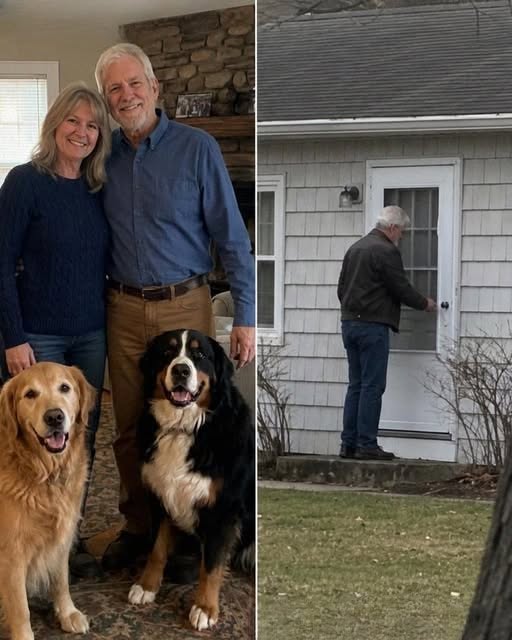
When my husband retired, he told me that volunteering at the local animal shelter gave him purpose and kept him busy. Then one day the shelter informed me he hadn’t walked through their doors in six months. The next morning, I followed him to a small white house he had never mentioned before, and what I discovered there shattered everything I thought I knew.
Grant had spent most of his life working with his hands. He was always up before sunrise and rarely sat still for long. Together we raised two children, Megan and Daniel, who had long since grown up and moved away.
The noise and chaos they left behind were eventually replaced by two German shepherds and a cat who behaved as though she owned the house.
I expected retirement to change our routine, but I never imagined it would bring secrets and lies into our marriage.
Grant had always been the kind of man who talked to animals as though they understood every word.
“You’re going to wear that poor cat out,” I teased one morning while watching him explain the weather forecast to her.
“She likes the conversation,” he replied with a grin. “Everyone likes being heard, Linda.”
When he announced that he wanted to volunteer at the animal shelter, it felt perfectly natural.
“You’ve always cared about strays,” I told him.
He smiled softly. “Someone has to.”
For the first few months, he came home full of stories.
He told me about a blind beagle named Marbles and a nervous shepherd who refused to eat unless Grant sat beside him.
Each evening I listened proudly as he described the animals and their struggles.
“You’ve got a gift for this,” I told him one night.
“I’m just keeping them company,” he answered. “That’s all most of us really need.”
But sometime around April, things began to change.
Grant started taking phone calls in the garage with the door closed and his voice lowered to a whisper.
He also began collecting the mail before I could get to it, quietly slipping certain envelopes into his jacket pocket.
“Everything okay?” I asked one evening.
“Fine,” he said quickly. “Just shelter paperwork.”
Sometimes I would catch him standing by the kitchen window staring into the distance, sadness lingering in his eyes.
I assumed the suffering he witnessed at the shelter was weighing heavily on him.
What I didn’t know was that every story he told me about those animals over the following months was a lie.
Then came the Tuesday morning that changed everything.
I was sorting laundry when I heard a sharp hiss behind the washing machine. Water immediately began spreading across the floor.
I tightened the connection and shut off the valve, then reached for my phone and called Grant.
No answer.
I called again.
Still nothing.
By the fourth attempt I was kneeling on towels trying to stop the water from reaching the hallway carpet.
On the fifth try, frustrated and worried, I called the shelter.
Looking back, that single phone call altered my life.
A woman with a gentle Southern accent answered.
“Hello,” I said. “This is Grant’s wife. Is he there today? I can’t reach him.”
Silence followed.
Then she said something that made my stomach drop.
“Ma’am, your husband hasn’t volunteered here in six months.”
I froze.
“Six months?”
“Yes. He stopped coming sometime in April. We tried calling him several times but never heard back.”
The phone nearly slipped from my hand.
Six months of stories.
Six months of kisses goodbye each morning.
Six months of lies.
That evening I made meatloaf, Grant’s favorite meal.
“How was your day?” I asked.
“Good,” he replied without looking up. “There’s a new dog at the shelter. Lab mix. Very nervous.”
“Really?”
“Yeah.”
I watched him carefully and wondered which would hurt more—confronting him or never learning the truth.
That night I slept on the far edge of the bed.
The next morning, I pretended to fold laundry while he grabbed his jacket.
“Heading out, sweetheart,” he said.
“Where to?”
“The shelter. I’ll be back around four.”
He kissed my cheek and left.
The moment his truck disappeared down the road, I grabbed my keys and followed.
I stayed several cars behind him.
Instead of turning toward the shelter, he drove past the old gas station, beyond the feed store, and out toward the edge of town.
With every mile, I became more convinced there was another woman.
Eventually he turned into the driveway of a modest white house tucked away on a quiet street lined with maple trees.
I parked out of sight and watched.
Grant stepped out of the truck and pulled a key from his pocket.
A key.
To a house I had never seen before.
I sat there for several minutes thinking about our forty-one years together.
Then I got out of the car.
The porch creaked beneath my feet. A wind chime swayed gently beside the window. Somewhere inside, a television played softly.
I raised my hand to knock.
Then I heard Grant’s voice through an open window.
Gentle. Caring. Familiar.
That was enough.
I turned the handle and stepped inside.
“Grant?” I called.
Moments later he rushed around the corner, his face completely drained of color.
“Honey,” he said. “Please. Let me explain.”
“Whose house is this?”
Before he could answer, another voice echoed from deeper inside the house.
A man’s voice.
Weak. Frail.
“Grant? Who’s there?”
My husband’s eyes filled with tears.
“Grant,” I said. “Who is that?”
He stared at me for a long moment before quietly saying:
“Come with me. It’s time you met him.”
In the living room sat an elderly man in a recliner. Oxygen tubing rested beneath his nose, and prescription bottles covered the table beside him.
“You weren’t supposed to find out like this,” Grant said.
“Find out what?”
The man cleared his throat.
“You must be Linda,” he said. “I’m Wesley.”
The name hit me like a punch.
Wesley.
Grant’s brother.
The same brother his family had cut ties with decades ago after stealing from their parents.
“Your brother?” I asked.
Grant nodded.
“The one who robbed your family?”
“Yes.”
“And you’ve been hiding this from me for six months?”
“He has stage-four pancreatic cancer,” Grant said quietly. “He called me from the hospital. He had nowhere else to go. So I rented this house for him.”
“With what money?”
Grant didn’t answer immediately.
And that silence told me everything.
“You used the retirement fund.”
“Part of it.”
“How much?”
“Sixty thousand dollars.”
The room spun.
“Sixty thousand?” I whispered. “Grant, that’s nearly a third of our savings.”
He looked down.
“You didn’t just spend money,” I said. “You spent our security. You spent the future we planned together.”
Wesley spoke softly.
“He was trying to protect you.”
“Please don’t speak for him.”
Grant knelt in front of me.
“I couldn’t let him die alone.”
“And so you lied to me?”
“I didn’t know how to tell you.”
“That was your choice, Grant. Every day for six months, you chose deception.”
His shoulders sagged.
“You listened while I talked about retirement, vacations, helping the grandchildren someday—all while you were secretly draining our savings.”
For the first time, he had nothing to say.
I drove home alone.
The moment I walked through the door, I called Megan.
“Your father has been hiding something,” I told her. “I need you and your brother here.”
Within an hour both children arrived.
Megan paced across the room while Daniel sat silently, jaw tight with anger.
“Uncle Wesley?” Daniel said. “The same Uncle Wesley who stole Grandma’s money?”
“Yes.”
Megan stopped pacing.
“Mom, are we sure he isn’t manipulating Dad?”
“I don’t know,” I admitted. “Apparently he’s dying.”
“That could be another lie.”
By that evening, word had spread through the family.
Then Grant’s sister, Lorraine, called.
After hearing the story, she said only one thing:
“After everything Wesley did to this family, your husband has completely lost his mind.”