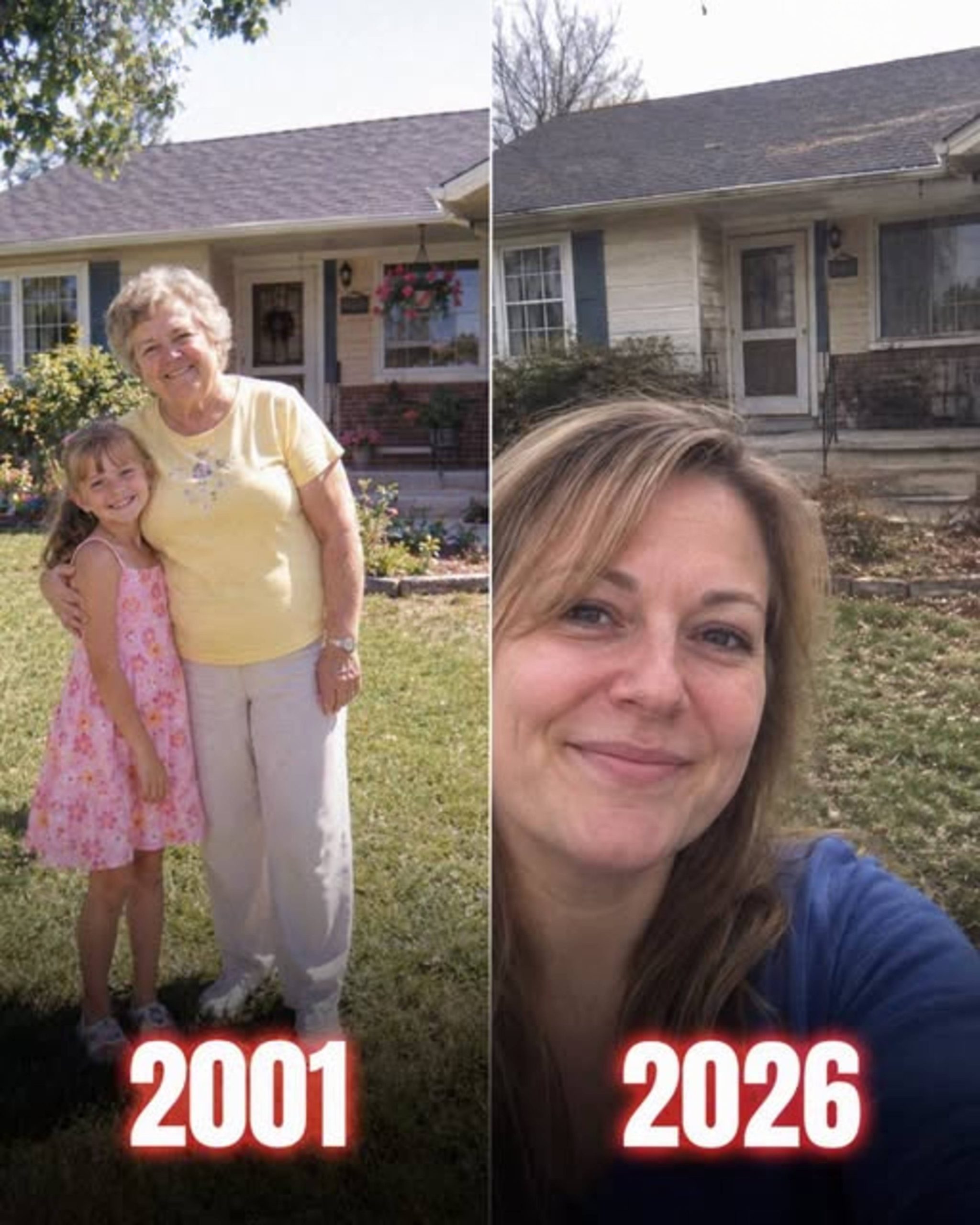
Giving my grandmother back the house she’d lost was supposed to be a happy surprise.
For years, I had imagined the moment.
I imagined pulling up in front of the house, handing her the keys, and watching her face change when she realized that the place she had once believed was gone forever was hers again.
I expected tears.
Maybe laughter.
Maybe one of Grandma Evelyn’s long complaints about how I had wasted perfectly good money on an old house when I could have bought her something “sensible.”
Instead, her reaction made me wonder what had been left behind all those years ago.
The first thing my grandmother asked after I told her I’d bought back her old house wasn’t whether the porch was still there.
After almost a full minute of silence, she didn’t ask about the apple tree Grandpa had planted.
She didn’t ask whether the living room still had the fireplace.
She didn’t even ask whether the kitchen had been remodeled.
She asked about the basement.
I stood on the front porch, my phone pressed to my ear.
Behind me was the house I’d spent years hoping I could one day give back to her.
The paint was fresh now.
The windows had been repaired.
The old wooden steps had been replaced, but I had kept the original railing because I remembered holding it when I was little.
Even the apple tree was still there.
It was older and twisted now, but somehow still alive.
I had spent months restoring the place.
Not because I wanted a beautiful house.
Because I wanted to give Grandma back a piece of her life.
A piece she had lost because of circumstances she never complained about.
I’d expected her to cry.
Instead, she went completely silent.
Then she asked:
“Did you go into the basement?”
I frowned.
“Grandma, no. I didn’t open it. Why are you asking about the basement?”
Another pause.
“Are you happy?” I asked. “Aren’t you happy that you’re getting your house back?”
“Yes, yes, sweetheart, of course I’m happy.”
Her voice sounded strange.
Too quick.
Almost rehearsed.
“I’ll get ready and come over right now,” she continued. “There’s probably a terrible smell down there.”
I looked toward the side of the house.
“It’s an old basement.”
“That doesn’t answer my question.”
“What question?”
“Did you open the basement door?”
“No.”
She exhaled.
I could hear something moving in the background.
“Good.”
“Grandma, what’s going on?”
“Nothing.”
“That didn’t sound like nothing.”
“I’m old, sweetheart. Sometimes old people worry about old houses.”
“That’s not an answer either.”
She laughed weakly.
“I’ll see you soon.”
Then she added:
“And please don’t touch anything until I get there.”
I smiled.
“Okay.”
“And don’t open that basement.”
I stopped smiling.
“Grandma…”
“I’m serious.”
“Why?”
“I’ll explain when I get there.”
“You’re two or three hours away, and you want me to just sit here doing nothing?”
“Yes.”
I looked at the basement door.
It was on the side of the house, underneath the old wooden stairs.
The door had been painted several times over the years, and the newest layer was beginning to crack.
I had noticed it during the renovation.
The contractor had asked me whether I wanted the lock replaced.
I’d said yes.
He had told me the lock was unusually old.
I hadn’t thought much about it.
Now I was beginning to.
“Okay, Grandma,” I said reluctantly. “Don’t worry. I’ll wait for you.”
“Thank you.”
She hung up.
I lowered my phone.
For the first time since buying the house, the place didn’t feel like a gift.
It felt like a question.
—
When I was eight, Grandma Evelyn took me in after my parents died in a car crash.
We lived in that little house on the outskirts of town.
I remember very little about the weeks after the accident.
I remember adults whispering.
I remember black clothes.
I remember someone bringing casseroles.
I remember sleeping beside Grandma because I didn’t want to be alone.
And I remember Grandma never giving me long speeches.
She didn’t tell me everything would be okay.
She didn’t promise that life would be fair.
She simply kept showing up.
Breakfast.
School.
Homework.
Dinner.
Bedtime.
Then she did it again the following morning.
And the morning after that.
She became my entire world without ever asking whether she was ready for it.
That house became my world too.
Grandpa Frank had built shelves in the garage.
He had planted the apple tree in the backyard.
He had repaired the fireplace himself.
Grandma used to tell me that when they first moved in, the living room walls were so ugly that Grandpa called them “the color of old oatmeal.”
She laughed every time she told the story.
They had spent most of their married life there.
It wasn’t a mansion.
It wasn’t even particularly large.
But it was theirs.
Every hallway carried a memory.
Every floorboard had a sound.
Every room seemed to know their names.
Then Grandpa got sick.
Cancer.
At first, Grandma talked about his treatment as if it were just another problem that needed solving.
She drove him to appointments.
She organized medications.
She made soup he barely ate.
She sat beside him through nights when neither of them slept.
But the medical bills kept coming.
And after Grandpa was gone, the bills didn’t disappear with him.
There were hospital expenses.
Medication costs.
The mortgage.
Utilities.
Property taxes.
Everything seemed to arrive at once.
Grandma had a small pension.
She took jobs wherever she could.
She hemmed pants.
She helped at the church office.
She cleaned houses twice a week.
For a while, she baked pies for a diner.
She once told me that making twelve pies before sunrise was “a plan invented by people who hated sleep.”
I laughed so hard that morning that she started laughing too.
But beneath the joke, I could see how tired she was.
Still, she never complained.
Not to me.
Eventually, she fell too far behind on the mortgage.
The bank took the house.
I was too young to understand what foreclosure meant.
I only understood that we were leaving.
I still remember packing.
Grandma folded dish towels before putting them into boxes even though she was crying so hard she had to keep wiping her eyes.
I asked her why she was crying.
She smiled.
“Old houses make people sentimental.”
I believed her.
We moved into a tiny rental apartment.
The bathroom door wouldn’t close unless you lifted it.
My bed was beside a radiator that made strange noises all winter.
The kitchen was so small that Grandma had to turn sideways whenever I was standing near the sink.
We counted every dollar.
Sometimes Grandma pretended she wasn’t hungry so I could have the last piece of chicken.
Sometimes I pretended not to notice.
But she never once made me feel as if I didn’t have a home.
Home wasn’t the house.
Home was Grandma.
—
Years passed.
I grew up.
I went to college.
I worked harder than I thought I could.
I took extra shifts.
I saved money.
And every time I received a raise, I thought about Grandma.
She had given me everything she had.
So I wanted to give something back.
When I could finally afford it, I moved her into a better apartment.
It had an elevator.
A proper bathroom.
A balcony.
Central heating.
Grandma complained immediately.
“This place is too fancy.”
“It’s not fancy.”
“It has an elevator.”
“That’s not fancy.”
“It’s an elevator inside a building.”
“Grandma.”
She smiled.
Then she whispered, “It’s lovely.”
That was her way of saying thank you.
But I knew there was still something missing.
She never talked about the old house.
Not really.
If I mentioned it, she changed the subject.
If someone asked where she had raised me, she’d simply say, “A little house outside town.”
She never said the address.
She never drove past it.
I eventually stopped asking.
Then, years later, I found out the house had gone back on the market.
I couldn’t believe it.
I drove there the same afternoon.
The place looked smaller than I remembered.
That’s what childhood does.
It makes ordinary places enormous.
The house was worn down.
The porch sagged.
The windows were dirty.
The garden had disappeared beneath weeds.
But the apple tree was still standing.
I bought it.
I didn’t tell Grandma.
I spent months restoring it.
I repaired the porch.
I refinished the floors.
I had the fireplace cleaned.
I painted the living room the same warm color Grandma used to like.
I even found a contractor who could restore the kitchen cabinets without replacing them.
I wanted her to recognize the house.
I wanted her to walk through the front door and feel eight years old again.
Safe.
Loved.
Home.
And now, standing there with the phone still in my hand, I realized there was one thing I hadn’t restored.
The basement.
I had deliberately left it alone.
The contractor had warned me that the stairs were unstable.
I had planned to deal with it later.
Now I wasn’t sure I wanted to.
—
Grandma arrived just after sunset.
Her car pulled into the driveway.
She got out slowly.
She stood there for several seconds.
She stared at the house.
I watched her face.
Her eyes filled with tears.
“Oh, sweetheart,” she whispered.
I smiled.
“Surprise.”
She walked toward the porch.
Her hand touched the railing.
Then the front door.
She closed her eyes.
For a moment, she looked like the young woman she must have been when she first moved there with Grandpa.
Then she opened her eyes.
“Is the basement door still there?”
My smile disappeared.
“Grandma.”
“I’m sorry.”
She looked at me.
“I know.”
“You’ve been asking about it since I called.”
She nodded.
“I have.”
“Why?”
She looked toward the side of the house.
“I never told you about something.”
“What?”
She didn’t answer.
Instead, she walked around the house.
I followed.
When we reached the basement door, Grandma stopped.
She placed her hand on the old knob.
Her fingers began trembling.
“Grandpa and I had a fight here once,” she whispered.
“About what?”
“About you.”
I stared at her.
“Me?”
She nodded.
“Before you came to live with us.”
My stomach tightened.
“What happened?”
Grandma looked at the door.
“Your grandfather wanted to tell you something.”
“What?”
She shook her head.
“I never let him.”
“Why?”
“Because I was afraid.”
She took a deep breath.
“After your parents died, there were things I didn’t tell you.”
“What things?”
She looked at me.
“There was a reason your grandfather kept that basement locked.”
My heart began pounding.
“What’s inside?”
Grandma didn’t answer.
She pulled a small key from her coat pocket.
I stared at it.
“Where did you get that?”
“I’ve carried it for thirty years.”
She placed the key in my hand.
Then she whispered:
“Your grandfather didn’t want the bank to take what was down there.”
I looked at the basement door.
“Grandma, what did he hide?”
Her eyes filled with tears.
“Everything we couldn’t afford to lose.”
I turned the key slowly.
The lock clicked.
Grandma grabbed my wrist.
“Wait.”
I looked at her.
“Before you open it, you need to understand something.”
“What?”
“That basement isn’t full of money.”
“Then what is it?”
She looked at the house.
“The life we had before we lost everything.”
I opened the door.
Cold air rushed up the stairs.
The smell was old wood, dust, and something faintly familiar.
I turned on my phone flashlight.
At first, I saw boxes.
Dozens of them.
Then I saw the shelves.
Grandpa’s tools.
Grandma’s old sewing machine.
Christmas decorations.
Photographs.
And against the far wall was a wooden cabinet I had never seen before.
Grandma walked slowly down the stairs.
She stopped in front of it.
Her hand rested on the cabinet door.
“This is why I was afraid you’d open it without me.”
She unlocked it.
Inside were dozens of envelopes.
Each one had a date written across the front.
I picked up the oldest.
It was addressed to me.
My hands began shaking.
“Grandma…”
She nodded.
“Your grandfather wrote those.”
I opened the envelope.
The first line made my heart stop.
*”For the day Emma finally comes home.”*
I looked at Grandma.
She was crying.
And suddenly I understood why she hadn’t asked about the porch.
Why she hadn’t asked about the apple tree.
Why she hadn’t cared about the fireplace.
She hadn’t been afraid of the basement because of what was inside.
She had been afraid of what I would learn.
Because for all those years, I had believed Grandma lost the house when the bank took it.
But she hadn’t lost everything.
She had hidden the most important parts of it downstairs.
And Grandpa had spent his final months making sure that one day, when I was old enough to understand, I would find them.
I looked down at the envelope again.
The house I had bought for Grandma was no longer simply a house.
It was a message that had waited decades for me.
And as I opened the first letter, Grandma whispered behind me:
“Your grandfather always believed we’d come back.”
She paused.
“He just never knew it would be you who brought us home.”