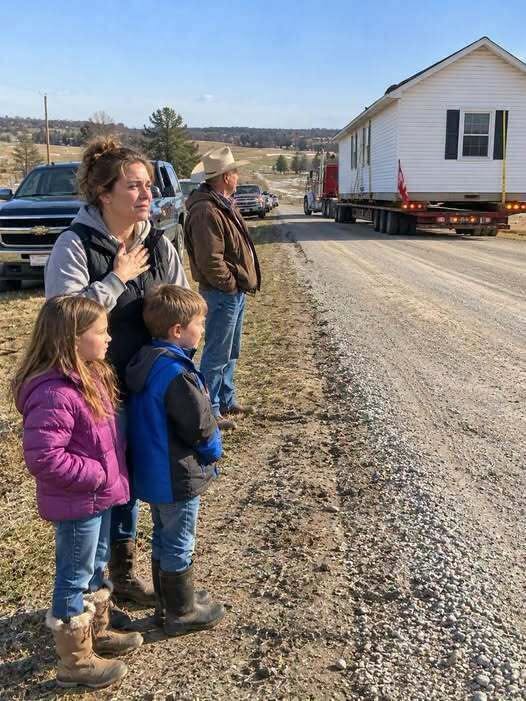
My Father-in-Law Said the House We Built Was His Because It Sat on His Land — So We Moved the Entire House Three Miles Away
When my husband and I finally finished building our dream home, I thought the hardest part of our lives was behind us. We had spent years saving money, sacrificing vacations, working long hours, and putting nearly everything we had into creating a place where our family could feel safe.
The house wasn’t enormous or particularly luxurious, but every corner meant something to us. We had chosen the windows, painted the walls ourselves, and spent countless weekends turning an empty piece of land into the home we had always imagined.
Then my father-in-law walked through the front door, looked around the living room, and made a statement that changed everything.
“This house belongs to me,” he said calmly. “It’s sitting on my land.”
At first, I thought he was joking.
He wasn’t.
And what happened over the following weeks would turn a family disagreement into a story none of us would ever forget.
The Land Was Supposed to Be a Gift
When my husband, Daniel, and I got married, his father, Richard, offered us a piece of land outside town.
He owned several acres in the countryside, and he told us that he wanted to help us get started in life.
“You two build your home here,” he said during a family dinner. “There’s plenty of space, and one day, this will all be yours.”
We were grateful. Buying land would have taken years, and his offer gave us an opportunity we otherwise might not have had.
But there was one problem: we never properly documented the arrangement.
Richard repeatedly assured us that there was nothing to worry about. He was family, after all. My husband trusted him completely, and I didn’t want to be the person who turned a generous offer into a legal negotiation.
Looking back, that was our first mistake.
We spent our savings on construction materials, hired workers when we could afford them, and did much of the finishing work ourselves. Daniel worked overtime, and I took on extra shifts to cover unexpected expenses.
For nearly two years, our lives revolved around the house.
Every brick represented another sacrifice. Every finished room brought us closer to the future we had imagined.
When we finally moved in, we invited both families over for dinner. Richard raised a glass and congratulated us.
“Now you’ve got a place of your own,” he said.
I remember those words clearly because, less than a year later, he would insist that we had never owned anything at all.
The Conversation That Changed Everything
The trouble began when Richard started making suggestions about the property.
First, he wanted us to let his brother store equipment in our garage.
Then he announced that he intended to build a shed beside our driveway.
Finally, he told us that he wanted a key to the house because he might need to enter the property when we weren’t home.
Daniel politely explained that we appreciated his help with the land, but we needed privacy in our own home.
Richard’s expression changed immediately.
“Your own home?” he repeated.
He looked around the living room as though he had suddenly noticed something offensive.
“Don’t forget that this house sits on my property. Without my land, you wouldn’t have a house at all.”
I felt my stomach tighten.
Daniel reminded him that we had paid for the construction ourselves. We had receipts, bank statements, contractor invoices, and records of every major purchase.
Richard shrugged.
“You paid for the materials. That doesn’t make the house yours.”
Then he delivered the sentence that would eventually determine our next move.
“If I decide I want this property back, you’ll have to leave.”
The room fell silent.
I looked at my husband, expecting him to argue. Instead, Daniel stood there with his jaw clenched, struggling to understand how the man who had promised us a future could suddenly threaten to take it away.
That evening, after Richard left, we sat at the kitchen table until nearly midnight.
For the first time, we admitted that our trust in him might have been misplaced.
The Legal Reality Was More Complicated Than We Expected
The next morning, Daniel contacted a property lawyer.
We arrived at the office carrying folders filled with receipts, construction contracts, bank records, photographs, and messages from Richard discussing the land.
We expected the lawyer to tell us that the house was ours because we had paid for it.
Instead, she explained that property ownership could be more complicated than that.
Depending on local law, the ownership of a building may be connected to the ownership of the land beneath it. The legal effect of an informal promise, the nature of the original agreement, and whether any rights had been formally transferred could all matter.
Our receipts helped establish what we had spent, but they did not automatically prove that we owned the land or had an unconditional right to remain there.
The lawyer advised us not to move out, sign anything, or attempt to relocate the structure until our rights and obligations had been properly assessed.
She also explained that moving an entire house was sometimes technically possible, but it could require permits, structural assessments, specialist contractors, a suitable destination, and substantial expense.
Daniel and I left the office feeling disappointed, but we finally understood something important: we needed a plan based on evidence rather than anger.
We asked the lawyer to contact Richard and request a written resolution.
He refused.
Instead, he sent Daniel a message saying that he had been generous enough already and expected us to respect his authority.
That was when my husband made a decision I never expected.
“If he wants to argue that the house belongs to the land,” Daniel said, “then we’ll find out whether the house can stand somewhere else.”
I thought he was speaking out of frustration.
He wasn’t entirely joking.
The Idea That Seemed Impossible
Behind our property was a large field that belonged to a different owner. Several miles away, there was another parcel of land available for purchase.
The idea of moving the house was initially just that: an idea.
But Daniel began researching companies that specialized in relocating buildings.
To my surprise, he discovered that certain houses could be lifted from their foundations, placed on specialized equipment, transported along suitable routes, and lowered onto new foundations.
It wasn’t something that could be done casually. The feasibility depended on the building’s construction, weight, structural condition, access routes, utility connections, and local regulations.
Our house was a relatively straightforward timber-frame structure, which made an assessment worthwhile.
We contacted a specialist company and arranged an inspection.
The engineers examined the foundations, structural supports, roof, and surrounding access. They studied the route to the potential new property and assessed whether obstacles such as bridges, overhead wires, narrow roads, or sharp turns would make the move impossible.
Several weeks later, they returned with a preliminary plan.
It was technically feasible.
But the cost was significant.
Moving the house would require engineering work, permits, new foundations, disconnection and reconnection of utilities, transportation, and careful coordination.
We sat at the kitchen table again, this time with a different set of numbers in front of us.
Moving the house would consume a large part of our remaining savings.
Selling it or abandoning it would also mean losing years of investment.
Neither option was simple.
Still, the possibility of owning a home on land that was legally ours changed the conversation.
We began investigating the purchase of a suitable property approximately three miles away.
The Decision That Shocked the Family
When Richard learned what we were considering, he laughed.
“You cannot move a house,” he told Daniel over the phone. “This isn’t a toy you can pick up and carry somewhere else.”
Daniel calmly explained that a specialist company had inspected the building and believed relocation was possible, subject to permits and final engineering approval.
Richard stopped laughing.
He accused us of being dramatic and insisted that we were wasting money just to prove a point.
Perhaps he was partly right. Moving a house solely to win an argument would have been an expensive mistake.
But our decision was no longer about embarrassing him.
It was about creating a future that did not depend on whether a family member decided to change his mind.
We consulted the lawyer again, negotiated the purchase of the new parcel, and made sure the arrangements were properly documented.
Only after obtaining the necessary approvals and confirming the financial implications did we authorize the relocation.
The project took months of preparation.
Furniture had to be removed or secured. Utility connections had to be disconnected. The structure needed reinforcement, and the transport company had to coordinate the route with the relevant authorities.
Neighbors gathered to watch when the work finally began.
The house was carefully lifted from its foundation and positioned for transport.
For a moment, I stood beside Daniel, staring at the place where our home had rested for years.
It was strange to watch the building that had once represented our future become something that could physically leave the ground.
Then the structure began its slow journey toward the new property.
Three miles away, our next chapter was waiting.
The Day Richard Saw an Empty Foundation
Richard arrived at the old property shortly after the house had been removed.
According to Daniel’s cousin, who happened to be nearby, his father stood silently for several minutes.
The familiar building was gone.
The windows he had looked through, the driveway he had criticized, and the front porch where he had once congratulated us had disappeared.
All that remained was the cleared site and the work associated with preparing it for whatever came next.
Richard called Daniel immediately.
“What have you done?” he demanded.
“We moved our house,” Daniel answered.
“You spent all that money just to spite me?”
“No,” Daniel replied. “We spent it so that our future wouldn’t depend on your permission.”
There was a long silence.
Then Richard accused his son of turning the family against him.
Daniel did not shout. He did not insult his father or threaten revenge.
He simply explained that the original arrangement had left us vulnerable, and that we had decided to establish our home somewhere we could legally control.
“If you believed the house belonged to you because it was on your land,” he said, “then there was only one way to remove that argument from our lives.”
Richard hung up.
For several weeks, he did not speak to us.
Some relatives said we had gone too far. Others quietly admitted that Richard should never have treated a generous offer as a weapon.
We understood why the decision looked extreme.
But the years of work, the uncertainty, and the feeling that our home could be taken away had changed us.
We were no longer willing to confuse family loyalty with surrendering every boundary.
A New Beginning Three Miles Away
The house was eventually installed on its new foundations.
The finishing work took longer than expected, and the final costs were higher than the initial estimates. We had to repair parts of the exterior, reconnect utilities, and make adjustments before the building was ready for everyday life again.
It wasn’t a magical solution, and it certainly wasn’t cheap.
But one evening, several months after the relocation, Daniel and I sat on our new front porch and watched the sun disappear behind the trees.
The house looked almost exactly as it had before.
The same windows caught the evening light. The same kitchen stood behind the front door. The same marks on the hallway wall reminded us of the years we had spent building our life together.
Yet everything felt different.
For the first time, we were no longer worried that someone else’s changing opinion could determine whether we were allowed to remain in our home.
We had paid for the land, completed the required legal arrangements, and established our rights properly.
The peace we felt was worth more than we had expected.
Richard eventually resumed speaking with Daniel, although their relationship remained strained for some time. We did not demand an apology, and we did not pretend that the conflict had never happened.
Trust, once damaged, takes time to rebuild.
We also learned that reconciliation does not require forgetting what happened. It requires honesty, accountability, and a willingness to respect boundaries.
The Lesson We Learned the Hard Way
Looking back, I sometimes wonder whether we could have resolved everything without moving the house.
Perhaps a different legal agreement, a negotiated settlement, or a properly documented transfer could have prevented the entire dispute.
What I know for certain is that we should have clarified the ownership arrangements before spending our savings on construction.
Trusting family is not a mistake. But trust and clear agreements can exist together.
In fact, putting expectations in writing can protect relationships by preventing misunderstandings before they become conflicts.
Our story also taught us that a home is more than a structure. It is the feeling of security that comes from knowing you have a place where you can live without constantly fearing that someone will take it away.
We had spent years building walls, installing windows, and choosing paint colors.
In the end, the most important thing we built was the courage to protect our future.
My father-in-law believed that owning the land gave him the final word over our home. He never imagined that we would be willing to move the entire house rather than continue living under that threat.
Three miles may not seem like a great distance on a map.
For us, however, those three miles represented the distance between uncertainty and independence.
And that made every difficult step worthwhile.
Editorial note: This is a fictionalized, inspirational story based on the supplied headline. The events and characters have not been independently verified. In real property disputes, building ownership and relocation rights depend on local law, written agreements, permits, and professional assessments.