My hand was on the back-seat door when I heard my mother step outside and call my name.
I had my 6-year-old son in my arms, and only minutes earlier, the same woman calling after me had taken my phone out of my hand when I tried to call 911.
That was the part I could not get past.
Not the arguing. Not my sister’s expression. Not even my father’s insistence that I was overreacting.
My mother had seen my son hurt, heard him say he could not breathe properly, and still decided the person who needed protecting was somebody else.
I kept thinking about the moment I had first looked down at him on the floor.
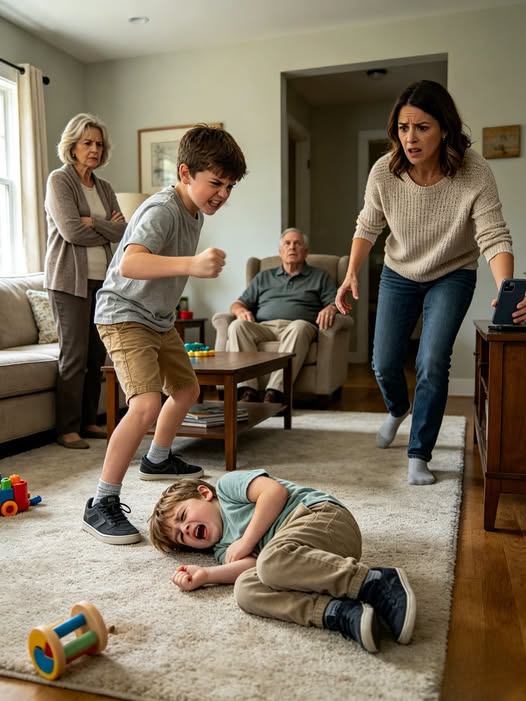
He had been beaten by his 10-year-old cousin, and he was gasping with a broken rib, one small hand pressed against his side as if he could somehow hold the pain in place.
Every attempt to move made his body tighten.
He was six.
He was scared.
He was hurting.
He was surrounded by adults who were discussing his condition as though the biggest danger in the room was my reaction to it.
When I reached for my phone to call 911, my mother snatched it away before I could make the call.
“Boys fight,” she said. “Don’t ruin your nephew’s future.”
For a second, I could barely process the sentence.
My son was on the floor struggling for breath, yet she was already thinking about consequences for the 10-year-old who had hurt him.
My father barely looked up.
“You’re overreacting.”
My sister smirked.
It was such a small expression, but I remember it because of what it said without words: they expected the family pattern to hold.
They expected me to get angry, get talked over, get accused of being dramatic, and eventually give up because everyone else had agreed that I was the difficult one.
They were prepared for shouting.
They were prepared for guilt.
They were prepared for me to defend myself.
They were not prepared for me to stop caring whether they approved.
I stared at my mother’s fingers around my phone and then looked back at my son.
His breathing was coming in thin, uneven catches, and that sound made every argument around me seem suddenly useless.
“Give me my phone.”
My mother pulled it closer against herself.
“You need to calm down first.”
There are sentences families use so often that they stop sounding like sentences and start functioning like commands.
Calm down.
Don’t make a scene.
Think about the family.
For years, those words had probably done exactly what they were designed to do: shift attention away from whatever had happened and onto the person refusing to accept it.
But my child was still on the floor.
“He needs medical help.”
My sister stood then, but she did not go toward my son.
She came toward me.
“My kid is ten. Do you understand what a police report could do to him?”
I looked at her and realized she was asking me to enter a completely different conversation from the one happening in front of us.
She wanted to discuss her son’s future.
I was looking at my son’s next breath.
“Do you understand what your kid just did to mine?”
Her mouth tightened.
She glanced toward the hallway where her son had gone, then looked back at me.
“They were fighting. Your son isn’t innocent just because he’s younger.”
That was when I understood how hard everyone in that room was working to flatten what had happened into something easier to live with.
If it was just a fight, nobody had to ask harder questions.
If both children were equally responsible, nobody had to admit that a 6-year-old was now on the floor in visible distress.
If I was overreacting, then they could make my behavior the problem instead of facing theirs.
My father let out an irritated sigh.
He sounded less like a grandfather looking at an injured child and more like a man inconvenienced by an argument that had gone on too long.
Then my son reached for my sleeve.
His fingers barely caught the fabric.
“I told Grandma,” he whispered.
I dropped down beside him.
“Told her what?”
His eyes moved toward my mother.
“That I couldn’t breathe right. Before you came.”
Everything inside me seemed to narrow around those words.
Until then, part of me had still been assuming my mother was reacting badly in the moment.
Maybe she had walked in late. Maybe she had misunderstood how serious it was. Maybe she had seen crying and assumed the worst of the pain had already passed.
But my son had told her.
Before I arrived.
He had told an adult he trusted that he was having trouble breathing after being hurt, and she had known that before she ever took my phone.
I looked at her.
She did not deny it.
She did not crouch beside him.
She did not ask him another question.
She tightened her grip on my phone and said, “He was crying. Kids say things when they’re upset.”
That sentence changed the room for me.
It meant this was not simply a disagreement about what to do after I arrived.
She had already made a decision before I walked in.
She had heard him describe a problem with his breathing, and instead of treating that information as urgent, she had decided it was emotional exaggeration.
Then, when I tried to get help myself, she physically removed the phone from my hand.
My father finally stood.
“Enough. Nobody is saying he shouldn’t get checked out. We’re saying you don’t need to turn this into some huge family disaster.”
I remember looking at him and thinking how strange those words were.
The disaster, according to him, was apparently something that might happen if I acted.
Not what had already happened to my son.
Not the injury.
Not the breathing difficulty.
Not my mother’s decision to dismiss what he told her.
The disaster was the possibility that the situation might leave the room and become real somewhere beyond the family.
“It already is one,” I said.
My sister folded her arms.
“So what, you’re going to have my son arrested?”
Again, the conversation was being dragged toward a future consequence for her child while mine was still beside me needing care.
I refused to follow her there.
“Right now, I’m taking care of mine.”
That answer changed something.
They had been ready to argue with accusations.
They had been ready to argue with anger.
They had been ready to argue with anything that gave them a chance to put me on trial instead.
But there was very little to debate in the sentence I had given them.
My son needed me.
I was going to take care of him.
My mother’s free hand came up as though she could slow the entire situation with one gesture.
“Think about what you’re doing. Once you make that call, you can’t take it back.”
I looked at my son again.
He should not have been hearing any of this.
At six, his worries should have been ordinary child-sized worries, the kind that disappear after a snack, a cartoon, or twenty extra minutes before bedtime.
Instead, he was lying on the floor listening to grown adults measure his pain against the inconvenience it might create for someone else.
That realization did more than make me angry.
It clarified my job.
I did not need to win an argument.
I did not need my sister to admit anything.
I did not need my father to agree with me.
I did not even need my phone back before I made the next decision.
“Keep the phone,” I told my mother.
For the first time, her expression shifted.
My sister blinked.
“What?”
They had treated the phone like leverage.
As long as my mother held it, they seemed to believe they controlled what happened next.
Maybe they expected me to keep demanding it.
Maybe they expected another round of arguing.
Instead, I slid one arm behind my son’s back and the other under his knees.
When I lifted him, he whimpered.
I stopped immediately and held him steady against me until he settled.
There was no dramatic speech after that.
There was just the weight of my child in my arms and the awareness that every second spent convincing people who did not want to understand was another second I was not moving toward help.
Then I stood.
My father moved toward me.
“Where are you going?”
“To get my son help.”
My mother still had my phone.
My sister was watching me as though I had somehow become the dangerous person in the room.
My father positioned himself between me and the easiest path out.
And for one moment, the entire conflict became physical in the simplest possible way.
There was a door.
There was my injured son.
There was my father standing between us and the way outside.
I had my car keys in my pocket.
That was enough.
I adjusted my son carefully against my shoulder and headed toward the front door.
My father moved before I got there.
He planted himself directly in front of it.
Then his voice dropped.
“You are not taking family business outside this house.”
I stopped.
My son stayed against my chest.
That tone was familiar.
It was the voice my father used when he believed a discussion had ended because he had decided it was over.
For years, that kind of certainty could make everyone around him reorganize themselves.
People lowered their voices.
People backed off.
People found ways to call surrender peace.
Not now.
“Move.”
He looked at me as though I had failed to understand him.
“You’re upset.”
“Move.”
Behind him, my mother said I was making a mistake.
My sister began talking about her own son upstairs, saying he was terrified.
I did not answer either of them.
My child tightened his fingers in my shirt.
That tiny movement carried more weight than every adult voice in the room.
I looked directly at my father.
“If you stop me from taking an injured 6-year-old for medical care, then whatever happens next is a choice you made standing right here.”
His jaw shifted once.
It was the first moment when the argument stopped being about whether I was emotional and became about what he himself was willing to do.
He could keep standing there.
Or he could move.
He stepped aside.
No apology.
No admission.
Just enough space for me to pass.
I opened the door and carried my son across the porch toward my car.
I did not look back.
The remarkable thing was how ordinary the movement felt compared with everything that had just happened.
One foot in front of the other.
One arm supporting his back.
One arm beneath him.
Keys still in my pocket.
Car ahead.
The family argument was behind me, but I could still feel the pressure of it—the demand that I reconsider, minimize, protect somebody else’s comfort, and accept their version of what counted as serious.
My son’s breathing kept the truth simple.
He had been hurt.
He had told his grandmother he could not breathe right.
She had dismissed him.
When I tried to call 911, she had taken my phone.
My sister had worried aloud about what a police report might do to her 10-year-old.
My father had called me unreasonable and then physically blocked the door before finally stepping aside.
None of those facts became smaller just because everyone involved belonged to the same family.
That was the part they seemed unable to accept.
They kept using the word family as though it should erase consequences.
But standing there with my son against me, family meant something much more basic.
It meant the person in my arms had to know that when he said he was hurt, I would believe him.
It meant he had to know that an adult’s embarrassment would never outrank his safety.
It meant that if a room full of relatives decided the easier choice was to stay quiet, I could still walk out of that room.
There is a difference between keeping peace and protecting silence.
I understood it clearly then.
The family wanted peace because peace required nothing from them.
No uncomfortable acknowledgment.
No acceptance that somebody had failed a child.
No confrontation with the fact that my mother had already been warned by the person who was hurt.
Silence would have let everyone return to their preferred roles.
My sister could focus on her son’s future.
My mother could call the whole thing a fight between boys.
My father could decide that the person raising the alarm was the real source of trouble.
And my son would learn something from that silence too.
He would learn that saying “I can’t breathe right” was not enough.
He would learn that being younger did not make adults protect him.
He would learn that pain could become negotiable if admitting it created trouble for the family.
I could not control what the other adults chose to believe about that day.
I could control what he saw me do next.
So I kept moving.
By the time I reached the car, the decision no longer felt dramatic.
It felt overdue.
I shifted him carefully so I could get the rear passenger door open without jarring his side.
My fingers closed around the handle.
Behind me was the porch I had just crossed, the front door my father had finally stopped blocking, and the house where my mother still had the phone she had taken from me.
In front of me was the car.
That was the direction I had chosen.
Then I heard the door behind me.
My mother had followed us outside.
Her voice carried from the porch and called after me by name.
My hand remained at the open rear door, my son still held carefully against me, and for the first time since I had found him on that floor, nobody else in the family was standing between us and the way forward.